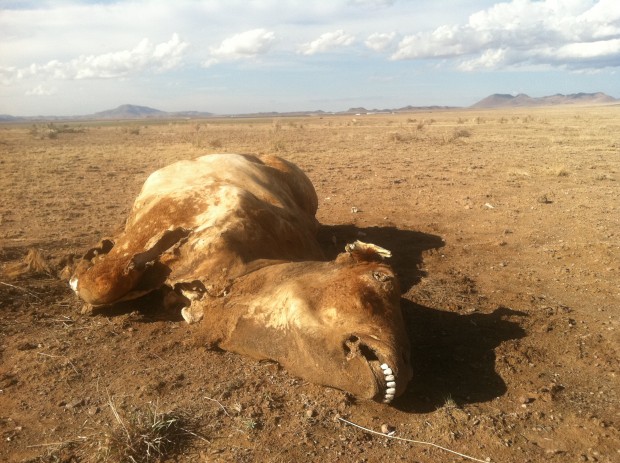
A cow that perished on a ranch outside of Marfa was dried "like jerky" by the drought.
Jake Silverstein of Texas Monthly contributed to this article.
It’s a disaster unlike any other. Floods, hurricanes and earthquakes enter swiftly and destroy efficiently. But a drought doesn’t herald it’s arrival. And people usually don’t pay attention to drought until the damage is already done.
For most Texans, especially those living in big cities, a drought is usually little more than an irritation—a brown lawn or a high water bill.
But for Texans living in the country, it’s a little different. For them, a drought is impossible to ignore.It can mean the end of a family tradition or a way of life.
Yet it requires a truly extreme drought, like the one we suffered last year, before the average city-dweller sits up and takes notice.
Controllers make daily forecasts of the next day’s electric demand and supply down to every five minutes.
Temperatures breaching the low 100s are expected to hit all around the state early next week, according to the Electric Reliability Council of Texas (ERCOT).
By Monday, the high in the Dallas-Fort Worth area should be about 100 degrees, according to the National Weather Service.
“This is exactly the season that the generators have been preparing for for several months,” says ERCOT’ spokesperson Robbie Searcy. “All the power producers in Texas know that it’s most important to have all of their units available when we start seeing hot summer days in Texas.”
ERCOT said, however, that there should be sufficient power supplies available to avoid hitting emergency alerts that call for rolling outages. Continue Reading →
They creep in slowly. Reveal themselves so gradually, that it’s easy not to notice. Until you do.
“A drought is kinda like a cancer, it just slowly eats and eats and eats,” says John Jacobs, the mayor of Robert Lee. That town nearly went dry last year. “Your water sources dry up. Your businesses start drying up,” he says. “Without water people aren’t gonna stay there.”
You can listen toLife By the Drop: Drought, Water and the Future of TexasFriday, June 22 at 3 p.m. on KUT 90.5 FM. The program will air again at 7 p.m. on Monday, and you’ll also be able to hear the entire documentary here and on other public radio stations throughout the state. And you can learn more about the history of the drought at our interactive web page, Dried Out: Confronting the Texas Drought, and share your thoughts on Twitter with the hashtag #txwater.
The environmental group’s notice of intent cites Clean Air Act violations at the Fayette Power Project (FPP) near La Grange (about 60 miles outside of Austin) as cause for the lawsuit. Specifically, the group claims that the coal plant has exceeded limits on particulate matter emissions.
“We’ve discovered what we believe are egregious violations of the air pollution permit for the power plant and that harms public health, pollutes the air that we all breath,” said Ilan Levin, the Associate Director of Environmental Integrity Project, in an interview with StateImpact Texas.
And like many environmental vs. energy spats in the state, this is another case of He Said, She Said. LCRA General Manager Becky Motal believes the groups claims are groundless.
So far in our special report on Texas water issues, we’ve heard from communities along the Colorado River that survive with its water. But what about the Colorado itself? Does a river have a right to flow? People in Texas bays and coastal areas that depend on fresh water inflows might answer in the affirmative.
As last year’s drought pushed through the summer, the Colorado brought less and less fresh water into the Gulf of Mexico. In Matagorda Bay, where the river empties into the sea, the water quality suffered. Oyster harvesting was shut down and fishermen reported fewer crabs and fish in the bay. Continue Reading →
The map on the left shows current drought conditions in Texas. None of the state is in exceptional drought. At right, is the October 4, 2011 map. Just 8 months ago, exceptional drought (deep red) covered 88 percent of the state.
On Thursday, we profiled John Jacobs, the mayor of Robert Lee, who compared the onset of last year’s drought to the incremental growth a cancer. “It’s just a slow, declining death,” he said. But the positive news is that in the same way, much of the state has been creeping out of it.
In fact, Texas has just hit a milestone in a possible recovery from the drought. In data released today by the U.S. Drought Monitor Map, no portion of the state is any longer in the worst stage of drought, “exceptional.” The last time there was no exceptional drought was back in March 2011, fourteen months ago. If you compare where things are now to the peak of the drought in October of last year (to the right), you’ll see a world of difference.
San Antonio may have to go into Stage 3 water restrictions soon.
Water levels are falling rapidly in the Edwards Aquifer in San Antonio, the primary source of water for municipal users in the region. In just two weeks, the levels have dropped 5 feet, and are projected to drop further. Victor Murphy, the Climate Program Manager for the National Weather Service Southern Region, says there’s even more cause for concern than last year.
“I would say by this weekend or by early next week, the level of the J-17 will be lower this year than last year,” Murphy says. “Not good.” The J-17 is a measurement of water pressure at a test well in San Antonio. If water levels continue to drop, the San Antonio Water System (SAWS) may need to implement stricter water restrictions.
“At 640 feet, that’s when SAWS kicks in their Stage 3 water restrictions,” Murphy said. “To my knowledge, they’ve never had to implement that.”
As of this morning, the well is reading 644.6 feet. “With little to no rain in the forecast over the next week and with triple digit temps looming on the horizon early next week, this level should continue to drop,” Murphy says. San Antonio has already seen more rainfall this year than all of last year combined, with above-average rainfall in May, but the levels continue to drop.
2011 was not only Texas’ worst single-year drought. By a strange twist of fate, it was also the year the state formed its new long-term water plan. Some planners viewed this as a blessing-in-disguise: as least the drought was raising awareness of water issues.
The planning process forced some hard questions: what role will agriculture play in the future of Texas? Should Texans continue to raise water-intensive crops like corn and rice? Continue Reading →
Last year’s drought forced Texans to take a hard look at their water resources. But in many ways the crisis just underlined a scarcity already looming in the state. Most people in Texas live in urban areas, yet most of the water still goes to rural agriculture.
Where will the state find the water to sustain its booming urban population? Many believe some of it will have to come from agriculture, where farmers and ranchers will have to cut back. Others stress conservation. And some think that Texans should be investing in major infrastructure projects to develop new water supplies, like desalination.
Today we take a look at where the city of Austin fits into all of this. During roughly the same time frame that Texans endured the worst single-year drought in the state’s history, Austin was the second fastest-growing city in the U.S.
A Secret Service agent is seen at the largest photovoltaic solar plant in the United States where President Barack Obama delivered a March 21 speech about the importance of energy security.
Though the military’s energy initiatives aren’t new (the Army’s plan “Net Zero” facilities, like the one at Fort Hood, were signed off on in 2005), progress made over the past several years has been easing over into the private sector.
Last week, the Texas Coalition of Water, Energy, and Economic Security (TCWEES) hosted a legislative briefing featuring three military-affiliated specialists familiar with the energy conservation efforts of the Texas Army and National Guard.
Greg Kuhr is the Director of Facilities and Logistics at the US Army Installation Management Command. Colonel Tracy Norris is the Director of Construction & Facilities Management at Camp Mabry, and Brian Dosa is the Director of Public Works at Ft. Hood.
The three experts said that sustainable energy is a military priority. They hope to achieve “energy security,” which one panelist defined as “assured access to reliable supplies of energy and the ability to protect and deliver sufficient energy to meet operational needs.”
StateImpact seeks to inform and engage local communities with broadcast and online news focused on how state government decisions affect your lives. Learn More »