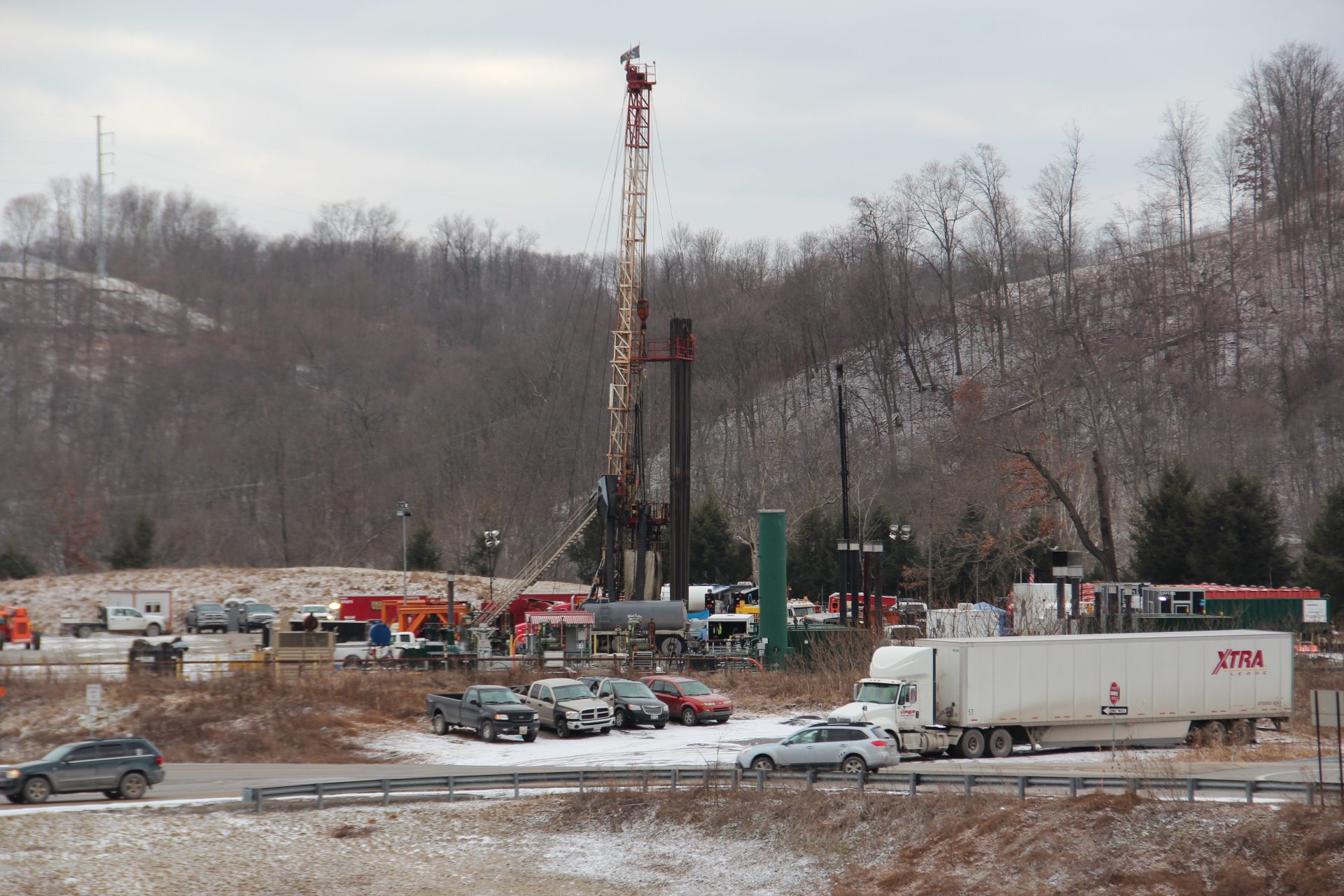

Empty water jugs used to haul clean water hang from a house in Washington County. Residents suspected nearby gas drilling as the culprit for their wells going bad. The DEP investigation concluded drilling was not to blame.
Here’s a key question amid Pennsylvania’s natural gas drilling boom: How is drilling affecting residential water wells? Researchers say data on that core question is spotty. But one Pennsylvania agency could hold the key to answering questions from both residents and scientists. The problem is, the state Department of Environmental Protection says it organizes its records only to “support our operations,” according to agency spokesman Kevin Sunday.
So a simple request that could shine light on at least how many cases of water contamination the DEP determined were due to gas drilling operations, turned into a protracted legal battle. In an open records case settled last year between DEP and the Scranton Times-Tribune, the Commonwealth Court criticized the DEP for poor record-keeping.
But the DEP remains unapologetic about their unsuccessful argument to the court that providing copies of their water investigation determination letters would be “burdensome.”
New York Governor Andrew Cuomo, a Democrat, says he will make a decision on lifting the state's fracking moratorium before 2014.
The Syracuse Post-Standard reports New York Governor Andrew Cuomo says he will make a decision on whether to lift the state’s moratorium on fracking before the 2014 election.
It’s not clear how much that statement means, though, since the debate in New York has gone on for nearly five years.
The Pittsburgh Post Gazette reports the federal Environmental Protection Agency has settled water pollution violations for three wastewater treatment facilities in Western Pennsylvania.
EPA is assessing the plants (which formed a new company called Fluid Recovery Services LLC) $83,000 in penalties.
The violations relate to discharges of Marcellus Shale drilling wastewater into the Allegheny River watershed in between February 2007 and August 2011.
The Pittsburgh Post-Gazette reports a National Academy of Sciences committee will convene next week to scrutinize public concerns and potential risks of shale gas drilling.
The panel will examine a number of topics including air, water, and climate concerns, but they will not issue specific recommendations, according to the Post-Gazette:
“This review will be successful if the current state of knowledge about shale gas drilling is clarified and the uncertainties identified so we have better understanding and insights to help manage the risks,” said Mitchell Small, the NAS committee chair and Carnegie Mellon University professor in the Department of Civil and Environmental Engineering. He will moderate a discussion this morning on a survey of concerns about lesser-studied drilling issues including impacts on rural quality of life, domestic animals, industry transparency and social justice.
Paul Stern, director of the review and senior scholar with the academy’s Board on Environmental Change and Society, said the review’s goal is to pull together the best available information for use by national and state policymakers.
Among the questions he faced were how much the state’s economy has benefited, and how Pennsylvania has managed to “beat the environmental groups.”
Corbett touted the jobs brought by the industry, and said fracking technology has been demonstrated to be safe.
“We passed a law last year, which is the toughest environmental law in the nation, when it comes to fracking” said Corbett, referring to Act 13. “We are following what the industry is doing and they have so far been safe. When there’s been accidents, they have been penalized for it.”
Dr. Amy Pare, a Washington County plastic surgeon, says she worries the requirement for healthcare providers to sign non-disclosure agreements will harm patient care.
State Rep. Greg Vitali, (D-Delaware County), says he’ll be introducing a bill to amend Act 13 public health provisions. One of the most controversial provisions of the state’s new drilling law requires doctors to sign non-disclosure forms in order to get information on chemical exposures to treat patients. The language of the law is vague, and has created confusion and fear among doctors and other health professionals.
Dr. Amy Pare, a plastic and reconstructive surgeon from Washington County, has spoken out against the provision.
“As I understand it,” Pare told StateImpact, “it’s legally binding, so if 20 years from now I hiccup that someone was exposed to zippity doo dah, I’m legally liable for that.”
Pare says it could also have larger implications regarding public health data.
Vitali says his bill would allow health workers to share that “trade secret” information with other health professionals and regulatory agencies for healthcare purposes. Continue Reading →
A Seneca Resources well pad in the Loyalsock State Forest on land leased from the state. Anadarko Petroleum actually owns mineral rights in the Loyalsock, which it plans to develop.
After facing mounting public pressure regarding the possibility of expanding natural gas drilling in the Loyalsock State Forest, the state Department of Conservation and Natural Resources has agreed to hold a public meeting on the issue.
“DCNR is responding to requests that the public be given the chance to provide the department with information and comments on possible gas development in the Loyalsock, in an area where we do not own the subsurface rights,” DCNR Secretary Richard Allan said in a statement.
At issue is a 25,000 acre swath known as the Clarence Moore tract. Anadarko owns about 50 percent of the mineral rights. DCNR officials say they’re legally required to provide surface access. But environmentalists say the state has the authority to limit access to some of the most sensitive areas. Conservation groups have been actively pushing for a seat at the table.
Anti-fracking activists protest gas drilling at Philadelphia's Love Park. Some activist groups are critical of the Environmental Defense Fund for working with industry.
Discord over how to best protect the environment from impacts of natural gas drilling has led to a coalition of grassroots environmental groups shunning the Environmental Defense Fund. The groups plan to hold a conference call on Wednesday to “send a message…disapproving of [EDF's] willingness to be coopted by industry interests on the issue of hydraulic fracturing for shale gas.”
EDF recently drew the ire of fractivists when it announced its participation in The Center for Sustainable Shale Gas Development, a collaboration with energy companies and philanthropical organizations to develop performance standards related to protecting air and water quality. EDF is the only national environmental group to join the coalition, which also includes PennFuture, Group Against Smog and Pollution, and the Pennsylvania Environmental Council. [CSSD includes two organizations that also provide funds to StateImpact Pennsylvania: the Heinz Foundation and the William Penn Foundation.]Continue Reading →
Lawler is currently the senior vice president for international and deep-water operations at Anadarko. He also will also join Chesapeake’s board. His appointments take effect June 17.
"We have to be the voice of the birds," said Paul Zeph, of the Pennsylvania Audubon Society.
Deep in the Loyalsock State Forest, where no cell phone signal reaches, the sounds of rushing waterfalls and forest birds are suddenly interrupted by the sound of a helicopter.
Paul Zeph of the Pennsylvania Audubon Society says the noise could be related to gas drilling. Drillers will often drop seismic testing equipment into remote areas that are difficult to reach by roads. And that leads Zeph to cite one of the many worries that naturalists and outdoors lovers have with plans to expand drilling in the Loyalsock.
“Song birds identify one another through singing and they identify their territory through singing,” says Zeph. “With a very noisy environment, studies are starting to show that it’s impairing the ability to find mates.”
StateImpact seeks to inform and engage local communities with broadcast and online news focused on how state government decisions affect your lives. Learn More »