Mose Buchele is the Austin-based broadcast reporter for StateImpact. He has been on staff at KUT 90.5 in Austin since 2009, covering local and state issues. Mose has also worked as a blogger on politics and an education reporter at his hometown paper in Western Massachusetts. He holds masters degrees in Latin American Studies and Journalism from UT Austin.
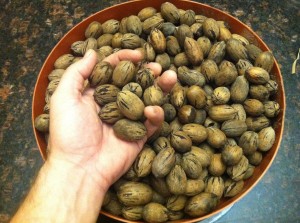
This is a story of two nuts: the almond and the pecan.
In the 1960s the pecan industry loomed large over the almond. But, then, something changed. Since then, the almond crop has seen a nearly 33-fold growth, while the pecan crop has seen little to no growth. But things are looking up for the once-proud pecan.
The pecan is the only commercially grown nut in Texas, and now the U.S. Department of Agriculture is agreeing with the pecan industry that it should be allowed to start something called a “federal marketing order” for the official nut of Texas.
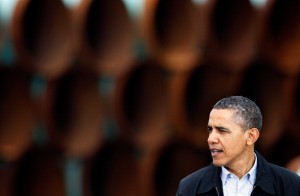
U.S. President Barack Obama spoke in Cushing about fast tracking the Keystone pipeline from Cushing to the Gulf.
President Obama’s rejection of the Keystone XL pipeline provoked cheers from environmental groups, boos from rival politicians and a little bit of head scratching in the state of Texas.
“Technically, from my vernacular, the northern leg of the Keystone XL was rejected because the southern leg of the Keystone XL has been in operation since January of 2014,” said Julia Trigg in response to the news.
Trigg was one of the most visible faces in the fight against the Keystone XL in Texas. She sued TransCanada when it used eminent domain to run pipeline through her Northeast Texas
farm. But she lost that fight long before Obama’s announcement and TransCanada started running oil from Cushing, Okla., to the Texas Gulf Coast almost two years ago.
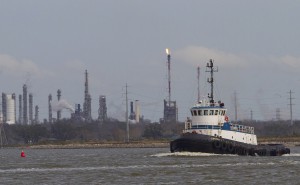
A tug boat navigates the Houston ship channel with a flare from an oil refinery and storage facility in the background south of downtown Houston
It might sound surprising that the U.S. does not allow the export of one of its most valuable and plentiful natural resources — but in the case of crude oil, it’s true.
A lot of Texas politicians would like to see the ban overturned, and soon lawmakers in the U.S. House of Representatives may vote on just that. But why is there a ban in the first place?
The year is 1973. It’s midway through the Arab-Israeli war, and the Organization of Oil Exporting Countries just made an historic announcement.
A dozen smaller earthquakes have struck Dallas this week.
An inquiry by the agency that regulates the oil and gas industry in Texas has found that oil and gas activity did not likely cause a swarm of earthquakes around the north Texas towns of Azle and Reno starting in 2013. The finding, however, flies in the face of a peer-reviewed scientific study of the quakes.
The Texas Railroad Commission is the strangely named agency that regulates the state’s oil and gas activity. The agency held a hearing in June looking at whether ExxonMobil subsidiary XTO Energy contributed to the earthquakes by pumping millions of gallons of drilling and fracking wastewater into the ground.
A peer-reviewed study out of Southern Methodist University had already found that that was “most likely” the cause, adding that industry data would be vital in widening the scope of future studies. But at the hearing, agency examiners weighed that study against the evidence put on the record. XTO was the only party that offered direct evidence, and examiners found in favor of an XTO well located near Azle and Reno.
In some parts of Texas that’s bad news for almost everyone. The economic ripple effect of low prices leads to layoffs and slams the breaks on local economies. But there’s one business that’s going through a boom in oil patch right now: the repo business.
Ryan Peck says when you’re a repo man some jobs are harder than others.
A box at the Alice Food Pantry accepts prayer requests. Many people in Alice have lost jobs since the price of oil dropped.
Even before oil prices plummeted last year, the town of Alice, Texas was feeling the paincaused by a restless oil industry. Some oilfield service companies had moved operations from Alice, located near Corpus Christi, to places deeper in the Eagle Ford Shale. That cost the town jobs and tax revenue. Then, starting around Thanksgiving, the value of Texas crude dropped by more than half. More layoffs came, the real trouble started.
“A lot of people are in depression right now. And in denial,” says Bonnie Whitley, volunteer coordinator at the Alice Food Pantry. “They just can’t come to grips with what’s happened. So there’s depression and we really need some good counselors down here. Which we don’t have…”
Research looked at Golden Eagle deaths caused by wind turbines.
Texas leads the nation in wind power, but some environmentalists worry about bird deaths cause by wind turbines – typically, birds fly into the blades of the turbines.
Now, a new approach pioneered by the U.S. Geological Survey and the U.S. Fish and Wildlife Service hopes to decrease those fatalities by trying to calculate the probability of bird-turbine collisions, while recognizing the inherent uncertainty of the phenomenon.
The approach is basically a mathematical formula. You plug in what you know about the local bird population, and where the turbines will be built. You run the numbers and get a fatality estimate. Dr. Leslie New is an assistant professor of statistics in Washington State University. She helped create the model looking at Golden Eagles, an endangered species; though, she says the model could be used for other species like the Bald Eagle.
Obviously, killing an endangered eagle is illegal, but wind farms can apply for a permit to exempt them from prosecution under the Endangered Species Act. New says the permits provide more an on-the-ground assessment of deaths as a result of collisions, but they will also help the model in predicting patterns of eagle deaths.
This week, oil prices dropped below $50 for the first time since February, a development that could upend the state’s predictions of oil revenue for this year.
Estimates from the Comptroller of Public Accounts put oil prices at an average of just over $64 per barrel in 2015 and 2016. And, as of now, those predictions are rosier than the reality of the market, meaning the state’s loss in oil and gas tax revenue could impact the Texas budget going forward.
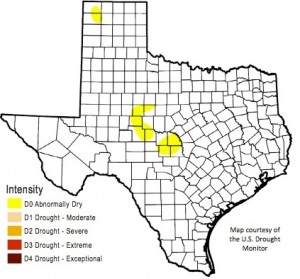
The latest drought report from the Texas Water Development Board has some good news. After more than five years, spring rains saturated the ground enough to finally end our long drought — our long soil moisture drought. But that doesn’t mean water shortages don’t still plague some parts of the state, and that water challenges wont stay with Texas into the foreseeable future.
“So we have hydrologic drought,” says Robert Mace with the Texas Water Development Board.
He says the ground is doing great, but parts of the state need much more rain to replenish their reservoirs.
“If you look at Lake Abilene, which is, believe it or not…3.4 percent full. And that was last full in 2011. Another example is Lake Meredith, up north of Amarillo, [which is] 15.6 percent full currently,” Mace says.
Mace is optimistic those and the rest of the state’s reservoirs can recover this winter, when El Niño conditions are expected to bring us more rain.
Small town Cotulla depends on the oil industry to bring people to fill its many hotel rooms.Jorge Sanhueza-LyonJose Rodriguez is recently laid off from his oil industry job.
Cotulla, Texas, is a small town deep in the oil fields of the South Texas Eagle Ford Shale.
It’s a town that bet big on the oil boom.
Five years ago the census put the population at less than 4,000 people. There were three or four motels then. Now in Cotulla there are around 25 motels, hotels and inns. It’s earned the town a nickname: “The ‘Hotel Capital of the Eagle Shale,’” says City Administrator Larry Dovalina.
He says for years Cotulla was like a lot of places in rural Texas: “Dying on the vine. Kind of forgotten.”
StateImpact seeks to inform and engage local communities with broadcast and online news focused on how state government decisions affect your lives. Learn More »