Dave Fehling is the Houston-based broadcast reporter for StateImpact. Before joining StateImpact Texas, Dave reported and anchored at KHOU-TV in Houston. He also worked as a staff correspondent for CBS News from 1994-1998. He now lectures on journalism at the University of Houston.
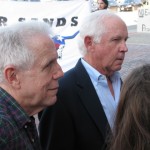
James Holland (left) and his brother David own property that they say has been in their family since the Civil War.
Their land is just south of Beaumont.
It’s crossed by more than 60 pipelines because it lies in a corridor linking refineries and fuel depots along the Gulf Coast.
Their land is an area of coastal plains used for growing rice and hay and for grazing cattle.
TransCanada Keystone Pipeline took the case to civil court at the Jefferson County Courthouse
Judge Tom Rugg Sr. listens to arguments by TransCanada’s lawyer, Tom Zabel.
Protestors from along the Keystone XL route, from North Texas and as far away as Montana, came to Beaumont in support of the Hollands.
Faced with landowners who’ve refused to sell access to their property, lawyers for TransCanada’s Keystone XL pipeline project—already under construction in Texas—told a judge in Beaumont that they’re doing only as the Texas legislature intended: using “eminent domain” and “condemnation” to gain access to private land over the protests of the landowners.
“The legislature came up with this scheme because they wanted to promote the development of oil and gas in the State of Texas,” said Tom Zabel, a Houston lawyer representing TransCanada. “Texas is the largest producing state in the nation. Why? Because the legislature has encouraged the production of oil and gas pipelines. Because you can’t have oil and gas production without pipelines.” Continue Reading →
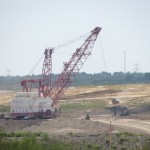
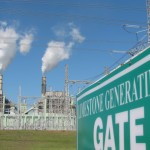
Giant shovels carve away acres of soil and rock, digging dozens of feet down to reach seams of lignite coal. This is the Big Brown Mine in Freestone County where so far some 14,000 acres have been excavated.
Big Brown was one of the first mines opened in East Texas in the 1970’s to fuel power plants.
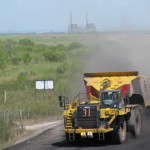
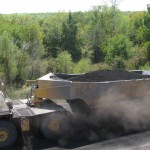
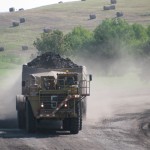
Coal haulers run 24/7/365, bringing tons of Texas lignite coal to the Big Brown Power Plant, owned by Luminant. The mine employs 250 people, the plant 150. Luminant said last year that it would have to shut down the mine and lay off workers if new pollution rules affecting coal-burning power plants were enforced.
The EPA says older plants like Big Brown must cut their emissions of sulfur dioxide and other pollutants and that doing so would save hundreds of lives in Texas. But Luminant argued it didn’t have enough time to upgrade the plant with pollution control equipment. Last month, Texas won a ruling blocking the EPA from enforcing the “Cross-State Air Pollution Rule”. Luminant now says it will keep mining here. However, it will shutdown two other generating units for the winter at another plant in Titus County. Like Big Brown, that plant was built in the 1970’s.
Surface mining, also called strip mining, involves massive excavation, creating canyons where meadows once were. Federal and state laws require “reclamation” to replace and recontour the land.
For the most part, Texas lignite coal is used only to fuel power plants located nearby. Because it burns with less intensity, it has less value than compared to higher quality coals from other states including Wyoming. And since more has to be burned, it produces more pollution. Power plants use a mix of out-of-state coal and Texas lignite in order to meet clean air rules.
Located in Limestone and Leon Counties in East Texas, the Limestone power plant is owned by NRG. It was opened in the 1980’s.
The Limestone power plant is fueled by the Jewett Coal Mine nearby which is owned by Colorado-based Westmoreland Coal Company.
Gary Melcher with NRG manages the Limestone plant. He said the plant’s “scrubbers” remove enough of sulfur that had the new, stricter EPA rules taken effect, “We would have been able to meet that and continued operating the plant.”
According to the city of Fairfield in Freestone County, coal mines and power plants are three out of the area’s four biggest employers (number two is a state prison).
Anthony’s Restaurant in Jewett draws a lunch crowd from the mine and power plant.
If coal becomes less competitive compared to natural gas or even wind and production drops or stops, the Fairfield school district could lose millions in taxes it currently receives from the Big Brown mine.
There are 15 coal mines in East and Central Texas, five in South Texas.
In East Texas, where unemployment rates in some counties are among the highest in the state, coal mining ranks as one of the biggest employers.
In the war between Austin and Washington over the U.S. Environmental Protection Agency’s efforts to put stricter limits on air pollution, some people in communties like Fairfield and Jewett worry what will happen if coal production drops…or stops.
When Jed Clampett was “shootin’ at some food and up through the ground came a bubblin’ crude,” TV viewers might have thought it was funny. But as it turns out, some of crude oil pipelines in use today in the United States were built about the same time The Beverly Hillbillieshit the air on CBS in 1962. And when the crude comes bubblin’ up from pipelines now? It’s not so funny.
“In 2010, several systems that remain in service today already exceeded 50 years in age, with no major plans to retire existing infrastructure based on … age alone,” said a panel of pipeline executives in “Crude Oil Infrastructure“, a report to the National Petroleum Council. The panel warned that while age doesn’t always matter, “integrity issues,” including corrosion and failure of welded seams, “will become more common due to a number of age-related issues.”
Big industrial plants like these near homes in Houston don't have to pay into fund, homeowners do
It’s one of those charges on your electric bill that can be a blur of little figures. It’s called the Energy Efficiency Cost Recovery Factor and on a recent bill of a Houston customer it added $1.02 to the total. (It applies in “competitive” markets like Houston and Dallas but not in places with cooperatives or municipally-owned utilities like Austin and San Antonio.)
A buck may not sound like much but when you add up what’s collected annually from millions of Texas residential and commercial customers, it’s serious money. Continue Reading →
(Update: Texas Department of State Health spokesperson Chris Van Deusen emailed StateImpact Texas to clarify that the department’s efforts would rely on data “that’s already out there.”)
Environmental researchers in Utah tracked a mysterious smog problem to natural gas wells. Colorado public health researchers said living within a half mile of gas well drilling sites could be dangerous to your health. And in Texas, national attention has recently focused on a rise in breast cancer in one area where drilling is booming.
But finding definitive research on the health impact of oil and gas drilling on nearby residents has been difficult.
Texas health officials have done limited surveys and testing which generally concluded that the dramatic increase in drilling, largely due to the technique called fracking, isn’t hurting people who live near the sites. But conflicting findings, like those in Colorado, are prompting new concern. Continue Reading →
Courtesy The Greater San Antonio Chamber of Commerce
Attorney General Greg Abbott has filed multiple lawsuits against the EPA
If you search for “EPA” on thewebsite of the Texas Attorney General, you’ll find news releases touting how Greg Abbott is defending Texas against the United States Environmental Protection Agency (EPA).
“Texas Prevails Against EPA,” says one headline.
“Court Grants Texas Motion to Stay EPA’s Legally Flawed Cross-State Air Pollution Rule,” says another.
And there are lots more about how “Attorney General Greg Abbott Files Challenge” to the EPA’s greenhouse gas regulations.
Or to the EPA’s “Tailpipe Rule.”
Or to the EPA’s “Unlawful Attempt to Takeover State Air Permitting.”
Why so many lawsuits against the federal agency that claims it’s just trying to protect us from breathing dirty air?
In South Texas, state environmental regulators are using helicopters equipped with infrared cameras to sweep across gas and oil well sites. They’re looking for toxic vapor leaks that otherwise would be invisible. The leaks are from open hatches or bad valves on tanks and pipes. But what the state is finding—and not finding—is part of the debate over whether fracking threatens to dirty the air in Texas towns where drilling is surging.
“We are being proactive in trying to look at and address these issues,” says David Brymer, director of air quality with the Texas Commission on Environmental Quality (TCEQ). Continue Reading →
Retail electric providers (REPs) in Texas have to make a decision: should they pass on higher wholesale electricity costs to customers who’ve signed “fixed rate” contracts, contracts that were supposed to lock-in a per kilowatt hour price? If the REPs try it, the Public Utility Commission of Texas (PUC) is just waiting for the first customer to file a complaint.
The suspense begins Wednesday (August 1) when the state-set peak price for wholesale electricity jumps 50 percent to $4,500 per megawatt hour. The PUC approved the hike last month. The peak price can be reached on the hottest days when demand soars. Sky-high peak prices last a matter of hours and come a few dozen days a year. Otherwise, prices for a megawatt hour can be as low about $30. The PUC took the action because it says higher profits will encourage utility companies to build more power plants to keep up with the state’s growth. Continue Reading →
Sandstorm: dust rises during off-loading at drilling site
Federal workplace watchdogs are warning that the boom in “fracking” is now exposing oilfield workers to hazards they can inhale. It’s an additonal risk for roughnecks and service company crews working in an industry that already has a much-higher-than average injury rate.
NRG's Cedar Bayou power plant expanded in 2009: "We could not do that today"
According to some industry insiders, when the state-regulated peak price for wholesale electricity jumps 50% next month, it will fail to do what the Texas Public Utility Commission (PUC) had hoped: encourage the construction of new power plants to avert shortages.
“The prices have to go up before you see any significant generation being built,” said Dallas energy consultant John Bick, formerly with TXU Energy, now with Priority Power Management.
StateImpact seeks to inform and engage local communities with broadcast and online news focused on how state government decisions affect your lives. Learn More »