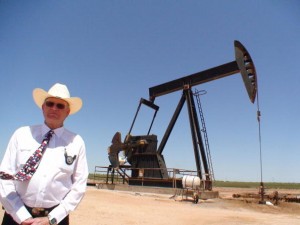
The Railroad Commission of Texas regulates one of the most advanced industries in the world — oil and gas drilling. Yet the commission’s software systems, many of its rules and even its name are from another era.
As the 122-year-old agency confronts a drilling boom that is altering the state and national economies, an overhaul of its operations is under way. Its old mainframe computer system will be upgraded with modern digital storage, clearing the way for a more user-friendly website. Decades-old regulations are getting updated to reflect the rapid spread of hydraulic fracturing, or fracking. And the Legislature may change the commission’s name to accurately reflect what it does. (The commission’s railroad duties ended in 2005.)
The push does not go far enough for critics, who charge that the commission is too cozy with the industry it regulates and fails to adequately address environmental problems. Nonetheless, observers say there is a burst of energy, unseen in years, at the sometimes-languid commission.
The changes are “very important. They’re long overdue,” said John Hays, a partner at the Austin law firm Hays & Owens, whose clients include oil and gas companies. Continue Reading →
At a Texas Tribune event this morning in Austin, Lieutenant Governor David Dewhurst talked with Tribune Editor-in-Chief Evan Smith about a whole host of issues facing the state, such as public education. And of course, they also talked about water.
On Wednesday, State Senator Troy Fraser (R-Horseshoe Bay) announced his support of a plan to take $2 billion from the state’s Rainy Day Fund to start funding water projects. That’s a whole billion more than Dewhurst had proposed in November. Asked today which number he believes is right, Dewhurst said they’re looking into it, but what matters most is that new water projects get the funding they need. “There’s no other option,” Dewhurst said. “We’re going to provide the funds necessary.” Dewhurst also advocated for prioritizing which projects get funding first.
But, Smith asked, does Dewhurst have the votes to get the conservative Senate to withdraw money from the Rainy Day Fund? You can hear Dewhurst’s answer in the video above. And be sure to join StateImpact Texas in Austin Monday for a special panel, ‘The Texas Water Crisis: Finding and Funding a Solution.’ You’ll have the opportunity to hear from lawmakers firsthand and ask your own questions. We’ll have State Rep. Lyle Larson and others on hand to discuss the issues. We’ll be at the Cactus Cafe at UT Austin Monday, January 28th. Doors open at 5:30 pm and the event begins at 6 pm. You can RSVP on Facebook here.
Funding, like water, can be diverted or even dry up.
The Texas State Water Plan has been described as a $53 billion dollar wish list. It’s full of local projects, proposed by regional water districts. They are meant to be enough to secure water for Texas for 50 years. But those projects remain largely unprioritized and unfunded.
Now state legislators say they are serious about funding the plan, but what projects may receive money remains a mystery.
On Wednesday two lawmakers, Senator Troy Fraser (R-Horshoe Bay) and Rep. Allan Ritter (R-Nederland) provided some hints at a Public Forum Hosted by the Texas Association of Realtors, the Austin Board of Realtors and the group H204TX.
First off, funding.
Both Ritter and Fraser want to pull $2 Billion dollars from the state’s rainy day fund. The state would give that money out as loans so that regional entities can jumpstart their water projects. Without money from the fund, Senator Fraser says the whole thing would probably fall apart. Continue Reading →
“Chase Power … has opted to suspend efforts to further permit the facility and is seeking alternative investors as part of a plan of dissolution for the parent company,” Chase Power, LLC CEO Dave Freysinger says in an emailed statement. He says that “while market conditions played a role, the direct regulatory obstacles purposefully erected by the US Environmental Protection Agency (EPA) resulted in the decision to suspend development of the plant.” Freysinger tells StateImpact Texas that the power plant was a “major part” of its portfolio.
Las Brisas was one of just a few coal plants still being planned for Texas. Now there is only one major coal plant still being considered, the White Stallion coal project in Matagorda County, and it, too, faces an uncertain future amid opposition and a market more favorable to natural gas power. Continue Reading →
Join us in Austin Monday, January 28 to hear how Texas legislators are proposing to tackle the state's water issues.
Please join us in Austin tonight, Monday, January 28th, for a panel examining water issues in the state and some of the solutions that the legislature is considering. The panel will feature members of the legislature, including State Senator Glenn Hegar and State Representatives Drew Darby and Lyle Larson. It will be free and open to the public.
The panel will run for one hour and include an audience Q&A.
We’ll be meeting at the Cactus Cafe on the University of Texas at Austin campus. You can RSVP on Facebook, or just show up tonight. Doors open at 5:30 p.m.
A new bill proposed by a Democratic State Senator would prevent HOAs from going after residents who want to use less water for landscaping.
While some Texans have employed water-efficient landscaping as a way of dealing with the ongoing drought, a large group is often left out: those who live in homes belonging to Home Owners Associations, or HOAs. HOAs can have strict restrictions on what kind of grass a homeowner can plant for a lawn (sometimes, the thirsty St. Augustine variety is mandated) and how green it has to be kept, water restrictions be damned. That has resulted in conflict between some homeowners, who wish to switch to drought-resistant grasses, or simply let their lawns die during drought-stricken summers, and HOAs, which have threatened to fine them for doing so.
Entering the fray this week is State Senator Kirk Watson (D-Austin), with a bill that would help homeowners living in HOAs switch to more water-friendly landscaping.
Senate Bill 198 would protect homeowners in HOAs who want to use less water by: using yard trimmings and glass clippings on their lawn for composting; putting in rain barrels or rainwater harvesting systems; installing more efficient irrigation; and/or using “drought-resistant landscaping or
water-conserving turf.” Continue Reading →
A 3.0 magnitude earthquake struck Fort Worth near the DFW airport tonight, according to the US Geological Survey. At 10:16 pm, the quake hit five miles Northwest of Irving, just off the President George Bush Turnpike. Its epicenter was ten miles below the surface.
On Twitter, people are reporting feeling the ground shake. “Loud and everything moved – we knew instantly! Scary!” tweeted @NatalieTX2012. The quake hasn’t resulted in any reported damage. Generally, an earthquake doesn’t do much harm until it’s 4.0 magnitude or higher.
The area where the quake occured was seismically quiet until a few years ago. That’s when the oil and gas industry began using deep underground wells to dispose of fluids from the drilling process known as hydraulic fracturing, or “fracking,”
There is conclusive scientific evidence that the injection of those fluids is causing quakes in the U.S., in particular in this area of Texas. A University of Texas at Austin from study last summer found a definitive link between earthquakes in the Dallas-Fort Worth area and disposal wells, in the drilling area known as the Barnett Shale.
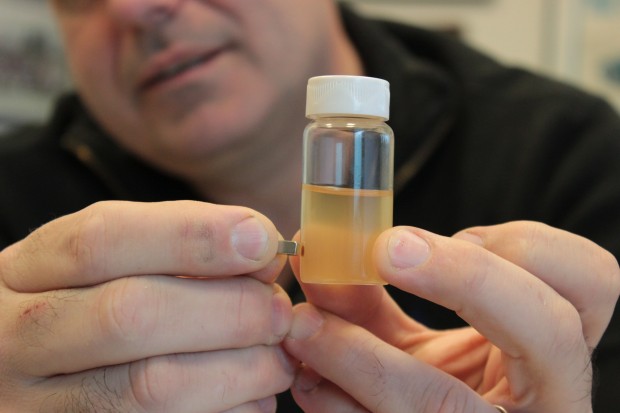
"Nano rust" collects where a magnet is held to vial of water mixed with the tracer
Scientists are developing ways to add non-toxic tracers to drilling fluid so if groundwater is contaminated, investigators would be able to pinpoint if an oil or gas drilling operation was to blame.
“What’s impossible at the moment is if you’ve got multiple companies in an area and it’s thought there is contamination, there is no way to tell which company caused the contamination,” said Andrew Barron at Rice University in Houston. Continue Reading →
Feeling the Heat: President Obama said the country had a duty to act on climate change in his speech.
Citing “the devastating impact of raging fires and crippling drought and more powerful storms” President Barack Obama put tackling climate change on a list of goals for his second presidential term today.
In an inaugural speech that served to set an agenda for the next four years, the president said that failure to respond to the threat of climate change “would betray our children and future generations.”
The issue of climate change was noticeably absent during much of the presidential campaign. One debate between the president and his Republican challenger Mitt Romney marked the first time in 24 years in which global warming was not mentioned even once.
With water on the minds behind the Texas legislature, Rep. Allan Ritter, R-Nederland, the chairman of the House National Resources Committee, sat down last week to talk with the Texas Tribune about what lawmakers can do to secure new water supplies for a growing state. Ritter recently filed a fill that would take $2 billion from the Rainy Day Fund to start a bank for water infrastructure projects. You can watch the conversation in the video above.
About StateImpact
StateImpact seeks to inform and engage local communities with broadcast and online news focused on how state government decisions affect your lives. Learn More »