Photo Courtesy of the USDA. http://www.flickr.com/photos/usdagov/7732742494/in/photostream/
USDA workers inspect an unnamed beef processing plant in Plainview, Texas in 1991.
A beef processing plant in Plainview, Texas will close its doors today, citing a dwindling cattle supply in the region. Wichita, Kansas-based Cargill Beef said in a press release that about 2,000 jobs will be lost. The supply issue was brought on primarily by “years of drought in Texas and the Southern Plains states,” the company says.
“The U.S. cattle herd is at its lowest level since 1952,” Cargill president John Keating said in the statement. “Increased feed costs resulting from the prolonged drought, combined with herd liquidations by cattle ranchers, are severely and adversely contributing to the challenging business conditions we face as an industry.”
A rainier-than-expected winter and spring last year prompted some to think the Texas cattle industry might rebound, but the closure underlines the long-term effects that the years long dry spell has had on Texas agriculture.
“You can’t just bring cattle back the day it rains. You have to let grasses regrow and your forage base reestablish before you can bring cattle in,” Travis Miller, a scientist with Texas A&M’s Agrilife Extension Service, told KUT radio.
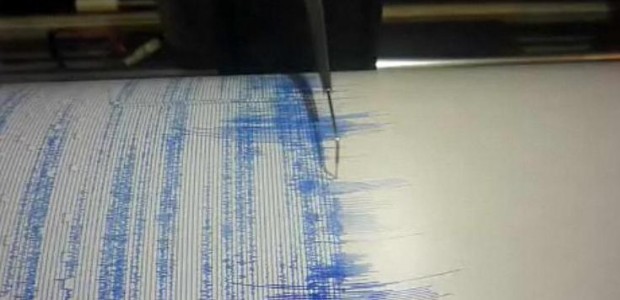
Still image taken from video posted to Flikr Creative Commons by Waifer X. http://www.flickr.com/photos/waiferx/2658307394/
A seismograph measures feet stomping nearby at the Thomas A. Jaggar Museum, Hawaiian Volcano Observatory, Hawaii Volcanoes National Park, HI.
StateImpact Texas’ Terrence Henry contributed reporting to this article.
Close to midnight last September 29th, the Tarrant County 9-1-1 call center lit up with phone calls from outside its usual service area. The ground was shaking again, and people in nearby Irving, Texas had overwhelmed their own 9-1-1 system.
“What’s going on are we having tremors?” one woman asked.
On the call, obtained by StateImpact Texas in an open records request, a child is heard yelling in the background.
“It was an earthquake, Yes ma’am. Apparently [Irving’s 911] phones are being inundated with calls and they’re overflowing into our police department,” said the operator.
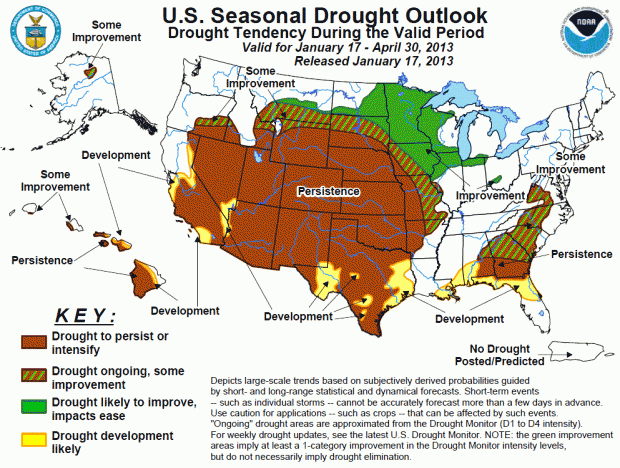
The latest federal drought forecast doesn't provide much hope for Texas.
The rains that made their way across much of Texas last week were a welcome sight for the state, currently in its third year of drought. The latest U.S. Drought Monitor Map shows that drought levels decreased for the first time since October 2012. But they didn’t fall much.
About seven percent of the state is in the worst stage of drought currently, “exceptional,” down from over 11 percent last week. But over 90 percent of Texas remains in some form of drought condition, and the state’s reservoirs are currently only 67 percent full, according to the Texas Water Development Board.
The latest federal three-month drought forecast out today doesn’t bring encouraging news. The drought in Texas is predicted to persist, and develop even further in some regions. Continue Reading →
A Legislative Budget Board (LBB) report on how government can be more efficient and effective has recommended that the state reduce its gas tax exemption for hydraulic fracturing.
The expansive report released Wednesday by the LBB, a state body that offers budget and policy recommendations for legislators, recommended that the state change the method it uses to calculate the tax. That change would have the practical effect of increasing tax rates on gas produced through hydraulic fracturing, or fracking.
The push to increase taxes on frackers has surfaced periodically in the Legislature, especially given the spread of fracking in recent years and the state’s tight budgets. But the drilling industry has argued that higher taxes would force gas companies to drill in other states. Continue Reading →
Many rice mills and drying and storage facilities in Southeast Texas didn't see much work last year. If they're cut off again this year, the slow business will continue.
For the rice farmers of Southeast Texas, 2012 was a rough year. For the first time in history, they were cut off from water because there wasn’t enough in the main reservoirs of the Lower Colorado River to supply them. In 2013, they face the same situation: if there isn’t enough water in the Highland Lakes come March 1, they won’t get water again this year. The quasi-public agency making the call is the Lower Colorado River Authority (LCRA). But there’s some good news for rice farmers coming from the LCRA as well. Today the Agency approved the first phase of a new plan that will help both rice farmers and municipal interests in the years to come.
Ronald Gertson is a fourth-generation rice farmer in Wharton County. The industry is over a hundred years old, and was damaged by the cutoff last year. While crop insurance covered up to 85 percent of the losses for the farmers, and will do the same this year if they go without water again, Gertson says that they’ve been told they will not get crop insurance if they are cut off again next year. “A third year would definitely put some folks permanently out of rice farming,” he says.
And the ancillary businesses without crop insurance that rely on the South Texas rice industry, like grain storage and processing, have suffered. “There were about 53,000 acres that didn’t get planted in 2012 that normally would have been,” Gertson says.
Enter the idea of “off-channel” reservoirs, smaller sources of storage downstream, below the Highland Lakes and the City of Austin. During wet times, as the Lower Colorado River sees good flows, water will be diverted and held for later use, alleviating the strain on the Highland Lakes. Continue Reading →
A parched Brazos River wends its way through Knox County.
Even if the Lower Colorado River Authority (LCRA) doesn’t send water downstream to rice farmers this year, the Colorado River will still flow. Without that constant flow, the river would dry up, destroying and inland ecosystems and the brackish estuary near the coast.
But how much water should be sent downriver to maintain the ecosystem? That’s the job of the rarely-mentioned Environmental Flows Advisory Group, which met yesterday at the Capitol to hear testimony from the representatives of science advisory groups and business and residential interests.
Most of the testimony heard involved talk of the perpetual lack of funds for the labor intensive studies of how much water a river needs.
“We have an obligation through federal mandate to make sure that we are taking care of the environmental needs of the bays and estuaries,” says Rep. Troy Fraser, R-Horseshoe Bay, Co-Presiding Officer of the group. “It’s a balancing act, making sure that we are also supplying water to the people upstream.”
Engineers on the drilling platform of the Cuadrilla shale fracking facility on October 7, 2012 in Preston, England.
A new University of Texas at Austin study has found that the amount of water used in the drilling practice known as hydraulic fracturing has risen sharply in recent years as oil and natural gas production has surged.
But the 97-page study, funded by the Texas Oil and Gas Association, also found that the amount of water used in hydraulic fracturing would level off sometime in the decade starting in 2020, as water recycling technologies matured and the industry’s rapid growth rate cooled.
Hydraulic fracturing, or fracking, is a water-intensive practice in which liquids are pumped underground at high pressure to retrieve oil or gas trapped in rocks, like shale.
The Texas Water Development Board circulated the study last week to regional water planning groups around the state. Those groups are preparing the state’s next water plan, due out in 2017. Continue Reading →
Nearly a year ago, the groundwater well serving the small lakeside community of Spicewood Beach, about 40 miles outside of Austin, began to fail. Ever since, the locals there, mostly retirees, have gotten their water trucked in several times a day to keep the taps flowing. As the levels of Lake Travis have fallen during the multi-year drought, the alluvial well that provides for the community has dropped so much that it no longer fully functions. “If the lakes come up, we get our wells back,” resident Wanda Watson told us last year. “If they don’t come up, we have no water.”
For residents, the distinction of being the first Texas community to run out of water during the drought has been a troubling one. People are moving away, and property values have dropped significantly, almost in tandem with lake levels. “There’s a lot of homes for sale out here right now,” Kathy Mull, who’s lived there ten years, tells StateImpact Texas. “We are definitely considering moving ourselves right now. There’s a lot of places that have come up for sale, but they’re not selling. Who’s gonna buy out here with no water?”
But for the first time since the well began to fail, an end may be in sight.
On Wednesday, the board of the Lower Colorado River Authority (LCRA) will vote on a $1.2 million project to build a surface water treatment plant to serve the community. It should work even if the lakes go lower, and provide ample water. The open question is who will ultimately bear that cost. Continue Reading →
Shrimp fisherman wait to board their boats following Hurricane Ike September 15, 2008 in Galveston, Texas.
Captain Dan, the ‘Flounder Man’ has been hunting flounder on the Texas coast for more than 30 years. In the dark of night, Captain Dan escorts his clients along the Gulf shore in his brightly lit skiff and stalks flounder laying on the sandy floor. Armed with miniature tridents set on poles, his clients wait until they see the tell-tale sign of a flounder, two reflective eyes peering up from the sand. Once the client is in striking distance, he or she plunges the trident down through the flat fish.
It’s called flounder gigging (yes, similar to the type of frog hunting where ‘Gig ‘Em‘ comes from) and it’s arguably the most popular way to catch flounder on the Texas coast. Unfortunately, commercial fishing, weather and certain types of gigging have put a hurt on Texas’ flounder. The Texas Parks and Wildlife Department is trying to stem the decline of flounder in Texas with a breeding program and stricter bag limits on flounder, and it seems to be working.
“I’m seeing a big increase in numbers,” says Captain Dan, who was a Gulf Coast commercial fisherman for 30 years before starting his own guide service three years ago. Continue Reading →
In a few months, a grouse known as the lesser prairie chicken will emerge from its West Texas winter hideaway. Males will do a loud and elaborate mating dance, delighting females — and birdwatchers.
“Clearly if there was some sort of moratorium on development, that would be catastrophic,” said Jeff Clark, executive director of the Wind Coalition, a regional advocacy group. He argues that wind power and prairie chickens can co-exist.
StateImpact seeks to inform and engage local communities with broadcast and online news focused on how state government decisions affect your lives. Learn More »