If a federal wind energy tax credit expires, Texas jobs could be at stake.
The potential expiration of a federal tax credit could have negative effects on Texas’ wind energy industry; as the U.S. develops more and more energy, some are taking a skeptical eye; and more, all in your morning meter reading:
Our neighbors at KUHF Houston take a look at what the expiration of the federal wind energy tax credit could mean for jobs in Texas. “EDP Renewables North America, a Houston-based wind developer, cut its workforce by 10% in September [2011],” they report. “Last month, Vestas Wind Systems announced it will close its research and development operations in Houston. Both companies cited uncertainty over the tax credit as the reason for the layoffs.”
Meanwhile, tax credits for the fossil fuel industry may be on the table as the country approaches the so-called ‘fiscal cliff.’ The Hill says deductions for the oil industry “haven’t been ruled out” as a way of increasing tax revenue. Continue Reading →
We recently sat down with a panel of land experts at theTexas Tribune‘s Oct. 29 summit on water to discuss agriculture and state water management. The panel featured Texas Agriculture Commissioner Todd Staples, David Langford of the Texas Wildlife Association and Laura Huffman of The Nature Conservancy of Texas. You can watch it in full above.
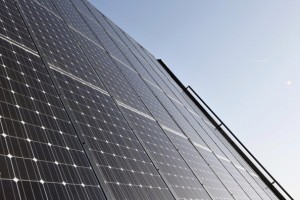
Panels of a photovoltaic power station installed on the roof of a building in the new Clichy-Batignolles district in Paris.
A new report says renewables will continue to rise, Austin is becoming more attractive to the oil and gas industry, and why trees fall so easily in a storm. All in this morning’s meter reading:
Here Comes the Sun: Bloomberg looks at a new report from the International Energy Agency that predicts renewable energy will be on par with coal power in just a few decades. “Wind farms, solar parks and hydroelectric dams are forecast to become the second biggest power generator in 2015 and rise to almost a third of all generation in 2035, a level approaching that of coal,” they write.
Keep Austin Oiled: In the Texas Tribune, Kate Galbraith writes about how Austin is becoming a destination for the oil and gas industry. “Despite its “Keep Austin Weird” slogan and passion for clean energy,” Galbraith writes, “Austin is increasingly attracting oil and gas companies like Three Rivers, a small firm founded in 2009 that focuses on oil development in West Texas and New Mexico, aided by the high oil prices of recent years. Austin’s oil industry, about 4,000 workers strong, is still dwarfed by Houston and Dallas. But the city’s entrepreneurial bent and reputation as an attractive place to live, along with the top-tier petroleum engineering program at UT, have trumped the fact that Austin is far from the oilfields.” Continue Reading →
Wildlife officer Jim Yetter led a criminal investigation of a site in Jefferson County
Landfarms are privately-owned but state-regulated fields where “low toxicity waste” is thinly spread then tilled into the soil. The tainted waste is supposed to degrade naturally.
In Texas, landfarms are used to dispose of the drilling fluid used to reduce friction as the drill chews through thousands of feet of rock and sand.
But a criminal case involving the operation of a landfarm near Beaumont raises questions about how the Texas Railroad Commission (RRC) is enforcing the state’s pollution laws. Continue Reading →
A Texas company says they've figured out a commercially-viable way to turn pine tree wood chips into gasoline.
Got any dead wood lying around your yard? If a new Texas company’s claims turn out to be accurate, that pile could theoretically fuel your car soon.
In the New York Times, Matthew Wald reports on Pasadena, Texas-based biofuel company KiOR. They say they’ve come up with a process to affordably, cleanly process wood chips into crude oil. At their plant in Mississipi, the company says they can take that crude and refine it into gasoline and diesel, according to the Times. They say they’ll be selling it commercially within the month. “That would be a first for the cellulosic biofuel sector,” the Times writes.
On their website, KiOR says their goal is to use non-food source for their fuel, “such as wood and agricultural waste, while avoiding feedstocks such as corn or soy which are also used for food or are grown on land typically used for food production.” The company says they’ll only use trees that have been “grown and sustainably harvested for commercial use in its facilities.”
The project has already figured out the most difficult steps. Here’s how KiOR did it, and what it could mean for the nascent biofuels sector: Continue Reading →
A new study finds that because of rapid climate change, the planet will warm even faster than expected.
It’s a good time to buy into sunscreen futures, the ‘War on Coal’ ends in a defeat for the industry, and wind is optimistic once again, all in your morning Meter Reading:
Extreme weather is likely to get more extreme, according to a report in the Washington Post. “Warming is likely to be on the high side of the projections,” John Fasullo of the National Center for Atmospheric Research tells the paper. A new study by his group finds that “the world could be in for a devastating increase of about eight degrees Fahrenheit by 2100, resulting in drastically higher seas, disappearing coastlines and more severe droughts, floods and other destructive weather.” Texas is far from immune, as our report Thursday on higher and higher temps finds.
Remember the ‘War on Coal?’ It was one of Mitt Romney’s main energy policy attacks on President Barack Obama: overreaching environmental regulations were “killing coal,” Romney alleged. (The truth was far more nuanced, as we reported last month.) A report in Politico post-mortems the line of attack, finding that “millions of dollars in advertising [in coal states] later, Obama still picked up Ohio, Pennsylvania and Virginia — states Romney needed desperately, leaving him with only West Virginia.” And that went for several down-ballot races as well. Continue Reading →
In Austin, a work of guerrilla art predicted the gradual desertification of Texas at the height of the 2011 drought.
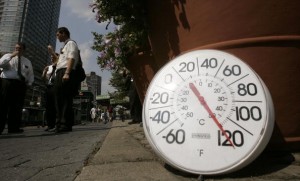
On Tuesday, we reported on how multiple years of unusually warm weather in Texas has changed attitudes about what’s hot and what’s not.
In a nutshell: people are starting to think of hotter-than-average weather as the new normal here in Texas. This year is a case-in-point: thanks to a warmer-than-usual winter, 2012 is currently on track to be the 4th hottest year (in terms of average temperatures) in Texas. But many people, shell-shocked from last year’s record breaking heat, are thinking of this year as a welcome respite.
A lot of the warming trend has to do with weather patterns that take decades to run their course. Strong and re-occurring La Nina patterns in the Pacific, for example, are in large part responsible for the dry, warm weather that Texas has seen since 2005 (with the exception of two wetter-than-average years). And, as we’ve explained in the past, dry weather in Texas means warm weather. But scientists say global climate change has exacerbated those trends, creating even hotter hot spells and drier dry spells.
What can the upcoming Texas legislature do about water, where will it find the funds if it decides to act? Those were some of the hot-button questions on tap at a recent Texas Tribune summit on water issues at Texas State University.
Tribune Editor-In-Chief Evan Smith sat down with two state legislators, Rep. Allan Ritter (R-Nederland), chairman of the House Natural Resources Committee, and state Sen. Glenn Hegar (R-Katy), who sites on the Senate Natural Resources Committee. You can watch their conversation above.
Some of these potential policies have big implications for the massive energy industry (and aging coal power plants) in Texas, but at this point it’s really anyone’s guess how exactly it will all play out. Continue Reading →
The pictured rotor head irrigation performed the worst in the drought-simulation study.
Drought doesn’t have to kill your lawn, say Texas A&M Agrilife researchers. Though it may appear brown, the grass can stay alive during water-restricted months. Researchers say it’s a matter of watering with the right sprinklers and the right techniques.
Texas A&M Agrilife researchers studied the best watering techniques during water restrictions by simulating drought-restrictions on grass. They used healthy plots of Bermuda and St. Augustine and limited their water intake to one-quarter inches and one-third inches of water twice a week. The researchers also tried out different sprinkler heads on the grass: spray, MP rotator, rotors and sub-surface drip.
According to the study, the drip irrigation sprinkler heads were the best at maximizing limited water supplies on grass. These sprinkler heads apply water slowly and directly to grass roots, although they are a little more labor intensive than other watering techniques. Continue Reading →
About StateImpact
StateImpact seeks to inform and engage local communities with broadcast and online news focused on how state government decisions affect your lives. Learn More »