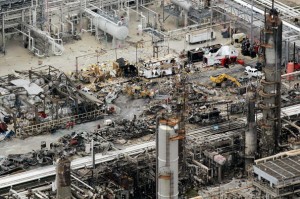
Workers sift through debris at the BP facility in Texas City 35 miles south of Houston, 24 March 2005, after an explosion that killed 15 the previous day.
On March 23, 2005, an explosion rocked the Texas City BP refinery outside of Houston. Fifteen people were killed and 170 more were injured. Since then, BP has paid over $2 billion in settlements. And last November the company and the state reached an agreement on a $50 million payment from BP for the tragedy.
And today comes news of a $13 million settlement between BP and the Occupational Safety Hazard Administration. That’s on top of a $21.3 million fine assessed by OSHA shortly after the incident, according to the Houston Chronicle.
The agreement settles 409 of the 439 citations that the agency leveled against BP following the 2009 follow-up inspection. At that time, BP agreed to pay $50.6 million in fines to resolve other citations.
BP, however, was facing more than $30 million in fines for the 439 citations. In Thursday’s agreement, most of the citations were either withdrawn, or re-classified as serious, repeat and unclassified. Only 57 remained classified as willful citations, according to the OSHA announcement.
BP has been trying to sell the plant but hasn’t had much luck finding a buyer because of the ongoing OSHA dispute.
Yet another earthquake has rattled North Texas. Early Tuesday morning, the city of Keene, 25 miles south of Fort Worth, experienced what the U.S. Geological Survey says was a 2.4 magnitude earthquake.
“We’ve been looking at the question of whether the number of earthquakes occurring across the mid-continent has changed in recent years. And we find that there is a statistically significant increase in the rate just over the past several years. And many of these are in areas where we know there is a lot of energy activity,” U.S. Geological Survey geophysicist Bill Ellsworth tells StateImpact Texas.
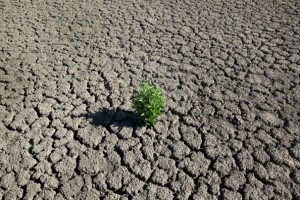
In a new report from NOAA, “State of The Climate,” the agency suggests that thanks to climate change, Texas is likely to see more extreme heat waves and dry spells like it did last year. Twenty times more likely, in fact.
Computer simulations from scientists in Oregon and England show heat waves and other weather patterns related to the La Niña weather pattern(which results in hotter, drier weather in Texas) as 20 times more likely to occur today than 50 years ago. “We found that extreme heat events were roughly 20 times more likely in 2008 than in other La Niña years in the 1960s and indications of an increase in frequency of low seasonal precipitation totals,” a paper within the report notes. The conditions behind the drought are “distinctly more probable than they were 40–50 years ago,” it says.
While the research doesn’t blame climate change as the sole cause of the extreme drought, it explains how the odds of such events occurring have increased because of global warming. Victor Murphy, a meterologist with the National Weather Service in Fort Worth tells the Houston Chronicle that warm and dry conditions thrive on each other. “Drought begets heat and then heat begets drought and a feedback cycle develops,” he says.
Thursday night at the University of Texas at Austin you can attend a special event from our ‘Life By the Drop’ series, Solutions for the Looming Water Crisis in Texas. Texas Monthly senior editor Nate Blakeslee will moderate a panel of experts and officials discussing what Texas can do to ensure it has enough water in the future.
(Free parking is available in the Library visitors’ lot #38 after 5 p.m.)
Panelists: Kip Averitt, former Texas legislator, founder, Averitt & Associates Laura Huffman, State Director, The Nature Conservancy Robert R. Puente, President/CEO, San Antonio Water System Andrew Sansom, Executive Director, Texas River Systems Institute Todd Staples, Texas Commissioner of Agriculture
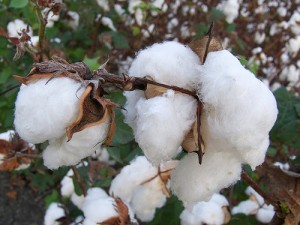
The white fruit of the cotton is called the boll. Texas has led the nation in cotton production for over a century.
Texas is cattle country, an image known the world over. What’s perhaps not so well known is the primacy of the other big C: Cotton. In fact, Texas has led the country in cotton production for over a century.
To find out we talked to State Extension Cotton Specialist, Dr. Gaylon Morgan. His overall take is positive, especially when compared to last year.
“35 percent of the [state’s] crop is good to excellent right now, 39 percent is fair, and then 26 precent is poor to very poor,” Morgan says. This time last year, he contrasts, “nearly 60 percent of the crop was poor to very poor.” Continue Reading →
On a certain level, you have to feel a bit of sympathy for the Texas grid, managed by the Electric Reliablity Council of Texas (ERCOT).
It’s a well-known fact that there isn’t enough power in the state to meet the grid’s guidelines. The group behind the grid would like to have a “reserve margin” (how much of a cushion of generation capacity there is during times of peak demand) of 13.75 percent. But this summer it’s projected to get down to twelve percent, and drop even further in the coming years. So they’re being cautious, telling people that things are going to be tight.
But at the same time, you don’t want to scare everyone. And you don’t want to look weak.
This quote pretty much sums it all up:
“You know, we want to get the message out of reduced usage during peak demand. At the same time, we want to get the message out that ‘Texas is open for business’,” Donna Nelson, the chair of the Public Utility Commission, said at a meeting last month. “We want to get the message out, peak demand, turn your thermostat up a couple degrees, don’t do your laundry, those kinds of things. But we don’t want to say, ‘if you don’t we’ll have rolling outages’, OK? So, it’s a fine line to walk.”
What will the future of energy look like? Will natural gas make a rebound? What about oil? Will our dependency on it continue, or will it wane?
We recently put some of these questions to Steve Coll of the New Yorker, whose new book, Private Empire: ExxonMobil and American Power looks at the oil giant and its role in the energy economy. Where the Texas-headquartered company goes next, and how it prioritizes its development, can offer insight on where our energy future as a whole is headed.
Coll notes that ExxonMobil has made huge investments in unconventional oil and gas in the United States, most notably with their purchase of the Fort Worth company XTO in 2010, one of the largest producers of unconventional natural gas deposits in the country. “ExxonMobil produces so much oil and gas every day, so just replacing the amount they produce and sell and remaining whole without shrinking is an enormous challenge,” Coll says. ExxonMobil also has had to look for oil and gas in developing countries like Nigeria, and in unconventional ways in the United States and Canada.
You can read the first two parts of our interview here and here.
Q: I think if you look at natural gas right now, people are really concerned. Hitting the lowest prices it’s seen in a decade in April. And people are saying: ‘Well, we’ve really developed this rapidly, and we’ve got this huge glut of natural gas now, and there’s not a lot of ways to use it.’ So I was curious: why you think Exxon Mobil made that choice to develop so much natural gas?
A: Well, I think they looked out over the next 30 or 40 years and they saw through their kind of projections of electric power demand in the United States, the future of the economy, and also the constraints on heavy carbon fuels like coal and also oil as a result of rising concerns about global warming, they assumed that eventually a price on carbon would come into play in the United States. All of that led them to natural gas. Continue Reading →
Texas Land Commissioner Jerry Patterson wants to build desalination plants on state land.
Texas is sitting on a massive amount of “brackish” water. Too salty to drink, but far less salty than ocean water. A lot of it is just sitting there, below our freshwater aquifers. And there’s enough of it to satisfy the current Texas population for a hundred and fifty years. But how do we get to it, and how much will it cost to do so?
That question is now on the mind of the Texas General Land Office. Today Commissioner Jerry Patterson proposed building some smaller desalination projects in Central Texas to help meet water demand in the region.
“Everyone says the state’s population is going to double by 2060,” Patterson tells StateImpact Texas. “And I guess you could say there’s enough water. But it’s not in the right place.”
Patterson, who’s running for Lieutenant Governor in 2014, is looking at several sites that belong to the commission’s Permanent School Fund, all of them along the I-35 corridor between Austin and San Antonio. “Anything we do to produce water for Central Texas reduces the impact on the Highland Lakes,” Patterson says. “That’s not only good for the folks that live around the Highland Lakes, it’s also good for those downstream consumers.” Patterson says less water taken out of the lakes means more for rice farmers, bays and estuaries, utilities and the petro-chemical industry.
But isn’t desalination expensive and energy-intensive? Continue Reading →
Natural Gas energy production has finally tied coal.
For the first time, natural gas has tied with coal. The U.S. Energy Information Administration (EIA) says that energy generation from natural gas-fired plants became “virtually equal” to energy generation from coal-fired plants in April.
Preliminary data shows that each fuel provides 32 percent of total energy generation, with natural gas generating 95.9 million megawatt hours – a figure just slightly less than that of coal, at 96 million megawatt hours.
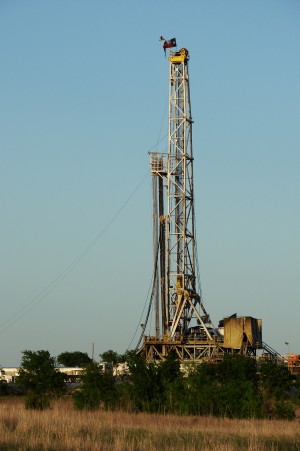
According to the EIA’s Annual Energy Outlook, natural gas production has increased. The reason? More drilling in “shale plays with high concentrations of natural gas” and “recent technological advances.” Texas has seen its fair share of this development with increased drilling in the Eagle Ford and Barnett Shale.
And the EIA projects that over the next 25 years, electricity generation from coal will fall to 38 percent – the result of increased competition from natural gas and renewable energy, along with the impact of new environmental regulations.
A man herds cattle at the West Auction in the winter of 2012.
“There was nothing we could do.”
It’s a phrase that rancher Jerry Abel returns to often when talking about the the day that his cattle dropped dead on his ranch. Listening to him talk about it, one is struck by the sense of powerlessness he felt watching the animals succumb.
Abel raises cattle for rodeo events, and it was after a roping exercise last May that he set his cows to pasture.
“The field adjacent to their pen, it wasn’t really good enough because of the drought for haying,” Abel told StateImpact Texas. “But there was quite a bit of grass on there. So we decided we could just turn the cattle out on it so they could graze some.”
It was about two hours later that the cows started to bellow. Abel and his trainer rushed back to see what was the matter.
StateImpact seeks to inform and engage local communities with broadcast and online news focused on how state government decisions affect your lives. Learn More »