Terrence Henry reports on energy and the environment for StateImpact Texas. His radio, print and television work has appeared in the New York Times, The Washington Post, The Atlantic, NPR, The Texas Tribune, The History Channel and other outlets.
He has previously worked at The Washington Post and The Atlantic. He earned a Bachelor’s Degree in International Relations from Brigham Young University.
The NEST learning thermostat has some big updates and is back on sale.
In December, a new thermostat came on the market. This normally wouldn’t be exciting news, but in this case the device — called Nest — was from some of the same designers behind the iPod, and the new thermostat promised to “learn” your habits and program itself. (You can read our earlier story on the Nest here.)
The product was such a success it quickly sold out (despite a $250 price tag). Today the company announced it’s back on sale, and has two innovative updates to its software:
A feature called AirWave, which maximizes the perfomance of your air conditioner, a feature that would be welcome in the hot, dry Texas summers. As the Nest website explains, “after your air conditioner turns off, it stays cold for awhile, just like your ice cream stays cold after it comes out of the freezer. Airwave stops your air-conditioner early, then uses the fan to spread cold air from your turned-off compressor through your home.”
You can now see a 10-day view of your energy history that shows you when your system was on and how weather, adjustments or being away from your home changed your energy use.
Gadget guide Harry McCracken applauds the new features. “I still think that Nest has a shot at helping to set off a revolution at least as important as the one launched by the iPod,” he says. You can read some thoughts on the new updates over at Time’s Techland blog.
The Texas drought has improved to levels not seen since over a year ago.
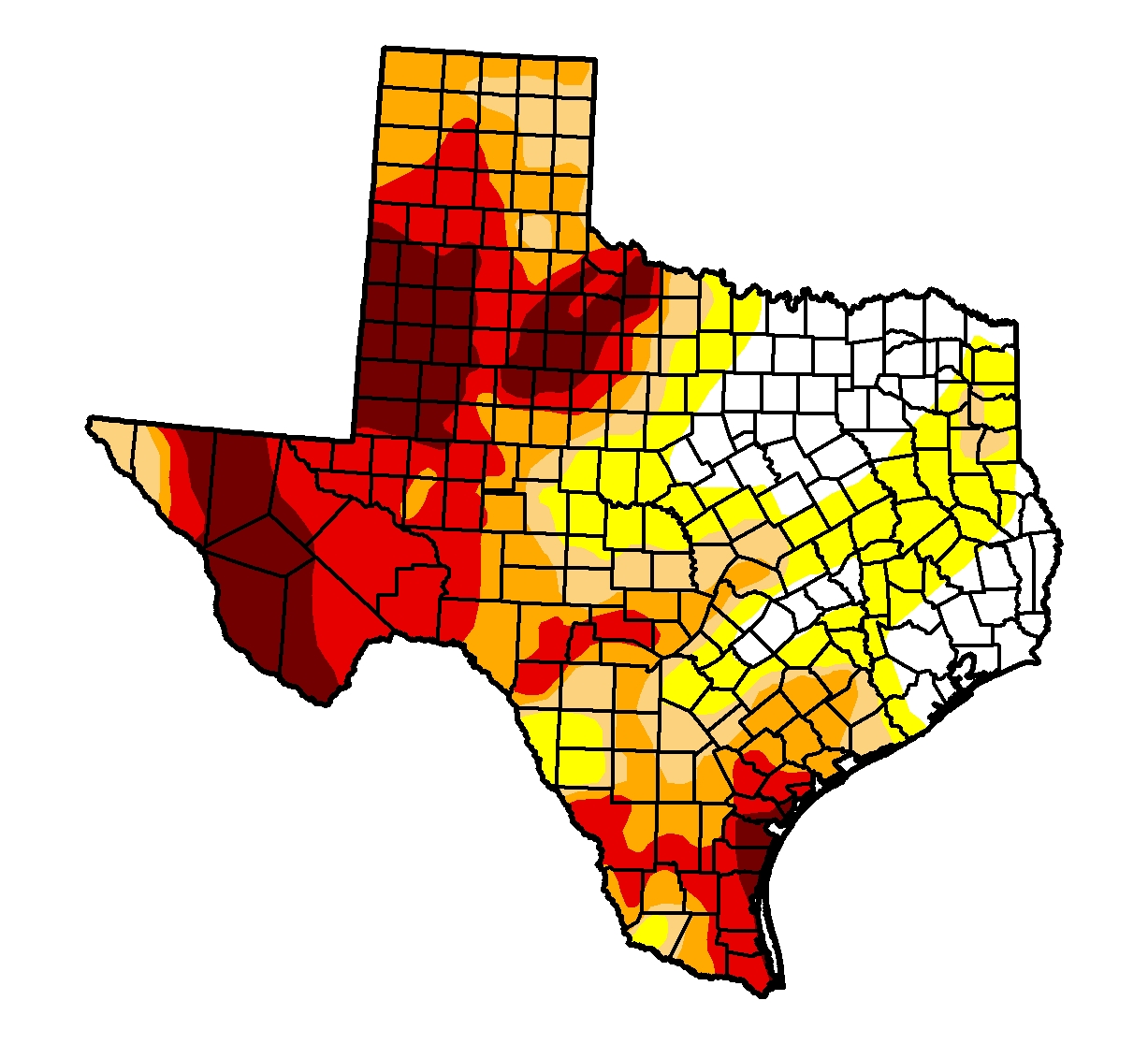
Another week, another update from the U.S. Drought Monitor. And today’s numbers bring some good news for much of the state: Texas is at its lowest levels of drought since more than a year ago.
Nearly 17 percent of the state is now completely drought-free (now including Houston). Compared to the peak of the drought, when 88 percent of Texas was in the worst stage of drought, “exceptional.” And other major cities like Dallas-Fort Worth, Austin, San Antonio are either drought-free or in the lower levels of drought.
But the situation in West Texas continues to be dry, as you can see from the map at the right. Lubbock, Midland and Odessa and their surrounding areas are still in the worst stages of drought. 14 percent of the state is still in “exceptional” drought, a great improvement from last fall and down from 32 percent just three months ago.
And as the levels of drought drop across Central, North and East Texas, water restrictions are being lifted. Kyle, Round Rock, and several cities in North Texas have eased restrictions recently. But not everyone is moving in that direction. Dallas-Fort Worth is considering permanent watering restrictions, drought or not. You can read more about the drought at our new interactive page, Dried Out: Confronting the Texas Drought.
The drought has affected Texans across the state. Haskell Simon, a rice farmer in Bay City, won't have water for his crops this year.
This week we launched a new interactive webpage about the historic Texas drought, Dried Out. The page gives you a visual sense of how intense the drought has been and its impact on the state.
And we want to hear your stories about how the drought has affected you. You can tell us how the drought has affected your business, your home — or your way of life. Send us your stories, photos or videos.
You can email them to news@kut.org, or you can leave a voicemail at (512) 537-SITX (7489). Please include a name and email address or phone number so we can contact you.
The folks at Climate Desk, a collaborative project from several major media groups on the climate, has put together a new multimedia story on why gas prices have been going up lately. You can view the presentation above.
Ocean currents may seem like a far away thing for Texans from the Hill Country to the High Plains, but weather patterns in the seas have an important effect on the state’s climate. The record single-year Texas drought, for instance, was mostly due to back-to-back years of La Niña, a weather pattern where the surface temperatures are cooler in the Pacific, which creates drier, warmer weather in the southern U.S. And those surface temperatures are influenced by ocean currents.
But despite the havoc they wreak, ocean currents and temperatures can be a beautiful thing. Artistic, even. As you can see in a new video by NASA, when you put the data behind ocean currents in motion, it becomes a van Gogh-esque vision.
NASA assembled the video, titled ‘Perpetual Ocean,’ from “ocean surface currents around the world during the period from June 2005 through December 2007,” according to its webpage. “The visualization does not include a narration or annotations; the goal was to use ocean flow data to create a simple, visceral experience.”
A 7,000 gallon truck brings in water about four times a day to Spicewood Beach
It’s been in the works for some time, and today the Lower Colorado River Authority (LCRA) announced that it’s reached an agreement to sell the Spicewood Beach water system along with 19 other retail water and wastewater systems to the Canadian company Corix Infrastructure.
Under an agreement between the LCRA and Corix, starting July 2nd until sometime in December 2013 when the sale is closed, Corix will operate the systems. In a release today, the LCRA notes that the company still “must apply to the Texas Commission on Environmental Quality for approval required for the sale, transfer or merger of a public utility as well as seek other regulatory approvals and consents for certain contract transfers.” The LCRA also says that it will “retain the rate setting authority over the systems” until the sale is finished.
You can read more about how the LCRA ended up owning the Spicewood Beach water system in the first place (and why some residents have questioned their management of it ever since) in this earlier story.
Pati Jacobs on her cattle ranch outside of Bastrop, Texas
“Four months ago this was just bare dirt. There was nothing,” Jacobs says.
Jacobs says the drought has been “devastating.”
Cows roam at the 235-acre Bastrop Cattle Company ranch.
During the peak of the drought, the cows here grew starkly thin and had no grass to graze on.
“What most people don’t realize, this wasn’t a one-year drought,” Jacobs says.
Jacobs say the drought has likely put many ranchers out of business.
There is no way to overstate the severity of the drought. Last year Texas had its driest year on record, paired with some of the highest temperatures we’ve ever seen. But even as the situation has improved for some thanks to a relatively wet winter, other parts of the state are still in the worst stage of drought.
For ranchers like Pati Jacobs at the Bastrop Cattle Company ranch east of Austin, Texas, the toll of the drought was enormous. Pointing to a stock tank on her 235-acre ranch, she notes that just a few months ago it was completely dry. And the same goes for the grass her cattle like to graze on. “Four months ago this was just bare dirt,” she says. “There was nothing.”
A new web-based app allows you to see the Texas drought like never before.
Just how much damage has the record single-year drought done to Texas? For the first time, you can see an interactive map and several visualizations that show just how severe the drought has been. On our new interactive web app, ‘Dried Out: Confronting the Texas Drought,’ you can see the intensity of the worst single-year drought in Texas’ history; learn more about the hard choices the state has to make; see the drought’s progression and its impact on the state; explore the pros and cons of the policy decisions that need to be made and share your stories.
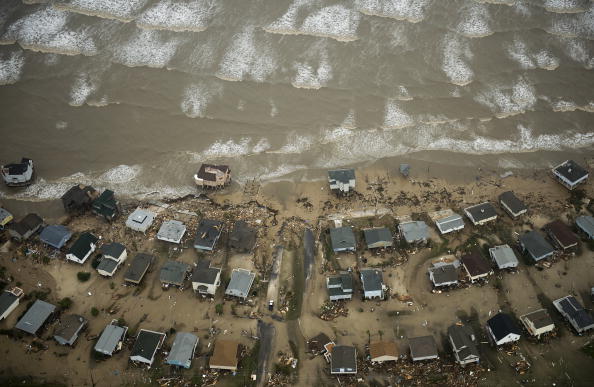
Damaged beach front homes are seen on Galveston Island after the passing of Hurricane Ike September 13, 2008 in Galveston, Texas.
Planning to go to a Texas beach this summer? If you’re hoping to hit the public beach at Galveston’s West End, you might find it’s now private property, thanks to a new ruling from the Texas Supreme Court.
In a 5-3 opinion, the Court ruled that “the State claims that it is entitled to an easement on privately owned beachfront property without meeting the law’s requirements for establishing an easement.”
“It seems that the Open Beaches Act — at least for Galveston’s West End — is dead, thanks to the Supreme Court,” Texas Land Commissioner Jerry Patterson said in a release. “This is truly a sad day.” He also said that the ruling “gives a pretty big club to anyone who wants to challenge the Texas Open Beaches Act anywhere else along the coast.”
“As we acknowledge continuous and natural physical changes in the West Galveston shoreline, we must also recognize ages-old private property rights that are protected by law,” the Court wrote in its decision, which you can read below. Continue Reading →
About StateImpact
StateImpact seeks to inform and engage local communities with broadcast and online news focused on how state government decisions affect your lives. Learn More »