Elon Musk introduces SpaceX's Falcon Heavy rocket which could complete missions to the International Space Station and Moon at a news conference on April 5, 2011 in Washington, DC.
Maybe you’ve heard of Space X, the private space exploration company that recently docked their first spacecraft at the International Space Station. Now they’re looking to expand their operation in Texas.
Space X is undergoing the permit process with the Federal Aviation Administration for a launch pad outside of Brownsville, at the southern tip of the state.
A new Space X launch pad could be economically beneficial for the city. Gilberto Salinas of the Brownsville Economic Development Council says Space X could “change the game” in town. “The jobs that it would bring with it,” Salinas says, “it would bring about 600 [direct] jobs paying extremely well. It could drop our unemployment by one full percentage point.”
But not everyone is happy about the site Space X has chosen. Continue Reading →
Tony Waldrope of the Garner spill response cleaning company walks among tubes used to contain an oil spill in flood waters at the idle Valero oil refinery 25 September 2005 in Port Arthur, Texas in the aftermath of Hurricane Rita.
The saying goes, “Don’t Mess With Texas,” and that was certainly the attitude on display today when a group of Texas regulators testified before a Congressional committee in Washington.
At a the hearing of the House Committee on Energy and Commerce’s Subcommittee on Energy and Power entitled “EPA Enforcement Priorities and Practices,” the head of the Railroad Commission of Texas, Barry Smitherman, and the chair of the Texas Commission on Environmental Quality, Bryan Shaw, took turns criticizing the Environmental Protection Agency (EPA) and its recently-resigned regional director Al Armedariz (who was also supposed to testify at the hearing, but canceled at the last minute). Smitherman and Shaw, along with other oil, gas and energy representatives, aired their usual grievances: the EPA has overreacted to allegations of fracking contamination, whether in Texas, Pennsylvania, or Wyoming; and the states are doing a fine job of regulating themselves without any intervention needed from the feds. There’s a wrap-up in the Texas Tribune by Kate Galbraith, but suffice it to say there’s little news to be had. Texas regulators don’t like the EPA, and the sky is still blue.
But there was one member of the panel that brought some statistical calm to the proceedings. Joel Mintz, a law professor at Nova Southeastern University, has studied the EPA for three decades. And he told the committee that despite all the anti-EPA rhetoric being used to attack the Obama administration, enforcement at the agency hasn’t changed since the president took office.
The NASA SDO satellite captures a ultra-high definition image of the Transit of Venus across the face of the sun at on June 5, 2012 from space.
A boy along with others wears special goggles to watch Venus crossing the sun’s face on June 5, 2012 in College Park, Maryland.
The planet Venus passes before the sun, a very rarely-seen event, on June 5, 2012 near Orange, California.
A astronomy enthusiast using his mobile phone, takes a photo of Venus sliding across the sun, off a projection, from a weather observatory in Manila.
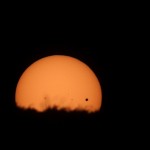
Venus (top R) viewed as a small black dot, passes across the sun in the sky of Rome early on June 6, 2012. Sky-gazers around the world held up their telescopes and viewing glasses June 6, to watch Venus slide across the sun — a rare celestial phenomenon that will not happen again for more than 100 years.
Davinia Troughton and Joshua Howes wear special goggles to observe the Transit of Venus from the High Line park in New York City.
The last transit was in 2004 and the next pair of events will not happen again until the year 2117 and 2125.
Israeli children use tinted glasses to watch the transit of Venus across the face of the sun in the Israeli coastal Mediterranean city of Tel Aviv.
Another NASA image of the transit of Venus.
A boy looks through a telescope to see Venus transit across the Sun at the Obuda observatory in Budapest.
Sky-gazers around the world held up their telescopes and viewing glasses June 6, to watch Venus slide across the sun — a rare celestial phenomenon that will not happen again for more than 100 years. Other small dots on the right of the photo are called sun spots.
Amanda Fear (L) and Sebastian Paquet wear solar viewing glasses as they share a rare kiss as the planet Venus transitsacross the face of the sun at the Griffith Observatory in Los Angeles, California.
A man uses his iPhone to photograph the planet Venus passing in front of the sun from a live feed from the coelostat telescopes at the Griffith Observatory, one of the largest and most-visited public solar observatories in the world, in Los Angeles, California
A man in Singapore uses special glasses to watch the transit of Venus across the surface of the Sun.
The transit of Venus is seen making its way across the Sun off a screen at Caltech in Pasadena showing NASA’s live feed from Hawaii
An Indian women in New Delhi uses special glasses and filters to observe Venus as it passes in front of the Sun.
The transit of Venus involves the planet Venus crossing in front of the sun. The last time it was seen in California was 1882 and the next pair of events will not happen again until the year 2117 and 2125. The transit of Venus across the sun has been seen only seven times since the telescope was invented.
A Pakistani man in Islamabad uses an X-ray to observe Venus as it passes in front of the Sun.
The transit was witnessed by sky-watchers across the world. And in case you missed it, we’ve assembled photos of the event taken from places as far as Israel and Singapore, as well as some fantastic images from NASA satellites. You can see the images in the slideshow above.
And after the jump, a fantastic time-lapse video of the transit by NASA: Continue Reading →
EAA general manager Karl Dreher was placed on paid administrative leave earlier this week.
Karl Dreher, the general manager for the Edwards Aquifer Authority (EAA), has been placed on paid administrative leave. An EAA spokesperson confirmed the news today to StateImpact Texas, which was first reported in the San Antonio Express-News.
The Authority manages the groundwater district of the Edwards Aquifer, which includes San Antonio and many of the surrounding counties, producing drinking water for more than 2 million people in Central Texas.
It isn’t clear why Dreher was placed on administrative leave. Assistant General Manager for Communications & External Affairs Roland Ruiz said that “as a personnel matter, there is no statement other than to confirm that the action did occur.” Ruiz also confirmed that Dreher was placed on leave by Laura Buckner, chair of the EAA board of directors. He says the decision will be taken up by the board at its next meeting June 12. Continue Reading →
In 1980, Congress passed a federal law to cleanup sites with excessive industrial contamination. These were places that were so polluted that they required long-term federal cleanups, and they’re known as Superfund sites. StateImpact Texas reporter Dave Fehling reports today that thirty years later, some of these toxic places are still being cleaned up.
In the map above you can see the many Environmental Protection Agency (EPA) Superfund sites in Texas. (There are also Superfund sites administered by the state environmental agency, the Texas Commission on Environmental Quality, that are not included on this map.) Some of the sites have been completely cleaned up (designated in green), while others are still being worked on (in red). Yellow points are places that have been proposed as EPA Superfund sites in Texas. Continue Reading →
Located in Galveston County, it was disposal site for millions of gallons of petrochemical waste
It’s the summer vacation season and on the way to Galveston, thousands of beach-goers drive right past it. It’s a 12 acre field that lies along the east side of I-45 right before you head over the causeway to Galveston Island. It’s doubtful many of the vacationers stop to look, but if they did, they might see a stone marker. It’s an historical marker, of sorts. In big letters it proclaims what is just the other side of a barbed wire-topped chain-link fence: the MOTCO FEDERAL SUPERFUND SITE.
It’s one of over 150 polluted Superfund sites in Texas. Some are under control of the Texas Commission on Environmental Quality. Many of the worst are managed by the U.S. Environmental Protection Agency. Continue Reading →
A boy views the planet Venus through protected binoculars as it transits across the face of the sun as seen from the Greenwich Observatory June 8, 2004 in London. The rare astronomical event last occurred in 1882, while the next transit is due in 2012.
This photo taken 08 June 2004 shows the transit of Venus across the sun’s disc through special spectacles, seen in the park of La Villette in Paris.
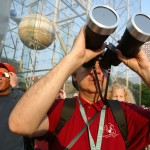
People watch through telescopes the transit of Venus across the sun’s disc 08 June 2004 in the park of La Villette in Paris. Backgrouns is the Geode, a spherical Imax cinema
The planet Venus is visible as a black dot as it transits across the facce of the sun June 8, 2004 as seen from Baghdad, Iraq. The rare astronomical event last occurred in 1882, while the next transit is due in 2012.
Visitors observe the planet Venus passing in front of the Sun with filtered optics at the American Museum of Natural History June 8, 2004 in New York City. The transit of Venus is a rare celestial event which last occurred in 1882.
The planet Venus is visible as a black dot as it transits across the face of the sun as seen from the Greenwich Observatory June 8, 2004 in London. The rare astronomical event last occurred in 1882, while the next transit is due in 2012.
An Israeli child views the planet Venus as it transits across the face of the sun at Tel-Aviv university June 8, 2004 in Tel-Aviv, Israel. The rare astronomical event last occurred in 1882, while the next transit is due in 2012.
The planet Venus is visible as a black dot as it transits across the face of the sun as seen from the Greenwich Observatory June 8, 2004 in London. The rare astronomical event last occurred in 1882, while the next transit is due in 2012.
It’s not quite an eclipse, it’s more like the sun is going to have a beauty mark for a rare, fleeting moment. On Tuesday, Venus (the brightest planet in our solar system) will pass in front of the sun, and if you’re hoping to catch it, plan with care. If you miss it, you won’t have another chance of seeing it until the next century. December 11, 2117, to be exact.
“During the transit, Venus will appear in silhouette as a small, dark dot moving in front of the solar disk,” writes EarthSky, which reports on astronomy and science. “Here in Austin, Texas, we’ll see the first half of the transit, while the second half will take place after the sun goes beneath our horizon. In North America, it’ll be to our advantage to find a level western horizon, as the sun will be low in the west at the time of the transit.”
For information on the best possible time to witness the phenomenon in Texas, check out local times from the Transit of Venus website. For much of the state, the transit will be viewable starting at 4 p.m. Tuesday and and ending around 10 p.m. You’ll want a telescope with a solar filter to safely observe the passing. Continue Reading →
Americans produce over seven pounds of trash per day, per person.
Did you know that America’s number one export is … garbage? Edward Humes, Pulitzer Prize-winning author of twelve books (and a former Austinite), examines this and other disquieting facts about American trash culture—literal trash culture, not the other kind—in his new book, Garbology: Our Dirty Love Affair With Trash. Americans, while making up only five percent of the world’s population, produce almost a quarter of its garbage, much of which ends up in landfills and the ocean.
Humes took some time to talk to StateImpact Texas about why the United States produces so much waste, and why he thinks it just doesn’t make a whole lot of sense.
Q: So how much trash do Americans produce in a given day?
A: Well, it turns out that this is not an easy number to come by. In fact, the “national trash bible” – the publication that the EPA puts out to examine our municipal – is really badly outdated. Research done by Columbia University and a trade journal called BioCycle shows that we produce, per day, 7.1 pounds of trash for every man, woman, and child in the country. And that compares not-favorably with the rest of the world – the average Japanese person produces about 2.5 pounds of trash. But it doesn’t even compare favorably to where we were a few decades ago. It’s about twice as much per capita trash as we produced in 1960. Where is it all coming from? What more do we have now that we didn’t have then? Those are the interesting questions. Are we more prosperous now than we were in 1960? Do we feel more prosperous because we have all this crap we’re throwing away? Continue Reading →
Juan Rico works in an cotton field that is watered by an underground irrigation system July 27, 2011 near Hermleigh, Texas.
The Texas Panhandle’s corn crops are greener now than they have been in many months. Recent rainfall has given this season’s crops a new lease on life. But, corn crops thirty years from now might not be so lucky. The rapid depletion of the Panhandle’s groundwater supplies could dramatically alter the character of agriculture in the region.
A new study on groundwater depletion in the Central Valley of California and the High Plains Region has placed most of the blame on agriculture irrigation practices. Researchers at the University of Texas claim that the Texas Panhandle will be unable to sustain irrigated agriculture within the next thirty years if current patterns of groundwater use continue.
“Current rates of replenishment in the Panhandle are very low and we are basically pulling out water faster than it is being replenished,” says Dr. Bridget Scanlon, senior research scientist at The University of Texas at Austin’s Bureau of Economic Geology. “It’s just like a bank. If you withdraw money faster than you deposit money, you will eventually run out. The groundwater depletion rate in the northern Texas panhandle is now at least ten times its recharge rate.”
And the Central Valley of California faces a similar situation. Continue Reading →
If you’re a fan of the wide-eyed Doc Brown in Back to the Future or the type who’s curious how many megawatts it took to blow up Alderaan in Star Wars, you’ll want to check out a special show airing on public television in Austin tonight, Energy at the Movies.
Michael Webber, who leads the Webber Energy Group at the University of Texas at Austin, takes a look at the last seventy years of film and how they portray issues of energy. It’s a lecture he’s been giving for several years, and is now even a class at UT. On the list of films are classics like Deliverance (which involves hydroelectric power) and Zoolander (coal mining) and Syriana (oil).
You can catch Energy at the Movies tonight in Austin at 8 p.m. on KLRU (Channel 255, Time Warner Cable; Channel 284, Grande Communications; Channel 18-3 Over the Air), and again Sunday at 1 a.m. and 2 p.m.
StateImpact seeks to inform and engage local communities with broadcast and online news focused on how state government decisions affect your lives. Learn More »