At last week’s “Life By the Drop” panel on solutions for solving the water crisis in Texas, not everyone agreed on what the next steps should be. But there was universal acknowledgment that greater conservation efforts were essential for the state’s future.
And Texas’ many water utilities aren’t behind the punch. Many have water conservation plans in place that often include residential rebates for products that reduce water use. The items range from small to large, cheap to expensive, and go from around your yard to inside your bathroom. Water-efficient toilets in Dallas and low-flow shower heads in El Paso are just a few of the incentives that we’ve culled into a ‘Rebate Round-Up’ below, where you can see what water conservation incentives are offered in your city.
How you get that rebate depends on where you are. Some utilities give away free products, others give the money up front and, in a majority of cases, others require proof of purchase. There are also eligibility requirements, so be sure to check those before you go out and buy a fancy rainwater catchment system.
In addition to products, some utilities offer free services. For instance, several cities offer a free water-saving audit. And Forth Worth teaches free seminars with water saving tips for landscaping.
Without any further ado, here’s our water conservation ‘Rebate Round-Up:’ Continue Reading →
Up until now, the commission had followed what’s already in the state employee ethics handbook. The new rules, proposed by commission chair Barry Smitherman, take things a bit further. “Adopting this policy is an important step to maintaining the public trust,” Smitherman said in a statement.
“Since [Smitherman] became chair, he’s been reviewing all the policies and procedures at the commission, and this is one that he found was deficient,” says Casey Haney, the chairman’s chief of staff. “So we thought it was important to address it sooner rather than later.”
Under the new policy, for the first two years after leaving the commission, former commissioners and executive directors must send all of their communications with the agency through the open records coordinator at the commission, just as any outsider would. The idea is to set up a more formal barrier. Continue Reading →
The carcasses of two Hereford cows that perished on the Patterson Ranch.
On Thursday evening, Texas Monthly magazine hosted a panel from our Life By the Drop series, which looks at the history and impact of drought and water issues in Texas. The panel, led by Texas Monthly senior editor Nate Blakeslee, was a “dream team” of water experts from the state. They all took questions about the ups and downs of the state water plan, how agriculture and cities will work out their water differences, and some of the intricacies of Texas law that are holding us back.
The Sky Isn’t Falling, and That’s A Problem
“I think we all accept we have a crisis on our hands,” Jake Silverstein, editor of Texas Monthly, said in his introduction. “But the silver lining is that it has focused more people.” The question before us, he said, is will the great drought of 2011 have the same stimulative effect as the drought of record in the 1950s?
For the rest of the evening, the panel attempted to answer that question, and many related to it. The first hot topic that came up was where exactly all of our water in Texas is going. Continue Reading →
NRG's Cedar Bayou power plant expanded in 2009: "We could not do that today"
According to some industry insiders, when the state-regulated peak price for wholesale electricity jumps 50% next month, it will fail to do what the Texas Public Utility Commission (PUC) had hoped: encourage the construction of new power plants to avert shortages.
“The prices have to go up before you see any significant generation being built,” said Dallas energy consultant John Bick, formerly with TXU Energy, now with Priority Power Management.
An oil refinery blow off stack in Texas City, Texas.
Last week, a Travis County district judge ruled in favor of a bunch of kids suing the Texas Commission on Environmental Quality. Three environmentally-minded minors and a young adult argued that Texas’ air should be protected under the public trust doctrine much like Texas’ water, and the Judge agreed.
In 2011, the youths drafted a petition alongside Kids Versus Global Warming, Our Children’s Trust, and other environmental groups in a national campaign to improve air quality in 49 states and the District of Columbia. In Texas, they requested that the Texas Commission for Environmental Quality (TCEQ) adopt a plan to slash carbon dioxide emissions to reduce climate change by making air part of the public trust. (The public trust doctrine says that certain resources should be protected by the government for public use.) When the TCEQ turned them down, saying that the proposed rules were a misreading of the public trust doctrine and would stifle business and industry in Texas, the kids sued.
Some of the children behind the suit are quite young. When the lawsuit was first brought against the TCEQ last July, one was in her mid-twenties, another was a teenager, and the other two were three and five. But Adam Abrams, an attorney at the Texas Environmental Law Center representing the minors, brushes this fact aside, claiming that the minors aren’t simply suing at the behest of their parents, Brigid Shea and Karin Ascot, who are prominent environmentalists.
“They’re not acting as proxies for their parents,” Abrams said in an interview with StateImpact Texas. “The parents are essentially asserting the rights of the children … If anything, the parents are just acting on behalf of the children and asserting the childrens’ right to a healthy, liveable planet.” Continue Reading →
Tomorrow night at the Cactus Cafe we’ll be hosting a special free listening session for our documentary on the drought, ‘Life By the Drop: Drought, Water and the Future of Texas,’ a collaboration with Texas Monthly and KUT News.
We’ll be on hand, along with Texas Monthly Editor Jake Silverstein and KUT’s Matt Largey, as part of a panel discussion on the documentary and the issues behind it. You’ll be able to ask questions of us and listen to the documentary in its entirety. Please join us if you can make it. (And if you can’t, you can always listen to the full show right here.)
If you’re a Texan interested in green building, smart grids and solar panels, there’s probably no better place to see them in action than the Pecan Street Research Institute in Austin’s Mueller neighborhood.
That neighborhood, just northeast of downtown Austin, is home to hundreds of green-built homes, all tied into a smart grid, with many of them even outfitted with solar panel arrays. It’s become a test ground for some of the most advanced home technologies in America.
In the video above from PBS NewsHour, you can take a look inside the project that’s become a vital incubator for the green building and tech communities. And to learn more about the Mueller development, you can read our earlier story, Green Experiment Takes Root in Austin.
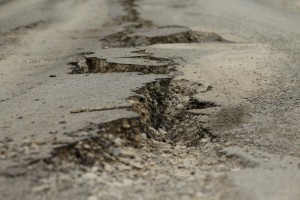
Scientists have drawn definitive links between hydraulic fracturing disposal wells and induced earthquakes. The photo above shows a crack in a road after a natural earthquake in 2011 in Christchurch, New Zealand.
They’re small, and so far mostly just a nuisance, but one thing is clear: there are more of them, and their intensity may be increasing.
Fortunately, the data is readily available. Using the US Geological Survey’s Earthquake Database (and with plenty of help from a friendly scientist at the USGS), we pulled up all of the quakes in the area, going back to the eighties.
Here’s what we found: Since 2008, there have been thirty earthquakes in the area measured by the USGS. Before 2008? Zero. What else hadn’t been in the area until a few years before that time?* Deep injection wells, used to dispose of wastewater from hydraulic fracturing, or “fracking.” Continue Reading →
Interstate 10 is flooded near an overpass in Houston after Hurrican Ike. The Houston area was the largest beneficiary of the recent storms in Texas, but of course that can bring harm with it as well.
It’s been an interesting role reversal for Texas weather these past couple of months. June, typically the state’s wettest month, was bone dry. But the high summer, a time of highly variable precipitation, has been downright soggy, especially this current week. Of course, we aren’t complaining.
What does all this wet weather mean for the state’s drought prospects? So far, it’s too early to say anything definitive. The weekly Drought Monitor Map was released Thursday, but the data it uses is cut off earlier in the week, on Tuesday morning. So, the rain the state received in the past two days – a significant amount – has yet to be added.
Still, if certain Texas cities’ recent advancements are any indication, a leap of improvement may be within reach. Continue Reading →
Scientists have drawn definitive links between hydraulic fracturing disposal wells and induced earthquakes. The photo above shows a crack in a road after a natural earthquake in 2011 in Christchurch, New Zealand.
“There is definitely a credible link between wastewater disposal, primarily related to production of gas from the Barnett Shale, with earthquakes,” William Ellsworth, a seismologist with the US Geological Survey, tells StateImpact Texas. But it’s important to note that for the most part, these quakes have done little damage. “At this point the earthquakes are a bit of an annoyance, certainly, and there’s always the possibility that something larger might occur,” Ellsworth says.
That group looked at quakes measuring 3.0 or higher on the Richter scale. It found that quakes have increased in frequency and intensity, beginning in 2001. In 2009, there were 50 quakes in the midcontinent region. In 2010, 87. And last year, the number jumped to 134. That’s a sixfold increase over earthquake frequency in the 20th century, according to the report. Continue Reading →
About StateImpact
StateImpact seeks to inform and engage local communities with broadcast and online news focused on how state government decisions affect your lives. Learn More »