Barry Smitherman won the Republican primary runoff for his seat on the Railroad Commission of Texas.
There weren’t any real surprises in tonight’s Republican primary runoff for two of the seats on the Railroad Commission of Texas. That’s the state agency in charge of regulating the oil and gas industry in Texas.
Incumbent chair Barry Smitherman won another turn at his seat after beating challenger Greg Parker. In the runoff for the open seat on the commission, Christi Craddick won over State Representative Warren Chisum.
Craddick is the daughter of longtime state house figure Tom Craddick. His funds helped her win the race. Both winners of the commission seats enjoyed a wide margin in their victories. With eight percent of precincts counted, Smitherman had 62 percent of the vote to Parker’s 38 percent. And Craddick had 60 percent of the vote to Craddick’s 40.
Photos courtesy of Chisum for Texas and Craddick for Texas
Warren Chisum, left, and Christi Craddick, right, face off today in the Republican Primary runoff for Railroad Commission of Texas.
Will Texas regulators be willing to police the hand that funds them?
Polls are open today in the Republican primary runoff race for two seats on the Railroad Commission of Texas. But the commission has nothing to do with railroads and everything to do with regulating the oil and gas industry in Texas.
The race for the other seat is a bit tighter. It features Republican Warren Chisum against Republican Christi Craddick. Warren Chisum is a state representative from Pampa who chose to run for the commission instead of reelection. He’s also made a fortune in the oil and gas industry. Chisum is facing off against Christi Craddick, an oil and gas attorney and daughter of longtime state representative (and former Texas House Speaker) Tom Craddick. In the initial primary, Craddick got roughly 36 percent of the vote, while Chisum won around 27 percent. Now the two are in a runoff, and the winner will face Democratic challenger Dale Henry this fall. (Update: With over 61 percent of the vote, Craddick beat Chisum.)
As far as what they would do differently on the commission, it’s been difficult to tell the two candidates apart. Chisum and Craddick have both employed heavy bravado about keeping the federal government out of state regulation of oil and gas. Not surprisingly, contributions to both Craddick and Chisum have come from individuals and corporations involved in oil and gas, the same companies they would regulate as commissioners.
Retail electric providers (REPs) in Texas have to make a decision: should they pass on higher wholesale electricity costs to customers who’ve signed “fixed rate” contracts, contracts that were supposed to lock-in a per kilowatt hour price? If the REPs try it, the Public Utility Commission of Texas (PUC) is just waiting for the first customer to file a complaint.
The suspense begins Wednesday (August 1) when the state-set peak price for wholesale electricity jumps 50 percent to $4,500 per megawatt hour. The PUC approved the hike last month. The peak price can be reached on the hottest days when demand soars. Sky-high peak prices last a matter of hours and come a few dozen days a year. Otherwise, prices for a megawatt hour can be as low about $30. The PUC took the action because it says higher profits will encourage utility companies to build more power plants to keep up with the state’s growth. Continue Reading →
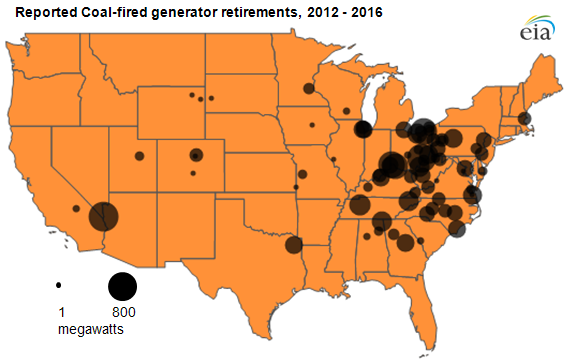
Source: U.S. Energy Information Administration, Form EIA-860, “Annual Electric Generator Report.” Note: Capacity values represent net summer capacity.
Earlier this month, the U.S. Energy Information Administration (EIA) announced that natural gas energy production finally tied with energy generated from coal in April. Now, that group is projecting that energy from coal-fired plants will likely contract in the next five years.
Between 2012 and 2016, almost 27 gigawatts of energy production from 175 coal-fired generators are expected to be lost – an amount that accounts for 8.5% of total coal-fired energy generation in 2011.
These losses are more than four times greater than the losses experienced during the last five-year period. And 2012, by all accounts, should be the largest one-year decline in coal power generation thus far with a total loss of 9 gigawatts.
According to the report by the U.S. Energy Information Administration, several factors have contributed to coal’s decline: Continue Reading →
Texas isn't the only place that gets a visit from Saharan dust. In this photo, dust and mist from the Sirocco, a Mediterranean wind that comes from the Sahara, obscure the moon above the Spanish Canary island of Tenerife on March 9, 2011.
If the sky looked a little hazier here in Texas over the weekend, it’s not necessarily air pollution you were seeing. Rather it was likely the result of extreme weather a half a world away.
Every now and again, massive sandstorms kick up in the Saharan Desert. That would normally go unnoticed in Central Texas, except when the dust from those storms is picked up by Atlantic trade winds, as it is around this time every year.
“And these trade winds will actually transport the dust all the way across the Atlantic all the way through the Caribbean, all the way through the Gulf of Mexico, and they then end up in Texas,” says Bob Rose, chief meteorologist for the Lower Colorado River Authority. He says that’s what happened this past weekend.
Now, to be clear, the dust we’re talking about is only a fraction of the circumference of a human hair. So that’s why we didn’t see a sandstorm of Lawrence of Arabia proportions. Continue Reading →
The Barton Springs Salamander is already on the endangered species list.
Two Texas politicians have introduced legislation to block several species of salamanders in Central Texas from being recognized as endangered or threatened species.
U.S. Senator John Cornyn (R-TX) and U.S. Representative John Carter (R-TX) say classifying the amphibians as endangered could hinder area job growth and economic development. “My goal is to make sure the salamanders and people can peacefully co-exist,” Cornyn says. “And we can take care of the concerns about these species but also at the same time not stop the economic growth and job creation that comes along with the boom we are seeing here in Texas and in this part of the state, which has made us the envy of the rest of the country, if not the world.”
A similar creature, the Barton Springs Salamander, is currently listed as endangered. Because of this, the city of Austin must follow a Habitat Conservation Plan approved by the FWS for its management of the salamander’s habitat. Aptly named, the Barton Springs Salamander lives only in Barton Springs Pool and the area immediately around it. Continue Reading →
Pipe is stacked at the southern site of the Keystone XL pipeline on March 22, 2012 in Cushing, Oklahoma.
All that stands in the way of the southern leg of the Keystone XL pipeline at this point are a few landowners. While the northern section of the pipeline from Canada to Oklahoma has hit some snags, the southern portion is now officially cleared to go ahead, according to the company.
TransCanada, the company behind the controversial project that would bring heavy oil harvested from sand deposits in Canada to refineries on the Gulf Coast, announced today that it has received the final of three permits from the U.S. Army Corps of Engineers.
“With the permit from the Fort Worth, Texas Army Corps district added to previously received permits from the Galveston, Texas and the Tulsa, Oklahoma districts, TransCanada is now in a position to start construction of the oil pipeline in the coming weeks,” the company said in a statement. The southern leg of the pipeline got a big boost in March when President Obama called for cutting “through the red tape” and making its construction a priority.
Park officials say they’re looking to partner with banks, hotels and sporting-goods stores. Soon, you could be the proud owner of an official Texas Parks & Wildlife cooler. The corporate sponsorship was approved during the last legislature.
“This is the first time, as far as we know, that a state agency has done this,” Darcy Bontempo, the department’s marketing director, says.
Governor Rick Perry speaks at the unveiling of the remodeled Texas Governor's Mansion on July 18, 2012.
Four years after a fire bomb nearly incinerated the entire building, the Texas Governor’s Mansion is rebuilt and running. And you may be surprised to learn that it boasts several new eco-friendly features.
“I think it’s not unlike the State of Texas having a diverse portfolio of energy,” Governor Rick Perry said at a tour of the restoration last week. “The Governor’s Mansion could be a showcase for that.”
As Jay Root reports in the Texas Tribune, there are 53 wells reaching 300 feet below the mansion for a geothermal heat pump that will help heat and cool the building. And solar panels on the roof will help heat most of the mansion’s water.
“Both solar and geothermal are some of the energy sources of the future,” Perry said at the ceremony. While Texas has a healthy fossil fuel base that adds to the economy, Perry said, it’s good for the state to have a “diverse portfolio” including wind, solar, geothermal and other types of energy.
In May, a Travis County District judge sent a letter to the Texas Commission on Environmental Quality (TCEQ) saying that he intended to revoke an air permit for a proposed coal plant in Corpus Christi. This week Judge Steven Yelenosky of the 345th Judicial District Civil Court made the order official, setting back construction on one of the few coal plants still being planned in Texas.
The plant, called Las Brisas, would use petroleum coke — carbon solids left over from refining — for power generation in a way much like coal, with much the same emissions. It was first proposed in 2008, and is the only proposed coal plant within a city’s limits in the entire country, according to the Sierra Club. It would sit on the northern side of the Corpus Christi ship channel, across from a residential area known as “Refinery Row,” which already sits in the midst of six major refineries.
The plant was given an air permit in January 2011 by the TCEQ. A challenge to that permit was brought by a coalition of environmental groups, including the Sierra Club, the Environmental Defense Fund (EDF), the Corpus Christi Clean Economy Coalition, and several Texas cities. Now Judge Yelenosky has ruled in those groups’ favor, reversing the air permit.
In his May letter, the judge found several things wrong with how the TCEQ processed the permit, and said it failed to meet the requirements of the Clean Air Act, among other issues. Tuesday’s order lays out in detail what the TCEQ did wrong. The TCEQ would not agree to an interview about the ruling, and would only give StateImpact Texas a prepared statement. Continue Reading →
About StateImpact
StateImpact seeks to inform and engage local communities with broadcast and online news focused on how state government decisions affect your lives. Learn More »