Where the Keystone XL pipeline would go through Texas.
UPDATED
An official with the EPA has told StateImpact Texas that the route of the pipeline has changed since the EPA letter was sent in November.
Under the new route the EPA will not be involved in the review.
EARLIER
The U.S. Environmental Protection Agency sent a letter late last year raising concerns that the southern leg of the Keystone XL pipeline might require more stringent permitting than planned by the Army Corp of Engineers, according to a report from the Associated Press. Continue Reading →
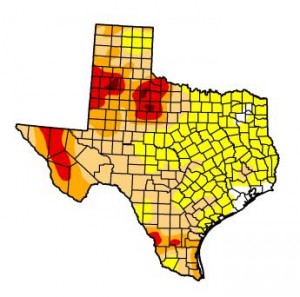
The state drought map released Thursday, May 31. The tan and red areas denote areas in drought.
After so much progress over the winter months, it’s a let down to see the drought map released today by the U.S. Drought Monitor showing a slight reversal in recent trends.
Despite an overall retreat of drought in Texas, the percentage of the state experiencing drought conditions actually increased by two percentage points since last week.
The Drought Monitor map released today reveals that 59.18% of the state is still in drought conditions, with parts of northwest Texas continuing to harbor islands of extreme and exceptional drought.
Recent weather for much of the state should allay some alarm, however. Wet weather passed through the Dallas-Fort Worth area yesterday and is in the forecast for much of the central and eastern parts of the state today. Still, some analysts say it’s anybody’s guess if wetter trends will continue. Continue Reading →
Juan Rico walks by a barren cotton field July 27, 2011 near Hermleigh, Texas. A severe drought has caused the majority of dry-land (non-irrigated fields) cotton crops to fail in the region.
If you’re a farmer in the Midwest, chances are your land values have gone up recently. A new survey by the Federal Reserve Bank of Kansas City, Mo. says that irrigated farmland value in those areas grew more than 30 percent over the last year’s first quarter. Factors such as higher crop prices and timely rains have caused demand for cropland to persist.
But if you’re a Texas farmer, you’re not seeing the same growth. The Federal Reserve Bank of Dallas’ most recent survey shows that Texas farmland values remain largely unchanged. Irrigated land values rose a little bit – up 9%. But cropland and ranchland values are essentially the same as they were this time last year, while they have gone up between sixteen and thirty percent in the Midwest.
Emily Kerr of the Federal Reserve Bank of Dallas says that drought is definitely a factor in Texas’ agricultural land value stagnation. Continue Reading →
It says while most of the nation has adequate reserves of electric power to make it through the summer, Texas may not.
“Given the expected reserve margin in the ERCOT Region for the 2012 summer season (below the minimum Reference Margin Level), unavailability of one or more large thermal generators due to the compliance requirements of the CSAPR or, in fact, for any reason (such as an extended maintenance outage), would increase the risk of emergency conditions during 2012 summer peak load hours, and could necessitate rotating outages in the event of extreme heat or significant other generation unit outages.”
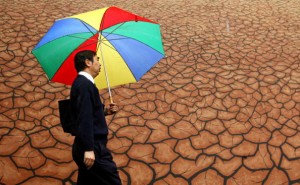
A man shelters from the rain under his umbrella as he passes a giant mural showing the drought-affected Australian outback in 2007.
A growing shortage of freshwater is transforming into a commonplace global experience. Australia, Northern Africa, the Middle East, India, North East China, Argentina, portions of Brazil, and even Southern Europe are witnessing declines in freshwater availability.
In the U.S., states that don’t normally experience drought conditions such as Wisconsin, Illinois, Indiana and Washington are now watching water caches run dry. “Drought is a trend, rather than just a temporary event,” says Michael Hightower, a representative of Sandia National Laboratories, “We are in about a three hundred-year drought that has been ongoing since the mid-1700s.” Hightower spoke about the challenges and opportunities for the expansion of water availability at the 2012 Water Summit hosted by the University of Texas at Austin’s Academy of of Medicine, Engineering and Science.
“I don’t think our political systems are set up to handle drought,” says Hightower. He cites the growing connections between energy development and water availability as a key justification for water resource expansion. He says that water availability issues are already impacting new energy development, like with fracking (a single hydraulic fracturing well requires up to three million gallons of water) and ethanol production (which requires three to four thousand gallons of water per bushel of corn).
So, what tools do we have to decrease the growing gap between our water resources and energy development plans? Continue Reading →
A coalition of Texas institutions announced a new water conservation and technology center today. It’s a group effort, headed by Texas AgriLife Research, Texas AgriLife Extension Service, Texas Engineering Experiment Station, and Texas A&M University-San Antonio.
Dr. Neal Wilkins, the director of the Texas Water Resources Institute, hopes that the new center will put the development of new technologies on the fast track to solving the state’s evolving water challenges.
“The center will accelerate the development and adoption of new and innovative technologies to solve emerging water problems and meet future water supply needs,” he said in a statement.
Researchers at the center will target four research areas: water conservation, water reuse, groundwater desalination, and energy development.
Among some of the first issues on the table is the link between energy development and water use. Continue Reading →
Did you know that you can get your daily dose of StateImpact Texas on Facebook and Twitter as well? We’d love for you to “Like” us on Facebook and follow us on Twitter:
And if you’re looking for our radio reports that air on public radio stations across Texas (and on occasion, across the county), you can find them right here.
Barry Smitherman, Chairman of the Railroad Commission of Texas
It would be a stretch to say it was a nail-biter, but two races for the Railroad Commission are headed for a runoff on July 31.
To take a primary in Texas, you must get fifty percent plus one vote, and in the Republican Primary races for two seats on the Railroad Commission, no candidate made those numbers. (The Railroad Commission of Texas is the state agency that regulates oil and gas drilling and pipelines in the state. It has nothing to do with Railroads.)
Incumbent commissioner Barry Smitherman took 44 percent of the vote in his primary race, with roughly 28 percent going to his challenger, Greg Parker. Whoever wins that runoff in July (which will likely be Smitherman) will not have a Democratic challenger this November in the general election.
The race for the open seat on the commission will be a runoff between Christi Craddick and Warren Chisum. Craddick got roughly 36 percent of the vote, while Chisum won around 27 percent. Whoever wins that runoff will face Democratic challenger Dale Henry this fall.
Alas, Houston Attorney Roland Sledge got less than ten percent of the vote, behind four others in the race, meaning we won’t have any more ads like these: Continue Reading →
Dr. John Nielsen-Gammon, Texas State Climatologist
Climate change has entered the discussion on water availability once again. “The same amount of water won’t go as far as it used to,” says John Nielsen-Gammon, the Texas State Climatologist at Texas A&M University. Nielsen-Gammon shed some light on the relationship between climate change and water availability at the 2012 Texas Water Summit held by the University of Texas at Austin’s Academy of Medicine, Engineering and Science last week.
Nielsen-Gammon and a team of researchers have built climate change models using data derived from the short term climate fluctuations known as La Niña. “We can use short-term issues as a window to understanding what we have to deal with in the long-term,” he says.
While a La Niña year may be predicted several months in advance, long-term climate fluctuation is a tougher nut to crack. Many factors feed long-term climate change, Nielsen-Gammon said, including variations in solar intensity, large volcanic events, greenhouse gases, the orbit of the earth, particulate matter, land cover, variations in oceanic conditions, and atmospheric chaos. Unfortunately, the bulk of these variables are, on average, quite difficult to predict.
But here’s where attention directed toward short-term climate variation pays off. Continue Reading →
Chesapeake CEO Aubrey McClendon has come under fire for using his company's wells to finance over a billion dollars in personal loans.
This post was co-reported by StateImpact Oklahoma’s Joe Wertz and StateImpact Pennsylvania’s Scott Detrow.
If you’ve been hearing a lot about Chesapeake Energy Corporation and its CEO Aubrey McClendon as of late, you might have some questions. What is this company? Who is McClendon and what’s the deal with his wine and antique map collection?
To tackle some of those questions and more, StateImpact reporters in Oklahoma, Pennsylvania and Texas teamed up to create a reading guide to Chesapeake Energy’s recent financial woes.
What is Chesapeake Energy?
It’s a drilling company, the second-largest natural gas extractor in the country.
Chesapeake is an energy producer that focuses on unconventional onshore oil and natural gas plays in the U.S. The company’s roots are in natural gas: Chesapeake is the nation’s second-largest natural gas extractor. However, near-record low prices for natural gas have forced the company to shift focus to oil and production of other valuable liquids. Continue Reading →
About StateImpact
StateImpact seeks to inform and engage local communities with broadcast and online news focused on how state government decisions affect your lives. Learn More »