Harold and Nell Myers live in Lakeside Beach. He used to manage the community’s water system before it was sold to LCRA.
Spicewood Beach was placed under stage 4 water restrictions on Tuesday, meaning residents can only use water for cooking, cleaning and drinking.
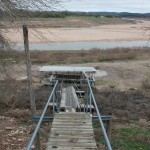
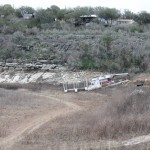
A beached boat dock on upper Lake Travis near Spicewood Beach sits dozens of feet from the water’s edge.
Clayton “Buddy” Howell, a Navy Veteran shares a modest home with his daughter in Spicewood Beach.
Boat docks that once floated on Lake Travis now sit on dry ground in Spicewood Beach.
Joe Barbera, the current president of the Spicewood Beach POA, sits in the community recreation center.
LCRA trucks parked outside a water pumping station in Spicewood Beach, where workers took measurements for the river authority engineers.
The Lakeside Beach community, along with Spicewood Beach, was put under stage 4 water restrictions Tuesday.
Ryan Rowney, LCRA manager of water operations, sits in his office near Red Bud Isle.
Andy Uhler and David Barer of KUT News contributed reporting to this article.
(Update: On Monday, January 30, the wells in Spicewood Beach began to fail, and water was trucked in. It was the first time during the current drought that a Texas town has run out of water. Read our latest reporting on the story here.)
The drought has come close to drying up several small Texas towns. Without exception they’ve all been spared, whether through rain, new water pipelines, or a mix of the two. But for the first time since the drought began, within a few days, one community’s well is expected to run dry.
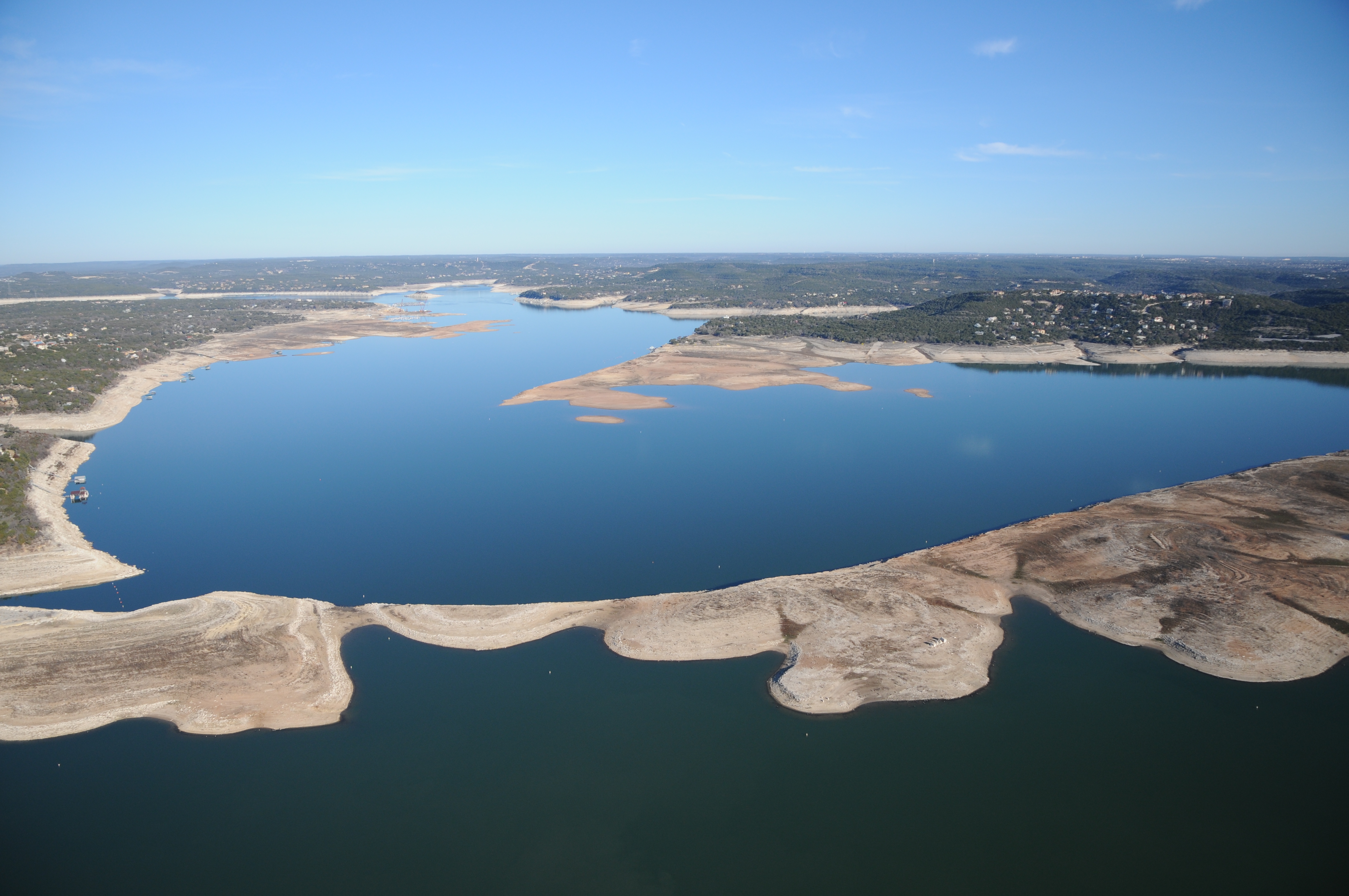
Spicewood Beach sits on a peninsula along the northern reaches of Lake Travis. Inflows into the lakes that provide for the region are at a historic low, while water demand is at an all-time high. The two main water sources for Central Texas, Lakes Buchanan and Travis, are currently only at a combined 37 percent of their full capacity.
There are 500 water meters in the Spicewood Beach area, serving an estimated 1,100 people. Water is drawn from wells managed by the Lower Colorado River Authority.
The irony of running out of water right next to a lake isn’t lost on locals like Joe Barbera, who is president of the Spicewood Beach Property Owner’s Association. “If you go down there, it’s nothing but sand,” he says. “If you actually walk down there, it’s unbelievable how far you have to go down to the creek bed just to see water.”
How Did This Happen?
Around here he’s known simply as “Buddy.” But his given name is Clayton Howell, an 85 year-old retired Navy vet who lives in a single-story home next to a golf course. Until about six months ago, you’d find him playing nine holes a day there. Now he’s more or less confined to his La-Z-Boy with a bad back problem. Over a late breakfast, he tells the story of how the local water wells came to be the property of the LCRA, and why they’re beginning to run dry. Continue Reading →
The drought has certainly lessened in recent month. The percentage of Texas in the most extreme, “exceptional” stage of drought is down from a whopping 86 percent in late September to 25 percent today. But there is still a long way to go. Continue Reading →
Photo by Flickr user Sharon Drummond/Creative Commons
Deregulation turns ten years old in Texas this year.
Anniversaries are horrible things to forget, so here’s one that you might have let slip by. This month marks ten years of de-regulation in the Texas electricity market.
But it hasn’t all been smooth sailing for rate payers since then, according to one new study.
A typical electric customer paid $3,000 in added costs over the last ten years because of deregulation, according to a history commissioned by the Texas Coalition for Affordable Power. The report estimates that Texans spent $11 billion cumulatively because of higher rates. Continue Reading →
A weed grows out of the dry cracked bed of O.C. Fisher Lake in July. The drought has taken a severe toll on Texas lakes and rivers.
Monday we told you about Spicewood Beach, a community in Burnet County that was going to run out of water within weeks. Today, despite several inches of rain in the forecast, an alert was sent out saying that moment may be just days away.
There are 500 water meters in the Spicewood Beach Regional Water System. Most of them are for homes, but at least one of them belongs to Spicewood Elementary School. Despite the fact that the golf course community sits right next to the Colorado River between Lakes Lyndon B Johnson and Travis, it gets all of its water from groundwater wells. And they are dangerously close to running dry.
The Lower Colorado River Authority (LCRA), which provides water to the community, released an alert today saying that overnight, well levels have dropped 1.3 feet, after dropping over a foot since last week. “With the overnight drop in water levels, LCRA estimates the well may remain functional for only a few more days,” the LCRA said in the alert. The community has been placed under Stage 4 water restrictions, which means only essential use of water is allowed, and no outdoor watering is permitted.
The field behind Robert Cervenka’s ranch in the small town of Riesel, Texas is scattered with historic equipment. There are horse-drawn plows and pickup trucks from bygone eras. Want to know what a 1954 John Deer tractor looks like? He’ll be happy to oblige. Cervenka’s been ranching since he was eight years old.
And now he’s eighty-one. “At my age I don’t want to buy any new tractors or anything,” he says, chuckling.
But not everything here is antique. A few years ago, much to his chagrin, Cervenka got a brand new coal-fired power plant as a neighbor, right next door to his ranch. The Sandy Creek Power Station was set to produce 925 megawatts of electricity for this energy hungry state, enough to power an estimated 900,000 homes. The chimney from the plant rises 360 feet in the air, higher than the Taj Mahal.
Cervenka opposed it, but in the end he watched from his field as it was built, and watched as plumes of steam and smoke first rose from it last fall. “They were what’s called cooking the boilers,” he recalls. “They were heating them up and making steam and trying to blow out all the pipes and tubing that may had welders slag or tools or anything in the pipes. And then one day, all of a sudden, it quit.”
It’s still not clear exactly what happened at the plant the day it quit on Oct. 17th last year. Continue Reading →
Trailers housing drill workers line a city park in Gonzales
Rancher Tim Pennell says you need only look out the window in DeWitt County to see what “fracking” has brought to the gently rolling terrain of South Texas.
“If you want to work, you come to DeWitt County and you can damn sure get a job,” said Pennell.
Fracking is helping create a gusher of jobs as evidenced by the the line of oil field workers at a barbecue stand that operates along the road next to Pennell’s house. A few hundred yards away, a drilling rig is running 24/7.
But all the trucks servicing the drilling rigs are ripping up the roads. And there is concern over how the fracking process is using enormous amounts of groundwater during a record drought. Continue Reading →
The extreme drought has lowered levels in Lake Travis, exposing formations not seen for some time.
It sounds strange to say it, but Spicewood Beach is running out of water.
The Lower Colorado River Authority (LCRA) released an advisory today to communities in the Spicewood Beach Regional Water System in Burnet County asking customers “to immediately cut back on all nonessential water use.”
Despite being adjacent to the Lower Colorado River, the wells serving the communities in the Spicewood Beach water system “are quickly approaching their minimum operating levels,” the advisory states. “At this time, based on the accelerated rate of drop in the well level, it is estimated that the wells have approximately two to three weeks of supply remaining.”
The LCRA is currently trucking in water to a storage tank in order to keep water flowing, and is looking at drilling new wells or possibly making existing wells deeper. Continue Reading →
Since then, things have turned around for Groesbeck. In late November, the town announced that they had literally bought a few more months of water by installing a three-mile pipeline further up the Navasota river, where the town’s water comes from. They even moved to Stage 2 water restrictions, which allows residents to water their lawns.
Last week the latest place to come dangerously close to running dry was Robert Lee, a West Texas town with a little over a thousand people about two hours east of Midland. Their sole source of water is the E.V. Spence Reservoir, which is currently only 0.44 percent full.
Today comes news that salvation has arrived, in the form of a “10-inch, light blue plastic pipe,” according to the Abilene Reporter-News: Continue Reading →
Burros marched, pipelines were delayed, and wells caught fire. In case you missed it, here are the five top posts from StateImpact Texas over the last week:
StateImpact seeks to inform and engage local communities with broadcast and online news focused on how state government decisions affect your lives. Learn More »