A contractor trucks in water to a storage tank in Spicewood Beach, Monday, January 30.
Another milestone in the ongoing drought was reached yesterday when Spicewood Beach, a small community of about 1,100 people outside of Austin, ran out of water. As trucks began rolling in to replenish the town’s water tank, questions inevitably arose. It’s still not clear how things ended up here (the agency that owns the system blames the drought; locals say the wells running dry is due to mismanagement), and it’s unknown how long it will take for a real solution to be found.
For answers on some of those questions we turned to Barney Austin, Director of Surface Water Resources Division at Intera, a water resources and environmental consulting firm out of Austin. He typically consults for water systems on how to best avoid situations like the one Spicewood Beach currently finds itself in.
He spoke recently with Andy Uhler of KUT News, who has been co-reporting on Spicewood Beach with StateImpact Texas.
Q: Who’s going to pay for the trucking in of water?
A: You know, I really don’t know. Someone’s going to have to pay for it, clearly. And someone is going to have to pay for the development of new water management strategies. Ultimately, the rate-payer will have to lift that burden.
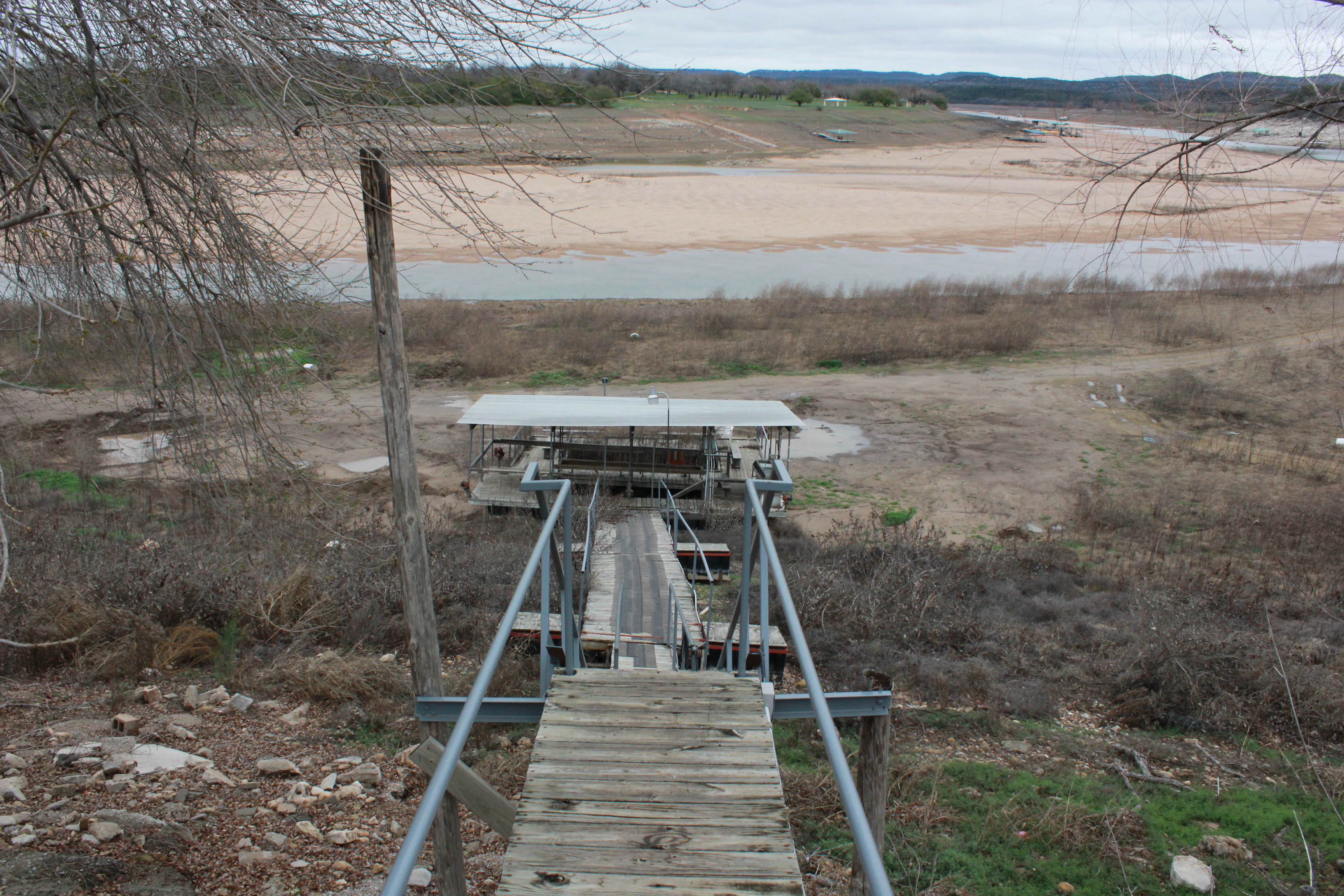
A beached boat dock on upper Lake Travis near Spicewood Beach sits dozens of feet from the water's edge.
Andy Uhler of KUT News contributed reporting to this article.
The community of Spicewood Beach isn’t the kind of place that goes looking for attention. There’s no “World’s Largest Pecan,” no grand entrance, no annual heritage festival. It’s just a place where people of modest means choose to settle in for retirement. But now it’s making headlines for a lamentable first: Spicewood Beach is the first Texas town to run dry during the current drought.
The problem is simple: there’s no more water. The wells serving the community of some 1,100 people have reached a level where they’re not reliable. So late Monday afternoon, a tanker truck pulled up to a water storage tank in Spicewood Beach and started pumping out 4,000 gallons of water that came from a fire hydrant some ten miles away.
The truck belongs to a water delivery service called H202U that the Lower Colorado River Authority (LCRA) has contracted for the time being. It is the first of many, as some three to four trucks are expected to pump out water for the town each day, which sits about 40 miles northwest of Austin.
Locals watched from their golf carts across the street as half a dozen cameras recorded the first opening of the first valve of the first tank. It was the opposite of a ribbon-cutting, more an official shrugging of the shoulders. “Just get water! Just get water!” resident Connie Heller exclaimed before the pumping began. “We don’t care where. Just. Get. Water.” Continue Reading →
After almost losing the entire season to drought, gulf oysters are back on the menu in Texas.
Texas Gulf oysters are back on the menu. In what could be the latest start ever for Texas oyster season, the bays of San Antonio and Espiritu Santu opened on midnight Thursday to oyster harvesting. Carol Huntsberger, who owns Quality Seafood Market in Central Austin with her husband, says the oysters should start showing up in markets within a week or two.
“Typically the oyster season opens in September,” says Huntsberger. “In the last couple years, due to the drought and red tide, you know, it was pushed back. Last year I think it didn’t open until November. So this is the latest I’ve ever seen it open.”
“It appears that, as of the end of last week, the Red Tide in Galveston Bay has officially dissipated, BUT this DOES NOT mean that waters are open, yet. Continue Reading →
A beached boat dock on upper Lake Travis near Spicewood Beach sits dozens of feet from the water's edge.
A Texas town came within days of running out of water, a mysterious accident at a coal power plant fell under investigation, and an oil boom in South Texas has locals grinning (when they’re not getting whiplash from potholes). In case you missed it, here’s our top five new stories from the last week:
What Happened at the Sandy Creek Power Plant? An accident at the plant means one thing for its operators, who might prefer that the information stays secret. But what does it mean for the state of Texas?
How Fracking is Changing the Face of South Texas: Drilling is creating a gusher of jobs in South Texas, but trucks are ripping up roads and large amounts of water are being used. A look at the ups and downs of the fracking boom.
Electric Deregulation Turns Ten in Texas: Anniversaries are horrible things to forget, so here’s one that you might have let slip by: This month marks ten years of deregulation in the Texas electricity market. But it hasn’t all been smooth sailing for rate payers since then.
In Midland, they try not to call it an oil boom because last time that happened in the 1980s, the economy went bust and stayed that way longer than anyone here wants to remember. But these days, things sure are boom-like.
K.C. Stallings, a landman, found that out when he moved last summer to Midland from Houston. He tried to buy a house.
“It’s the exact opposite as most of the country,” Stallings said.
How do you come back from a drought like this, especially one that’s still not over? While rains have eased conditions in parts of the state, there is still a very long way to go before we can say we’ve fully recovered from the worst single-year drought in Texas history.
Doris Steubing ranches cattle in Maxwell, Texas, about 30 miles south of Austin. Freelance videographer Jeff Heimsath visited her recently to see how the drought has affected her and other ranchers in the state. You can watch his video above, part of StateImpact Texas partner KUT’s “First Person” series.
But what about making the most of the water we already have?
Lyle Larson, Texas State Representative for San Antonio, has a plan that involves much more than a rain dance. Called the Emergency Water Act, the proposal contains a set of guidelines for state-wide desalination, cloud-seeding, and aquifer storage. Modeled after tactics adopted in the past by equally rain-strapped governments in Australia, India, and Argentina, the plan aims to offset the drought by immediately revamping the state’s water infrastructure.
I sat down recently to ask Rep. Larson about the inspiration behind the Emergency Water Act and his vision for an economically-developed, technologically-innovative, and above all, wetter, Texas.
Q: Could you explain what this plan is about and what motivated it?
A: The Emergency Water Plan involved looking at what Texas can do if we experience the drought of 2011 in 2012. All the climatologists are indicating that 2012 will be as dry or dryer than 2011. Continue Reading →
Photo courtesy of Pearsall Volunteer Fire Department
An explosion and fire rocked an oil fracking site in South Texas last week. Three were injured.
What happened last week at a disposal well outside of Pearsall, Texas? An explosion rocked the site early Thursday evening – about 50 miles southwest of San Antonio in the Eagle Ford Shale – blowing the lid off a storage tank and injuring three. A fire burned for over an hour as the all-volunteer Pearsall Fire Department (and three other nearby departments) battled the flames with twelve trucks and 33 firefighters.
The explosion likely started when workers there were welding near storage tanks, a decision that has many in the industry scratching their heads. The accident is now under federal investigation.
But there’s still much we don’t know.
Who Owns the Well?
First, we don’t know who owns the disposal well, which is used for taking wastewater from fracking and drilling and injecting it deep underground. That water contains highly flammable oil and natural gas.
While the well is operated by a company called High Roller Wells (which doesn’t appear to have a website), it’s unclear who actually owns it. When asked, the Railroad Commission would only say that it does not “have information on investors or owners of oil and gas facilities.”
A call to the only available number online for High Roller Wells leads to the office of Terry Bailey, listed as a manager of the company. A woman who answered the phone at his office declined to answer any questions about the company or the accident. She directed all inquiries to the Occupational Safety and Health Administration (OSHA), then abruptly hung up. Continue Reading →
After almost losing the entire season to drought, gulf oysters are back on the menu in Texas.
Some good news today for fans of Texas Gulf oysters, which have been off the menu this season due to the drought. Those heavy rains we’ve been having in parts of Texas have alleviated the red tide and oyster harvesting will begin again at midnight tonight in the Espiritu Santo and San Antonio Bays northeast of Corpus Christi.
But hurry, because those bivalves may not be open to harvesting for long, according to the Texas Parks and Wildlife department:
A very small portion of Texas waters will open to shellfish harvesting tomorrow. At 12:01 am on Friday, January 27, 2012 Espiritu Santo and the conditionally approved area of San Antonio Bay will open to commercial oyster harvest. Due to the recent rains in the Austin area the conditional area of San Antonio Bay might not remain open for long. The Texas Department of State Health Services will continue to monitor the red tide and will open areas to harvesting when it is safe to do so.
The return of gulf oysters in Texas is welcome news to gourmands and fisherman alike. In December, USA Today reported that “a monstrous bloom of toxic algae looming across the Texas coast has shut down oyster season.” Because of the drought, “the algae could cause nausea, vomiting and diarrhea in humans and is harmful to fish but not fatal to people.”
“Typically the oyster season opens in September,” says Carol Huntsberger, who owns Quality Seafood Market in Central Austin with her husband. “In the last couple years, due to the drought and red tide, you know, it was pushed back. Last year I think it didn’t open until November. So this is the latest I’ve ever seen it open.”
With some good rain, enough of that algae (the aforementioned red tide) has abated, and oysters are safe to eat again for the time being.
The department says you can call the Department of Health Services for updates on on the opening and closing of oyster harvest areas. The number? 1-800-685-0361.
The carcass of a cow that became mired in the mud in a dry stock tank in Knox County, Texas during the summer drought
At a hearing this week on funding for Texas state parks, several people voiced concern that as drought and extreme temperatures continue, funding will evaporate for the Texas Parks and Wildlife Department. Erika Aguilar of KUT News, StateImpact Texas’ local radio partner, has more:
“If we are going to keep these special treasures for all Texans to use and enjoy, we need to raise $4.6 million,” Texas Parks and Wildlife Executive Director Carter Smith told lawmakers this week. Last month, the agency launched a public fundraising campaign to fill a significant department deficit.
“The consequences of us not being able to realize those revenue targets are real,” Smith said. “They’re tangible. And we absolutely may be looking, particularly at 2013, at further cut backs and that could include things as drastic as closures and looking at transfers again.”
In December, the Parks and Wildlife Department asked for millions of dollars in donations to offset the loss of visitors due to the extreme drought and excessive heat of last summer. Since then, they’ve raised more than $460,000 from donations, some of which have come from a new Texas Department of Motor Vehicles opt-in donation program, and an additional $500,000 from the Texas Parks and Wildlife Foundation. That still leaves a funding gap of approximately $3.5 million.
StateImpact seeks to inform and engage local communities with broadcast and online news focused on how state government decisions affect your lives. Learn More »