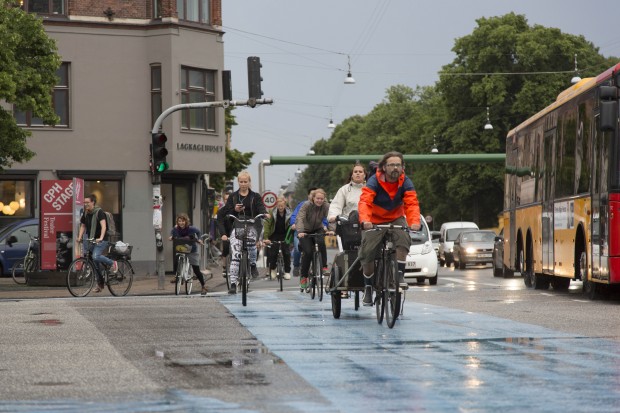
Cyclist commuting in the Copenhagen neighborhood of Norrebro.
Rain or shine, in the light of summer or the early afternoon darkness of winter, under heavy sleet, unrelenting winds or drifts of snow, people in Copenhagen just bike. They bike in fur coats, they bike in suits and ties. They bike old, they bike young. They wheel their kids around on a cargo bike with a wooden box carrying the children up front, taking them to and from school; this is Copenhagen’s take on a minivan. People just bike, and after arriving in the city myself, I soon found out why: it’s usually the fastest way to get around. So I rented a bike, too.
Today, 60 percent of people in the city’s core commute by bike. In the greater Copenhagen area, over 40 percent do. “We see the same numbers [of commuting by bike] all year round,” says Copenhagen Environmental and Technical Affairs Mayor Morten Kabell.
“It’s not something that’s in Copenhagen’s genes, or that we’re weirder or stranger than any other people on earth,” Kabell says. “Every city can do this.”
Copenhagen has had enormous success getting people out of their cars and onto bikes, public transit and their own two feet. But this development has less to do with Danes wanting to save the planet, and much more to do with saving their own sanity.
An offshore wind farm is seen near the Danish island of Samso
Three turbines sit just offshore at the Avedore Holm wind energy test site near Copenhagen, Denmark. The turbines are operated by DONG Energy.
The Royal Danish Yacht sails past Denmark’s biggest offshore wind power farm near the island of Anholt
One of the turbines at the DONG Energy Avedore Holm test facility, with a coal power plant that is converting to biomass energy in the background.
Standing on the shore of the Baltic sea a few miles outside of Copenhagen, Denmark, the view’s about what you’d expect. Rocky shore, grey horizon, a boat here or there. But this shore is special. Look up, and you’ll see — and hear — three giant offshore wind turbines cutting through the air. Each stands 500 feet tall, with three blades (each close to 200 feet long), spinning non-stop.
“The blades look quite thin, but don’t be cheated,” says Rune Birk Nielsen, with DONG Energy, which runs the turbines. “They each weigh about twenty tons. They are massive.” Each turbine has a capacity of 3.6 megawatts, or enough to power 3,000 Danish homes.
Nielsen guides me through the small offshore wind park — well, technically it’s offshore. The turbines aren’t actually too far from land — each is connected to the shore by a short footbridge about ten yards long.
“For us, it’s kind of a demonstration park,” Nielsen says, “where we are able to test all sorts of things.” With turbines close to shore, they’re easier to fiddle with or repair. The company can safely train their workers without sending them far out to sea, where most of the country’s offshore turbines are.
Denmark is booming when it comes to wind energy. To understand how and why, you have to go back a few decades.Continue Reading →
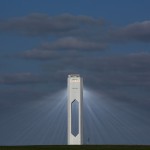
A tower at Abengoa solar plant at “Solucar” solar park
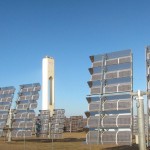
Photovoltaic solar panels (foreground) with the PS10 concentrated solar tower in the background at the Abengoa Solucar complex outside of Sevilla, Spain.
Towers at Abengoa solar plant at “Solucar” solar park are seen in Sanlucar la Mayor, near the Andalusian capital of Seville
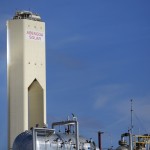
A view of the tower with the pressurized steam tank that allows for the production of solar energy after the sun goes down.
About an hour’s drive outside of Sevilla, Spain’s old city, past grazing black-footed pigs and olive orchards, sits the Abengoa Solucar complex, and it’s truly a sight: Imagine cresting a hill and then all of the sudden seeing several large towers, over 500 feet high, with hundreds of beams of light striking them — solar rays from an army of mirrors arrayed in a circle on the ground below. They’re called heliostats.
“These heliostats are reflecting solar radiation toward the receiver that we have at the top of the tower,” says Valerio Fernandez, manager of the complex. The rays from the heliostats strike the top of the towers, like hundreds of magnifying glasses focused on one point in mid-air. The top of the tower shines so bright, you can’t look at it without sunglasses.
Once the solar radiation gets to the top of the tower, it’s used to heat up water. And it’s at this step that innovation turns to a technology that’s been around for well over a century: turbine technology. The solar radiation creates heat, that heats up water, which creates steam, which moves the tubines, which generates energy.
In the summer, there’s enough sun for 12, sometimes 13 hours of energy that can power up to 100,000 homes. And the towers can keep providing solar energy for several hours after the sun goes down, by heating and pressurizing steam for later.
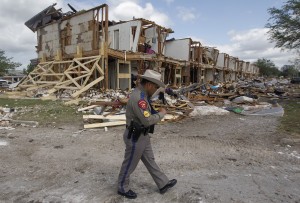
Texas Department of Public Safety Sergeant Jason Reyes walks past the site of an apartment complex destroyed by the deadly fertilizer plant explosion in West.
Accidents at facilities that handle dangerous chemicals in Texas were at the center of a hearing in Washington.
Accidents at facilities that handle dangerous chemicals in Texas were at the center of a hearing in Washington. Some senators are pressing for quick action to reduce the risk of deadly chemical leaks and explosions. They wanted to know if there’s been any progress since President Obama issued an executive order to improve chemical safety, an order that followed the fertilizer explosion in the city of West.
Sen. Barbara Boxer, D-California, said she was disappointed that “little progress” had been made.
“And we know there are problems because they keep happening. And people are dying, and people are going to the hospital,” said Boxer.
Other members of the Senate committee used a recent example of yet another deadly chemical accident. Continue Reading →
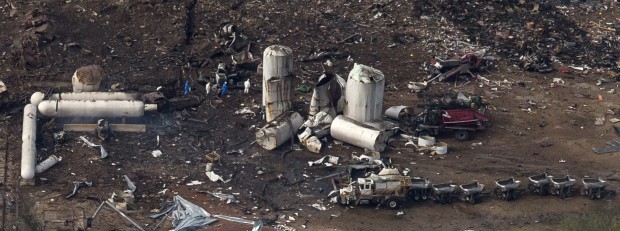
An aerial view shows investigators walking through the aftermath of a massive explosion at a fertilizer plant in the town of West, near Waco, Texas April 18, 2013.
The U.S. Chemical Safety Board says the industry it oversees is experiencing a safety crisis. The board investigates industrial accidents. It says recent deadly explosions and chemical leaks in Texas make a strong case for action.
It’s been a tragic couple of years for some people who work around dangerous chemicals in Texas.
“Fertilizer plant on fire, there was an explosion; we have several buildings that have been destroyed,” said a dispatcher to first responders headed to a fertilizer business in the city of West. It was on the evening of April 17, 2013. Ten volunteer firefighters would be among the 15 people killed by the explosion.
Then last month in La Porte, workers at a DuPont pesticides plant called for help. From a 911 call from the plant: “We have five people unaccounted for; we have had a chemical release.”
Four of those workers would later be found dead, apparently overcome by chemical fumes. Continue Reading →
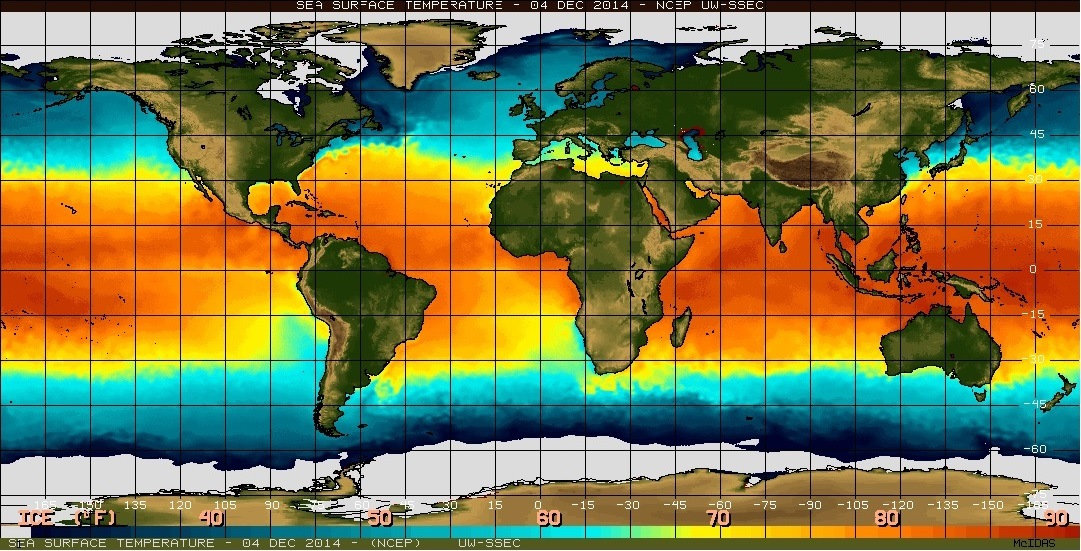
El Nino heats up parts of the ocean, and begins a pattern that can bring rain to North America.
The Climate Prediction Center is out with an update on El Nino. The weather pattern is often associated with heavy rains, so watching for its arrival has become something of an obsession in drought-stricken parts of the country like Texas.
In October, the center was giving odds that the pattern would form before the end of the year. That hasn’t happened yet. The reason is that warmer than average temperatures in parts of the Pacific Ocean have not heated up atmospheric temperatures as they’re expected to do.
On Thursday, the weather service said El Nino was still likely to appear, but might come later than previously thought. Researchers now give a 65 percent chance of El Nino forming some time this winter, but not necessarily by the end of the year.
Forecasters are also predicting that the El Nino will not have a particularly strong impact on the weather.
StateImpact seeks to inform and engage local communities with broadcast and online news focused on how state government decisions affect your lives. Learn More »