Lavaca Bay in Calhoun County is one proposed site for an LNG Terminal.
If you think the price of natural gas is too low and think the solution is to increase demand by exporting the stuff, who will benefit? Continue Reading →
One source of water in the Texas State Water Plan involves "seeding" clouds to create more rain.
The Texas legislature got underway this week, and one bit of spending that many seem to agree on, regardless of their political stripes, is water. Several proposals call for funding the 2012 State Water Plan, a bottom-up approach to Texas’ water needs. It relies on regional districts to come up with a wish list of projects that will provide the growing state with enough water for the next 50 years.
The water plan calls for a variety of techniques to harness more water in the coming decades, from new reservoirs to conservation, and some of the ideas are more offbeat than others. We’ve culled a handful of the more novel and obscure methods outlined in the plan.
Weather Modification: Cloud seeding involves blasting silver iodide, a chemical with similar composition to ice, into a thunderstorm, thereby increasing the cloud’s ability to produce rain. It may sound like science fiction, but it’s already being done around the world, particularly in China (and even here in Texas). Starting in 2020, the water plan earmarks about 15,000 acre-feet (or 4,8 billion gallons) of water to be procured each year through weather modification or cloud seeding. Most cloud seeding taking place in Texas today is done East of the Interstate-35 corridor. There’s just one (fairly significant) drawback: if there aren’t any rain clouds to seed, like much of the summer of 2011, there’s not much seeding can accomplish. Continue Reading →
Tom Ellis has been making mandolins in Austin since the 1970s. He says the restrictions on importing and exporting some rare tone woods have had a chilling effect on small traditional manufacturers.
Mandolins, guitars and banjos line the walls of the Fiddlers Green Music Shop in Austin, Texas. Every instrument has its own unique sound, something that depends on craftsmanship and musicianship and something else: wood.
“This is a Dreadnought. This would be in the style of a Martin, this has an Adirondack spruce top. And then Indian Rosewood back and sides. It’s all solid wood,” says employee Ben Hodges, as he tours the shop floor.
Each year, thousands of trees are harvested for the tonal properties of their wood, some of them so rare that they’re in danger of going extinct. But the law, created to help save rare species of trees, has had an unexpected effect on the musical industry. Ever since the U.S. government put endangered woods on its list of items restricted for import, some guitar makers, sellers, and even musicians have worried that they could be breaking the law simply by owning or trading in wooden instruments. Continue Reading →
Photo Illustration by Christof Koepsel/Getty Images
The small city of Brownwood, Texas, wants to build a water plant that will treat sewage and return it to the city's drinking supplies. But locals are having a hard time getting used to the idea.
The small city of Brownwood, Texas could soon have something in common with the African nation of Namibia: a wastewater treatment facility that cleans wastewater (including the stuff from the bathroom) and returns it directly to city water pipes, where it becomes drinking water.
The Texas Commission on Environmental Quality approved construction of the wastewater facility, with conditions, in late December, Brownwood City Manager Bobby Rountree announced at a City Council meeting Tuesday. City officials don’t know when they will begin construction.
“Some people are extremely supportive, some are not,” Rountree tells StateImpact Texas. “It’s one of those issues: Unless you know all the facts, it’s a difficult issue to get concurrence on.”
Brownwood, population 19,000, has been gripped hard by the ongoing drought. Lake Brownwood, the town’s sole reservoir, is at about 50 percent capacity and dry weather patterns don’t seem to be changing much, Rountree says.
“We’ve been at stage-three water restrictions for 2 years. We don’t want to stay on that forever,” Rountree said. Continue Reading →
State Rep. Allan Ritter has introduced two new bills that would take cash from the Rainy Day Fund to capitalize the State Water Plan.
A state representative filed legislation today to start funding new water projects in Texas, as the state continues to struggle with water supplies and drought. In two House Bills, State Rep. Allan Ritter (R-Nederland), Chairman of the House Natural Resources Committee, advocates taking $2 billion from the Rainy Day Fund to start “a new, dedicated revolving fund” to finance projects in the State Water Plan, according to a statement from Ritter’s office.
“It is vital for the future of Texas that a dedicated source of revenue be established for funding the State Water Plan,” Ritter said in a statement. “Our economy depends on it, our communities depend on it, and ultimately, our daily lives depend on it.”
That’s a whole billion more than previous proposals, and Ritter maintains that it would be enough to fund all of the projects needed today from the Water Plan. (The overall plan calls for $53 billion in projects over the next fifty years, with about half of that coming from the state. The lion’s share of money is needed for municipal water projects.) Continue Reading →
Extreme temperatures in 2012 brought plenty of extreme weather to the country.
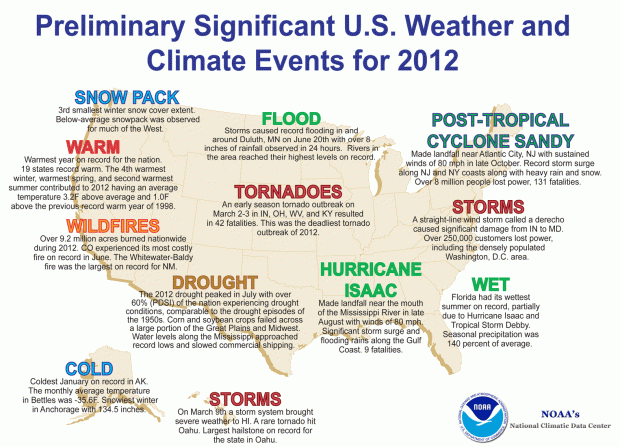
As you’ve probably heard by now, the numbers are in: 2012 was the warmest year in recorded history for Texas (technically tied with 1921, due to rounding) and the country as a whole. New data from the National Oceanic and Atmospheric Administration (NOAA) show that 2012 was a full 3.2 degrees Fahrenheit above average, and a full degree hotter than the previous record year, 1998.
Smell climate change? You’re not wrong. The record warmth is part of an established trend linked to growing emissions of heat-trapping gases. “Climate change is a fairly large part of it,” State Climatologist John Nielsen-Gammon says. “There’s some contribution from La Niña, which tends to make for warmer temperatures, especially in the winter time. But we’ve seen temperatures statewide go up about a degree, a degree-and-a-half, Fahrenheit since the 1970s.” While 2011 had a record hot summer, overall temperatures were warmer this past year. Continue Reading →
A Cabot Oil and Gas natural gas drill is viewed at a hydraulic fracturing site on January 17, 2012 in Springville, Pennsylvania. A domestic drilling boom has left the U.S. flush with natural gas, which some want to start selling abroad.
A new report by energy market analysts at Deloitte’s Center for Energy Solutions downplays the risk that exporting natural gas will cause prices to go up for consumers in the United States.
“This shows why the government doesn’t need to put a lid on projects. This says you don’t need to artificially constrain this,” said Deloitte’s Peter Robertson at a media briefing in Houston.
With fracking producing unexpected quantities of natural gas in Texas and other energy states, there are proposals to build export terminals where the natural gas would be converted to liquid (liquified natural gas or LNG) and loaded on to tankers. One facility that has won government permission to export LNG is in Cameron Parish, Louisiana and is owned by Cheniere Energy. Another making its way through the permit process is Excelerate Energy’s project in Port Lavaca, Texas according to a news release from the company.
Natural gas sells in the U.S. for about $3.30 per thousand cubic feet. Even though the liquifying process and shipping would add roughly $6 to that cost, it could still make U.S. LNG competitive in Europe and Asia (natural gas in Japan sells for about $15). Continue Reading →
In a unanimous vote today, the Board of Directors at the Lower Colorado River Authority (LCRA) approved an emergency plan that could cut off water for most rice farmers downstream in order to protect supplies for the City of Austin. The plan is identical to the one that last year resulted in rice farmers being cut off for the first time in history.
The Highland Lakes of Buchanan and Travis, vital reservoirs for Central Texas, have suffered from record low inflows in recent years, beginning in 2006. They’re currently only 41 percent full. If they don’t rise to the level of 42 percent full by midnight March 1, water will not go downstream to most rice farmers this year.
Ronald Gertson, a rice farmer in Wharton County, testified that another year without water could be catastrophic for rice farmers.
A massive swatch of rain is coming to Texas. But you may not need that umbrella for long.
Soaking rains will hit Central Texas today and tomorrow, washing garbage, dirt and leaves down the drains. Flash flood and heavy rain warnings have been issed for a wide swath of the state, from Houston to Paris. But the drought will remain.
We are several years into a dry cycle and climate forecasters predict that will remain true for at least the next few months — despite today’s potential deluge. It’s going to take much more than a couple days of good rain to bust our current drought, according to weather watchers.
“We are hoping that a lot of this rain will soak into the ground and help with the aquifers. Hopefully some of it will actually run off into the rivers and reservoirs.” says Patrick McDonald, National Weather Service spokesperson.
A Texas flag tattered by Hurricane Ike flies over a home September 13, 2008 in Texas City, Texas. Climate science says that stronger hurricanes will result from global warming, with Texas at risk.
As any climate scientist will tell you, the world is changing. More greenhouse gases mean a warmer and warmer planet. Texas just ended what could be its warmest year in history, with an established trend of warming over the last few decades. So what will climate change mean for Texas?
“One thing we know just from basic theory is that as the climate warms, and as you put more greenhouse gas in the atmosphere, the intensity of hurricanes should go up,” MIT Professor of Atmospheric Science Kerry Emanuel says. Emanuel’s work looks at how warming affects hurricanes, which have a long history of bringing destruction to Texas. His work has found a very high correlation between hurricane power and the temperature of the tropical oceans where hurricanes form. That level of energy actually dropped from the 1950s to the 1980s, then began going up quite rapidly. It’s more than doubled since then, Emmanuel notes, following the sea surface temperature.
“From the modeling studies that we’ve done, we expect to see an increase in hurricane risk in Texas,” Emmanuel says. That doesn’t necessarily mean more storms, but it does mean a larger number of the stronger ones. And bigger storm surges will have greater impact because of rising sea levels across the entire Texas coast. Continue Reading →
About StateImpact
StateImpact seeks to inform and engage local communities with broadcast and online news focused on how state government decisions affect your lives. Learn More »