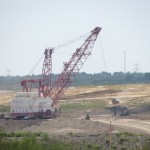
Giant shovels carve away acres of soil and rock, digging dozens of feet down to reach seams of lignite coal. This is the Big Brown Mine in Freestone County where so far some 14,000 acres have been excavated.
Big Brown was one of the first mines opened in East Texas in the 1970’s to fuel power plants.
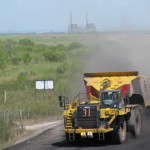
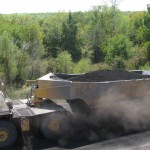
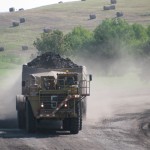
Coal haulers run 24/7/365, bringing tons of Texas lignite coal to the Big Brown Power Plant, owned by Luminant. The mine employs 250 people, the plant 150. Luminant said last year that it would have to shut down the mine and lay off workers if new pollution rules affecting coal-burning power plants were enforced.
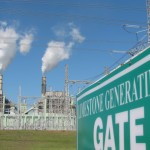
The EPA says older plants like Big Brown must cut their emissions of sulfur dioxide and other pollutants and that doing so would save hundreds of lives in Texas. But Luminant argued it didn’t have enough time to upgrade the plant with pollution control equipment. Last month, Texas won a ruling blocking the EPA from enforcing the “Cross-State Air Pollution Rule”. Luminant now says it will keep mining here. However, it will shutdown two other generating units for the winter at another plant in Titus County. Like Big Brown, that plant was built in the 1970’s.
Surface mining, also called strip mining, involves massive excavation, creating canyons where meadows once were. Federal and state laws require “reclamation” to replace and recontour the land.
For the most part, Texas lignite coal is used only to fuel power plants located nearby. Because it burns with less intensity, it has less value than compared to higher quality coals from other states including Wyoming. And since more has to be burned, it produces more pollution. Power plants use a mix of out-of-state coal and Texas lignite in order to meet clean air rules.
Located in Limestone and Leon Counties in East Texas, the Limestone power plant is owned by NRG. It was opened in the 1980’s.
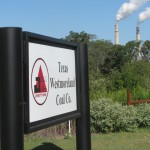
The Limestone power plant is fueled by the Jewett Coal Mine nearby which is owned by Colorado-based Westmoreland Coal Company.
Gary Melcher with NRG manages the Limestone plant. He said the plant’s “scrubbers” remove enough of sulfur that had the new, stricter EPA rules taken effect, “We would have been able to meet that and continued operating the plant.”
According to the city of Fairfield in Freestone County, coal mines and power plants are three out of the area’s four biggest employers (number two is a state prison).
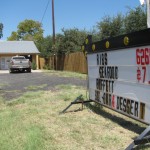
Anthony’s Restaurant in Jewett draws a lunch crowd from the mine and power plant.
If coal becomes less competitive compared to natural gas or even wind and production drops or stops, the Fairfield school district could lose millions in taxes it currently receives from the Big Brown mine.
There are 15 coal mines in East and Central Texas, five in South Texas.
In East Texas, where unemployment rates in some counties are among the highest in the state, coal mining ranks as one of the biggest employers.
In the war between Austin and Washington over the U.S. Environmental Protection Agency’s efforts to put stricter limits on air pollution, some people in communties like Fairfield and Jewett worry what will happen if coal production drops…or stops.
Cotton fields in bloom this year in Wharton County in Southeast Texas.
While the major metropolitan areas of the state have come back quite a ways from last year’s record drought, the same isn’t true for many farmers and ranchers in the rural parts of Texas. The latest drought monitor map shows that West Texas and the panhandle are still suffering, with much of the region in drought conditions ranging from ‘severe’ to ‘exceptional.’
Rangeland and pastures in the Panhandle are in “very poor to poor condition,” according to the latest crop and weather report from the Texas A&M Agrilife Extension Service. It’s not all bad news. This year’s cotton crop is doing well in parts of the state like the Gulf Coast, and worse in others, like the Coastal Bend area. Other areas of the state are seeing good yields with alfafa. Winter wheat is being planted. Suffice to say, Texas’ nearly $8 billion in agricultural losses last year won’t be repeated in 2012.
One of the main culprits of last year’s devastating drought was the La Nina weather pattern. That’s when warmer-than-normal surface ocean temperatures cause higher temperatures and less precipitation in Texas. After back-to-back La Nina’s, Texas was literally left in the dust last year.
But the counterpart to La Nina, El Nino, is on its way. And typically that means cooler temperatures and higher precipitation. Continue Reading →
Join us tonight for a discussion about wildfires in Texas.
We’re hoping you can join us tonight at our new studios for a panel and discussion of wildfires in Texas. We’ll be listening to and talking about our recent documentary with KUT News, Forged in Flames: An Oral History of the Labor Day Wildfires.
Our own reporter Mose Buchele will be on a panel with KUT News Director Emily Donahue and Erin Purdy of The University of Texas at Austin’s Briscoe Center for American History. You’ll get to participate in a discussion about wildfires in Texas and learn more about the Forged in Flames documentary and oral history project.
When: Monday, Sept. 10, 2012, 6–7 p.m.
Where: The KUT Public Media Studios, 300 W. Dean Keeton St. (northeast corner of Guadalupe and Dean Keeton streets), Austin
Hundreds of people turned out at a recent public hearing in Round Rock to discuss the listing of four Central Texas Salamanders as Endangered Species.
When it comes to the battle over what qualifies as an endangered species, the script practically writes itself. The government proposes adding new animals to the list; business interests and land owners fight the proposal, fearing the financial impact; environmentalists rally around the critters, arguing for sustainability.
These days, it’s Central Texas’ turn. The creatures in question? Four tiny salamanders.
On a recent evening in the town of Round Rock in Williamson County, hundreds of people packed into a nondescript convention center just off the interstate to talk amphibians. Round Rock is a suburban Austin community, the second-fastest growing metro region in the country, and most of the people at the public hearing opposed listing the creatures.
A boat overturned by Hurricane Isaac floats in lower Plaquemines Parish on September 2, 2012 in Buras, Louisiana.
Tar balls and oil from the BP spill in 2010 are washing up again on the shores of Louisiana. Hurricane Issac, which stirred up intense winds and dumped over a foot of rain in some parts of the state, has also disturbed some deposits that hadn’t been cleaned up after spill.
During the last week, oil from that spill has started making a second appearance, causing the state of Louisiana to close a 12-mile section of coastline southeast of New Orleans. Tests have confirmed that the oil washing ashore is indeed the same oil that leaked during the BP oil spill.
The Times-Picayunne has more on what’s behind the resurgence: Continue Reading →
Low humidity and high winds could lead to "critical" fire conditions this weekend.
If you live in Central Texas, particularly in exurbs abutting woodlands and greenbelts, you’ll want to keep a keen eye out this weekend for wildfires.
The National Weather Service is forecasting “gust” winds beginning tomorrow morning and increasing in the afternoon, leading to possible “critical fire weather conditions” for a few hours Saturday afternoon. The service says humidity will drop while winds will pick up, gusting up to 35 miles per hour, creating “potentially volatile” conditions. (Update: the service has now issued a red flag warning.)
The good news is the danger will be relatively brief. Come Saturday evening, the forecasters say that the winds will die down and humidity will recover. While there will be “elevated” fire conditions Sunday and Monday during the afternoons and evening, they aren’t expected to be as severe as Saturday.
Here’s a full list of the counties affected, and a map of burn bans in the area: Continue Reading →
The Gwin family walks through the aftermath of the Labor Day fires.
If you’re in Austin Monday evening, please join us at our new studios for a special listening session and panel discussion of Forged in Flames: An Oral History of the Labor Day Wildfires, a special project on the 2011 fires by KUT News and StateImpact Texas.
We’ll be listening to segments of the Forged in Flames documentary on the fires, with a panel discussion and Q&A with KUT News Director Emily Donahue, StateImpact Texas reporter Mose Buchele and Erin Purdy of The University of Texas at Austin’s Briscoe Center for American History. You’ll get to hear how the documentary and oral history project were produced and ask your questions about the fires and the project.
When: Monday, Sept. 10, 2012, 6-7 p.m.
Where: The KUT Public Media Studios, 300 W. Dean Keeton St. (northeast corner of Guadalupe and Dean Keeton streets)
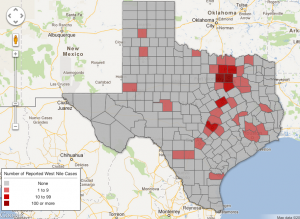
At least forty people have died from the West Nile virus in Texas. The neuroinvasive strain of the virus has been confirmed in nearly 500 cases in the state, more than any other year before. Naturally this brings up a lot of questions: Is it always fatal? Where in Texas is it a problem? How did it get here in the first place?
Where West Nile Has Hit Texas
Let’s start with where West Nile is in the state. As you can see in the map to the right by Texas Tribune, the virus is mostly in North and Central Texas. (Click here for an interactive version.) But new numbers reported by KUT News today show that the problem is becoming worse in Central Texas — mostly the area around Austin — while it’s improving in Dallas County, which has likely already hit its peak number of cases.
Here’s how Labor Day weekend 2011 started for Matt Lara, a musician living in Spicewood, some forty miles outside of Austin.
“I was going to town to meet some friends for a beer – just a good Sunday, a day off – and walked outside, and the light in the yard, the sunlight, was just really strange; it was just too – there was something too orange about it, like all the blue had been cut out of it, and I thought, maybe I’ve been staring at a computer screen too long or something, my eyes are messed up.”
When Jed Clampett was “shootin’ at some food and up through the ground came a bubblin’ crude,” TV viewers might have thought it was funny. But as it turns out, some of crude oil pipelines in use today in the United States were built about the same time The Beverly Hillbillieshit the air on CBS in 1962. And when the crude comes bubblin’ up from pipelines now? It’s not so funny.
“In 2010, several systems that remain in service today already exceeded 50 years in age, with no major plans to retire existing infrastructure based on … age alone,” said a panel of pipeline executives in “Crude Oil Infrastructure“, a report to the National Petroleum Council. The panel warned that while age doesn’t always matter, “integrity issues,” including corrosion and failure of welded seams, “will become more common due to a number of age-related issues.”
StateImpact seeks to inform and engage local communities with broadcast and online news focused on how state government decisions affect your lives. Learn More »