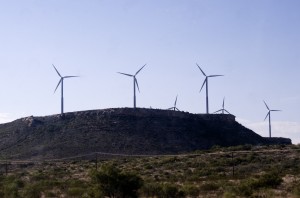
Wind turbines provide a sustainable source of energy in that they don't emit carbon dioxide or require water.
Texas has lots of ambition. Some Texans strive to open the world’s largest convenience store. But of more interest to us is another goal: the state wants to have10,000 megawatts of the power in its portfolio come from renewable energy by 2025. And according a new report by the Electric Reliability Council of Texas (ERCOT), the state continues to well exceed that.
While the state first achieved the goal, known as the renewable portfolio standard, in 2009, green energy in the grid continues to grow. Thirteen percent more power on the state’s grid came from renewables in 2011 than it did in 2010. In all, renewables provided enough power for about 31,000 Texas homes last year. (The state grid supplies about 85 percent of the juice in Texas.)
The big winners? Solar and biomass. Solar energy production jumped up 153 percent from 2010 to 2011, while biomass went up 40 percent. In the middle? Wind, which went up fifteen percent. But it still accounts for the majority of renewable energy generation in Texas, which has the most wind energy in the nation (and is the fifth-highest producer of wind energy in the world). Wind provided 30.8 million of the 31.7 million megawatt hours of renewable energy in Texas last year. Fossil fuels still produced about 80 percent of energy in Texas last year.
The big loser? Hydro-electric generation, which went down a whopping 56 percent in 2011. ERCOT says that “due to the ongoing drought in most of the state, generation of hydroelectric power decreased by more than half.”
The Rio Grande River in Eagle Pass at sunset, looking west toward the International Bridge to Piedras Negras, Mexico.
Our friends at the Texas Tribunereport today that the Kickapoo Traditional Tribe of Texas has dropped its opposition to a coal mining project along the Texas-Mexico border.
While some people in Maverick County welcome the jobs that could bring, many, including city and county governments, are vehemently opposed to it. Several locals have formed the Maverick County Environmental and Public Health Association to fight the mine.
“We’re sending coal over there that the United States will not use because it’s so low quality, and then we’re sending it to Mexico so they can burn it over there, and it pollutes us over there and it pollutes us over here when it goes through town every day,” Association member Martha Baxter told StateImpact Texas earlier this year.
Photo courtesy of Center for Plant Science Innovation/UNL
Professor Michael Fromm says plants remember stress, and that can help them weather droughts.
Do you remember the last time you were stressed out? You’re not alone. According to a new study, plants are feeling it, too. The report says that plants have a sort of “stress memory,” and it could help them survive drought.
Researchers at the University of Nebraska-Lincoln have recently confirmed what gardeners have long claimed: after surviving the stress of a drought, plants are better able to withstand future droughts—in the short-term, at least.
The team worked with Arabidopsis, a member of the mustard family, to compare stressed plants (plants that had been previously dehydrated, like in a drought) to non-stressed plants (plants that had never been dehydrated) in a simulated drought situation. The pre-stressed mustard plants consistently rebounded far more quickly than the non-stressed mustard plants.
Fromm and his team repeated this study with two other species, and the results were the same: plants are smart. Continue Reading →
Piles of petroleum coke sit uncovered on the ship canal in Corpus Christi.
On the northern end of the Corpus Christi ship canal, in the shadow of six major oil refineries, sit several large black mounds. They’re piles of petroleum coke, the carbon solids left over from the process of refining. Across the canal there are several hundred homes where locals live, known as Refinery Row. And until this week, the Las Brisas Energy Center was close to building a power plant that would burn that coke for energy.
In a letter Monday, Judge Stephen Yelenosky of the 345th Judicial District Civil Court said he intends to reverse the potential plant’s air permit. The Las Brisas power plant was given the permit in January 2011 by the Texas Commission on Environmental Quality (TCEQ). But in his announcement, the judge found several things wrong with how the TCEQ processed the permit, and said it failed to meet the requirements of the Clean Air Act, among other issues.
“The letter basically says that he found a number of legal errors in the TCEQ’s decision to grant the permit,” says attorney Erin Fonken with the Environmental Integrity Project, which was one of the parties that brought the case to court. “These aren’t just little things where they didn’t check a box. There are substantial analyses that [the TCEQ] failed to have the applicant do at all. These are some pretty serious errors.”
Without the air permit, which the company called “an important project milestone” when it was issued, things get set back significantly. Continue Reading →
Photographer and author Thomas Bachand put the Keystone Mapping Project together. While he only has data for four states, he’s still hoping to map out the rest. In an email to StateImpact Texas he wrote that he started the project because “neither TransCanada Corporation nor the U.S. Department of State (DOS) have been forthcoming with this project’s GIS information. This has made it impossible to evaluate the potential environmental impacts of the Keystone XL pipeline,” he wrote. “While it’s a good start, the scarcity of data underscores the lack of transparency and inadequacy of the Keystone XL review process.”
Photo by Flickr user GrungeTextures/Creative Commons
The Texas drought has killed an estimated 5.6 million urban trees and 500 million forest trees, roughly 10 percent of the trees in Texas.
The Texas Forest Service plans to take a long look at Texas’ trees to see how much damage the ongoing drought has done.
Last December, the forest service released a preliminary estimate of between 100 and 500 million trees killed by the drought. A later estimate of tree losses in urban areas of Texas have been pegged at more than five million. Both of those surveys relied on satellite imagery of trees in Texas.
$208 million of those losses were due to firefighting costs, most of it spent by the Texas Forest Service. But that estimate excludes the losses due to the Bastrop country Labor Day wildfires, as the analysis only looks at Fiscal Year 2011, which ended on August 31 of that year.
Other costs include groundskeeping and infrastructure, which were valued around $36 million. The Texas Department of Transportation (TxDOT) spent nearly $32 million toward pavement maintenance, and the Texas Youth Commission expended a million dollars for upkeep related to foundation, structure, and road repairs. Among the sixteen universities surveyed, landscaping, irrigation costs, and sports field repairs totaled nearly two million dollars.
These figures compound the monetary blow dealt by the drought. An earlier study by the Texas AgriLife Extension Service stated that total agricultural losses, including declines in livestock, cotton, hay, corn, wheat, and sorghum production, amounted to $7.6 billion. Cattle ranchers shipped 26 percent more cattle outside of Texas due to scarce hay and water supplies, and subsequent declines in beef cow production resulted in the smallest cow herd since 1960. You can learn more about the drought and water issues in Texas at our interactive webpage, Dried Out: Confronting the Texas Drought.
Workers prepare to remove a sailboat washed up onto the edge of the highway into Galveston by Hurricane Ike September 21, 2008 in Galveston, Texas.
Summer is almost here, and that means hurricanes are just around the corner, too. To help prepare for evacuations, a new digital billboard system went into action today in three counties in and around Houston at the start of Texas’ Hurricane Preparedness Week.
The billboards will usually carry ads (they were paid for by Clear Channel Communications), but in times of emergency and evacuation the billboards will carry messages specific to each county.
“The message in Galveston County may be a little bit different from the message in Harris County or Fort Bend County,” Lee Vela, Vice President of Public Affairs for Clear Channel Outdoor said at an unveiling today. “So the emergency management coordinators who work at the county level in the emergency management offices will determine what messages go where.”
Right now there are 11 billboards up and running in the Houston area that are able to display messages. In the next several weeks, four more will go up. The ads will change every eight seconds, but during emergencies, counties can “freeze” alert messages on the billboards.
And there are more digital resources for disaster preparedness. The Texas AgriLife Extension Service has posted many of its resources on disaster preparedness as free e-books online. They can be downloaded to your phone, tablet or computer. There are pamphlets on protecting range land from wildfires, disinfecting water after a disaster, and how to treat and care for livestock after a hurricane, among others. You can find all of them here.
Laura Rice of KUT News contributed to this article.
Deep in the Heart of Texas Oil: an Italian restaurant has pulse of industry
Barbie Lomonte works in a part of Houston that has one of its biggest concentrations of oil and gas companies. She knows a lot about the industry and what the price for a barrel of oil means to it.
“Business has been wonderful, oil and gas are doing well and I have nothing to complain about,” said Lamonte as her employees bustled around her, filling orders.
She herself isn’t an oil trader nor does her company do any drilling. But it does use lots of oil. But of the olive variety, not Texas tea. She owns Lomonte’s Italian Restaurant.
“We’re right in the middle of the Energy Corridor,” said Lomonte.
The Energy Corridor is what the locals call a strip along Interstate 10 that runs west out of Houston. From Lomonte’s restaurant, you can drive less than two miles and pass the headquarters of ConocoPhillips, BP America and CITGO. At lunch time, a shuttle bus brings geologists, oil engineers, and accountants by the dozens to Lomonte’s and several other eateries clustered under big live oaks.
Lomonte has run the restaurant for over two decades and has shared the roller-coaster ride that is the oil business in Texas.
Photo courtesy of Roland Sledge for Railroad Commissioner
Candidate Roland Sledge says he's "gaining momentum" from an online ad that went viral.
The Railroad Commission of Texas, which, despite its name, actually oversees oil and gas drilling in the state, has two seats up for election this fall. One of them will likely be re-taken by its current inhabitant (and chairman of the commission), incumbent Barry Smitherman.
But the other seat is wide open after Elizabeth Ames Jones resigned from the commission earlier this year to run for state Senate. (In the interim, Governor Perry’s appointee Buddy Garcia is occupying the seat until the election.) There’s a close race for it in the Republican Primary between Rep. Warren Chisum, R-Pampa and Austin attorney Christi Craddick, daughter of state Rep. Tom Craddick. (There are several others running for the seat but without much traction, with one exception, which you can read about below.)
Both seats will be determined in the General Election this fall when the Republican and Democratic primary winners face off (the open seat has only one Democratic candidate running unopposed in the primary; Smitherman’s seat has no Democratic challenger). With that out of the way, let’s take a look at some of the video ads the candidates have put forward.
StateImpact seeks to inform and engage local communities with broadcast and online news focused on how state government decisions affect your lives. Learn More »