Quail are released as part of a Texas A&M Agrilife research program.
The Texas quail are back – sort of. Experts say the Texas quail population has notably increased this fall compared to last year’s dismal numbers. However, it seems this season’s increase won’t be enough to reverse the 5-year trend of diminishing quail numbers in Texas. According to Texas A&M Professor and Wildlife expert Dr. Dale Rollins, despite this year’s improved conditions, it is likely many hunters will opt out of hunting quail again this year.
“There will be many ranches in the state that say, ‘Hey, we want to give our populations a break from hunting this year, we want to allow them to recover a little bit, and hopefully have good weather this year, so we have better breeding populations next spring. And then we’ll see a nice increase in our core population in the fall of 2013,’” Rollins tells StateImpact Texas.
Rollins also says the 2011 drought is only one cause of the lowest quail numbers in Texas history. Continue Reading →
James Holland (left) and his brother David own property that they say has been in their family since the Civil War.
Their land is just south of Beaumont.
It’s crossed by more than 60 pipelines because it lies in a corridor linking refineries and fuel depots along the Gulf Coast.
Their land is an area of coastal plains used for growing rice and hay and for grazing cattle.
TransCanada Keystone Pipeline took the case to civil court at the Jefferson County Courthouse
Judge Tom Rugg Sr. listens to arguments by TransCanada’s lawyer, Tom Zabel.
Protestors from along the Keystone XL route, from North Texas and as far away as Montana, came to Beaumont in support of the Hollands.
Faced with landowners who’ve refused to sell access to their property, lawyers for TransCanada’s Keystone XL pipeline project—already under construction in Texas—told a judge in Beaumont that they’re doing only as the Texas legislature intended: using “eminent domain” and “condemnation” to gain access to private land over the protests of the landowners.
“The legislature came up with this scheme because they wanted to promote the development of oil and gas in the State of Texas,” said Tom Zabel, a Houston lawyer representing TransCanada. “Texas is the largest producing state in the nation. Why? Because the legislature has encouraged the production of oil and gas pipelines. Because you can’t have oil and gas production without pipelines.” Continue Reading →
Environmental groups filed a petition with the Public Utility Commission of Texas to ramp up solar and geothermal power production in the state.
While state officials and representatives from the energy industry met at a conference to talk about the future of Texas renewables, environmental groups filed a petition charging the state’s Public Utility Commission with dragging its feet on solar and geothermal energy.
At the heart of the petition is a question that’s come up before: whether the PUC is mandated by the state legislature to reach renewable energy “targets.” Environmental groups say it is, and by not complying the PUC is depriving Texas of cleaner power. Sierra Club lawyer Casey Roberts says in 2007 lawmakers amended the Renewable Portfolio Standard, so that private and public electric utilities would comply with the renewable goals.
“That’s a clear indication that the legislature believes that that’s something to comply with,” said Casey in a conference call with reporters.
The PUC has not seen it that way. At the conference today, former PUC Commissioner and current Texas Railroad Commissioner Barry Smitherman fielded a question about the rule. He said the last time it came up before the PUC “we didn’t feel like it was a mandate we felt like it was guidance.”
So what’s the danger of being exposed to these chemicals? There are plenty. The Environmental Protection Agency (EPA) says that just five minutes of exposure can lead to “adverse respiratory effects,” especially for asthmatics. “Studies also show a connection between short-term exposure and increased visits to emergency departments and hospital admissions for respiratory illnesses, particularly in at-risk populations including children, the elderly, and asthmatics,” the agency says.
Milton Rister is the new executive director of the Railroad Omission of Texas.
An aide to Texas Governor Rick Perry has been selected by the Railroad Commission of Texas (RRC), which oversees oil and gas drilling and pipelines in the state, as the agency’s new executive director.
Milton Rister will take the spot that was abruptly vacated earlier this year when the previous executive director and longtime RRC employee John Tintera resigned. (Tintera quickly took a job at the lobbying group Texas Alliance of Energy Producers, where he works as a Regulation Advisor.)
Rister’s background is primarily political. He worked as a Director for Administration for Perry since 2010, and before that was Executive Director of the Texas Legislative Council, a nonpartisan state agency that provides research to the legislature. He’s also worked for Lt. Governor David Dewhurst and the Republican Party of Texas.
But his background is not without some controversy.
Texas had decent rain this summer, but its high temperatures aren't a good sign.
As a cold front made its way to Texas this weekend, you may have noticed a shift in habits. AC-addled couch-surfers took to their bikes for the first time in weeks, joggers weren’t relegated to nocturnal runs, and al fresco seating at bars and cafes was suddenly at a premium. Summer is over for Texas, so perhaps it’s time to take stock of how our season fared.
If you were to give the summer a grade, you’d probably have to do it in two subjects: heat and precipitation. For the latter, we’d give it a solid ‘B.’ Victor Murphy, meteorologist with the National Weather Service, tells StateImpact Texas that the state had 6.71 inches of rainfall this summer, while the average over the last hundred years is 7.59 inches. “So, as a whole, we were 0.88″ below normal, or about 12% less than normal,” Murphy says in an email. “This comes on the heels of the driest summer ever on record in 2011.” That summer the state only had 2.48 inches of rain.
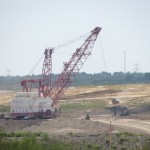
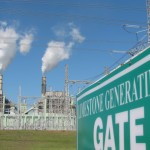
Giant shovels carve away acres of soil and rock, digging dozens of feet down to reach seams of lignite coal. This is the Big Brown Mine in Freestone County where so far some 14,000 acres have been excavated.
Big Brown was one of the first mines opened in East Texas in the 1970’s to fuel power plants.
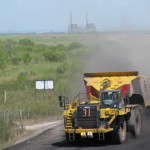
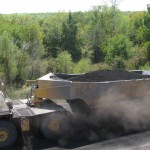
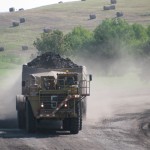
Coal haulers run 24/7/365, bringing tons of Texas lignite coal to the Big Brown Power Plant, owned by Luminant. The mine employs 250 people, the plant 150. Luminant said last year that it would have to shut down the mine and lay off workers if new pollution rules affecting coal-burning power plants were enforced.
The EPA says older plants like Big Brown must cut their emissions of sulfur dioxide and other pollutants and that doing so would save hundreds of lives in Texas. But Luminant argued it didn’t have enough time to upgrade the plant with pollution control equipment. Last month, Texas won a ruling blocking the EPA from enforcing the “Cross-State Air Pollution Rule”. Luminant now says it will keep mining here. However, it will shutdown two other generating units for the winter at another plant in Titus County. Like Big Brown, that plant was built in the 1970’s.
Surface mining, also called strip mining, involves massive excavation, creating canyons where meadows once were. Federal and state laws require “reclamation” to replace and recontour the land.
For the most part, Texas lignite coal is used only to fuel power plants located nearby. Because it burns with less intensity, it has less value than compared to higher quality coals from other states including Wyoming. And since more has to be burned, it produces more pollution. Power plants use a mix of out-of-state coal and Texas lignite in order to meet clean air rules.
Located in Limestone and Leon Counties in East Texas, the Limestone power plant is owned by NRG. It was opened in the 1980’s.
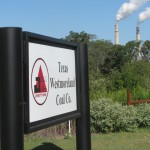
The Limestone power plant is fueled by the Jewett Coal Mine nearby which is owned by Colorado-based Westmoreland Coal Company.
Gary Melcher with NRG manages the Limestone plant. He said the plant’s “scrubbers” remove enough of sulfur that had the new, stricter EPA rules taken effect, “We would have been able to meet that and continued operating the plant.”
According to the city of Fairfield in Freestone County, coal mines and power plants are three out of the area’s four biggest employers (number two is a state prison).
Anthony’s Restaurant in Jewett draws a lunch crowd from the mine and power plant.
If coal becomes less competitive compared to natural gas or even wind and production drops or stops, the Fairfield school district could lose millions in taxes it currently receives from the Big Brown mine.
There are 15 coal mines in East and Central Texas, five in South Texas.
In East Texas, where unemployment rates in some counties are among the highest in the state, coal mining ranks as one of the biggest employers.
In the war between Austin and Washington over the U.S. Environmental Protection Agency’s efforts to put stricter limits on air pollution, some people in communties like Fairfield and Jewett worry what will happen if coal production drops…or stops.
Cotton fields in bloom this year in Wharton County in Southeast Texas.
While the major metropolitan areas of the state have come back quite a ways from last year’s record drought, the same isn’t true for many farmers and ranchers in the rural parts of Texas. The latest drought monitor map shows that West Texas and the panhandle are still suffering, with much of the region in drought conditions ranging from ‘severe’ to ‘exceptional.’
Rangeland and pastures in the Panhandle are in “very poor to poor condition,” according to the latest crop and weather report from the Texas A&M Agrilife Extension Service. It’s not all bad news. This year’s cotton crop is doing well in parts of the state like the Gulf Coast, and worse in others, like the Coastal Bend area. Other areas of the state are seeing good yields with alfafa. Winter wheat is being planted. Suffice to say, Texas’ nearly $8 billion in agricultural losses last year won’t be repeated in 2012.
One of the main culprits of last year’s devastating drought was the La Nina weather pattern. That’s when warmer-than-normal surface ocean temperatures cause higher temperatures and less precipitation in Texas. After back-to-back La Nina’s, Texas was literally left in the dust last year.
But the counterpart to La Nina, El Nino, is on its way. And typically that means cooler temperatures and higher precipitation. Continue Reading →
Join us tonight for a discussion about wildfires in Texas.
We’re hoping you can join us tonight at our new studios for a panel and discussion of wildfires in Texas. We’ll be listening to and talking about our recent documentary with KUT News, Forged in Flames: An Oral History of the Labor Day Wildfires.
Our own reporter Mose Buchele will be on a panel with KUT News Director Emily Donahue and Erin Purdy of The University of Texas at Austin’s Briscoe Center for American History. You’ll get to participate in a discussion about wildfires in Texas and learn more about the Forged in Flames documentary and oral history project.
When: Monday, Sept. 10, 2012, 6–7 p.m.
Where: The KUT Public Media Studios, 300 W. Dean Keeton St. (northeast corner of Guadalupe and Dean Keeton streets), Austin
Hundreds of people turned out at a recent public hearing in Round Rock to discuss the listing of four Central Texas Salamanders as Endangered Species.
When it comes to the battle over what qualifies as an endangered species, the script practically writes itself. The government proposes adding new animals to the list; business interests and land owners fight the proposal, fearing the financial impact; environmentalists rally around the critters, arguing for sustainability.
These days, it’s Central Texas’ turn. The creatures in question? Four tiny salamanders.
On a recent evening in the town of Round Rock in Williamson County, hundreds of people packed into a nondescript convention center just off the interstate to talk amphibians. Round Rock is a suburban Austin community, the second-fastest growing metro region in the country, and most of the people at the public hearing opposed listing the creatures.
StateImpact seeks to inform and engage local communities with broadcast and online news focused on how state government decisions affect your lives. Learn More »