Terrence Henry reports on energy and the environment for StateImpact Texas. His radio, print and television work has appeared in the New York Times, The Washington Post, The Atlantic, NPR, The Texas Tribune, The History Channel and other outlets.
He has previously worked at The Washington Post and The Atlantic. He earned a Bachelor’s Degree in International Relations from Brigham Young University.
After almost losing the entire season to drought, gulf oysters are back on the menu in Texas.
Some good news today for fans of Texas Gulf oysters, which have been off the menu this season due to the drought. Those heavy rains we’ve been having in parts of Texas have alleviated the red tide and oyster harvesting will begin again at midnight tonight in the Espiritu Santo and San Antonio Bays northeast of Corpus Christi.
But hurry, because those bivalves may not be open to harvesting for long, according to the Texas Parks and Wildlife department:
A very small portion of Texas waters will open to shellfish harvesting tomorrow. At 12:01 am on Friday, January 27, 2012 Espiritu Santo and the conditionally approved area of San Antonio Bay will open to commercial oyster harvest. Due to the recent rains in the Austin area the conditional area of San Antonio Bay might not remain open for long. The Texas Department of State Health Services will continue to monitor the red tide and will open areas to harvesting when it is safe to do so.
The return of gulf oysters in Texas is welcome news to gourmands and fisherman alike. In December, USA Today reported that “a monstrous bloom of toxic algae looming across the Texas coast has shut down oyster season.” Because of the drought, “the algae could cause nausea, vomiting and diarrhea in humans and is harmful to fish but not fatal to people.”
“Typically the oyster season opens in September,” says Carol Huntsberger, who owns Quality Seafood Market in Central Austin with her husband. “In the last couple years, due to the drought and red tide, you know, it was pushed back. Last year I think it didn’t open until November. So this is the latest I’ve ever seen it open.”
With some good rain, enough of that algae (the aforementioned red tide) has abated, and oysters are safe to eat again for the time being.
The department says you can call the Department of Health Services for updates on on the opening and closing of oyster harvest areas. The number? 1-800-685-0361.
The carcass of a cow that became mired in the mud in a dry stock tank in Knox County, Texas during the summer drought
At a hearing this week on funding for Texas state parks, several people voiced concern that as drought and extreme temperatures continue, funding will evaporate for the Texas Parks and Wildlife Department. Erika Aguilar of KUT News, StateImpact Texas’ local radio partner, has more:
“If we are going to keep these special treasures for all Texans to use and enjoy, we need to raise $4.6 million,” Texas Parks and Wildlife Executive Director Carter Smith told lawmakers this week. Last month, the agency launched a public fundraising campaign to fill a significant department deficit.
“The consequences of us not being able to realize those revenue targets are real,” Smith said. “They’re tangible. And we absolutely may be looking, particularly at 2013, at further cut backs and that could include things as drastic as closures and looking at transfers again.”
In December, the Parks and Wildlife Department asked for millions of dollars in donations to offset the loss of visitors due to the extreme drought and excessive heat of last summer. Since then, they’ve raised more than $460,000 from donations, some of which have come from a new Texas Department of Motor Vehicles opt-in donation program, and an additional $500,000 from the Texas Parks and Wildlife Foundation. That still leaves a funding gap of approximately $3.5 million.
Harold and Nell Myers live in Lakeside Beach. He used to manage the community’s water system before it was sold to LCRA.
Spicewood Beach was placed under stage 4 water restrictions on Tuesday, meaning residents can only use water for cooking, cleaning and drinking.
A beached boat dock on upper Lake Travis near Spicewood Beach sits dozens of feet from the water’s edge.
Clayton “Buddy” Howell, a Navy Veteran shares a modest home with his daughter in Spicewood Beach.
Boat docks that once floated on Lake Travis now sit on dry ground in Spicewood Beach.
Joe Barbera, the current president of the Spicewood Beach POA, sits in the community recreation center.
LCRA trucks parked outside a water pumping station in Spicewood Beach, where workers took measurements for the river authority engineers.
The Lakeside Beach community, along with Spicewood Beach, was put under stage 4 water restrictions Tuesday.
Ryan Rowney, LCRA manager of water operations, sits in his office near Red Bud Isle.
Andy Uhler and David Barer of KUT News contributed reporting to this article.
(Update: On Monday, January 30, the wells in Spicewood Beach began to fail, and water was trucked in. It was the first time during the current drought that a Texas town has run out of water. Read our latest reporting on the story here.)
The drought has come close to drying up several small Texas towns. Without exception they’ve all been spared, whether through rain, new water pipelines, or a mix of the two. But for the first time since the drought began, within a few days, one community’s well is expected to run dry.
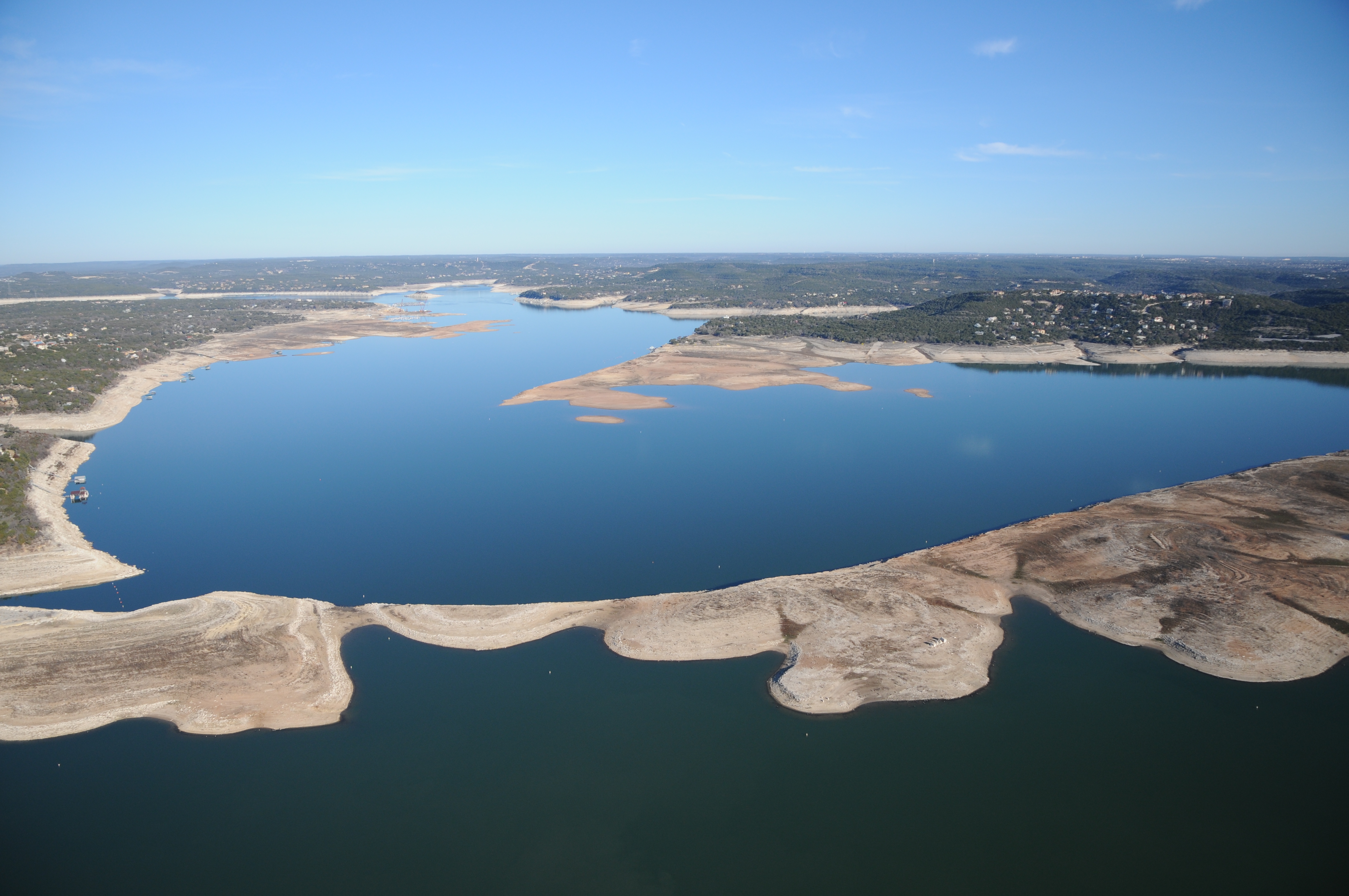
Spicewood Beach sits on a peninsula along the northern reaches of Lake Travis. Inflows into the lakes that provide for the region are at a historic low, while water demand is at an all-time high. The two main water sources for Central Texas, Lakes Buchanan and Travis, are currently only at a combined 37 percent of their full capacity.
There are 500 water meters in the Spicewood Beach area, serving an estimated 1,100 people. Water is drawn from wells managed by the Lower Colorado River Authority.
The irony of running out of water right next to a lake isn’t lost on locals like Joe Barbera, who is president of the Spicewood Beach Property Owner’s Association. “If you go down there, it’s nothing but sand,” he says. “If you actually walk down there, it’s unbelievable how far you have to go down to the creek bed just to see water.”
How Did This Happen?
Around here he’s known simply as “Buddy.” But his given name is Clayton Howell, an 85 year-old retired Navy vet who lives in a single-story home next to a golf course. Until about six months ago, you’d find him playing nine holes a day there. Now he’s more or less confined to his La-Z-Boy with a bad back problem. Over a late breakfast, he tells the story of how the local water wells came to be the property of the LCRA, and why they’re beginning to run dry. Continue Reading →
The drought has certainly lessened in recent month. The percentage of Texas in the most extreme, “exceptional” stage of drought is down from a whopping 86 percent in late September to 25 percent today. But there is still a long way to go. Continue Reading →
A weed grows out of the dry cracked bed of O.C. Fisher Lake in July. The drought has taken a severe toll on Texas lakes and rivers.
Monday we told you about Spicewood Beach, a community in Burnet County that was going to run out of water within weeks. Today, despite several inches of rain in the forecast, an alert was sent out saying that moment may be just days away.
There are 500 water meters in the Spicewood Beach Regional Water System. Most of them are for homes, but at least one of them belongs to Spicewood Elementary School. Despite the fact that the golf course community sits right next to the Colorado River between Lakes Lyndon B Johnson and Travis, it gets all of its water from groundwater wells. And they are dangerously close to running dry.
The Lower Colorado River Authority (LCRA), which provides water to the community, released an alert today saying that overnight, well levels have dropped 1.3 feet, after dropping over a foot since last week. “With the overnight drop in water levels, LCRA estimates the well may remain functional for only a few more days,” the LCRA said in the alert. The community has been placed under Stage 4 water restrictions, which means only essential use of water is allowed, and no outdoor watering is permitted.
The extreme drought has lowered levels in Lake Travis, exposing formations not seen for some time.
It sounds strange to say it, but Spicewood Beach is running out of water.
The Lower Colorado River Authority (LCRA) released an advisory today to communities in the Spicewood Beach Regional Water System in Burnet County asking customers “to immediately cut back on all nonessential water use.”
Despite being adjacent to the Lower Colorado River, the wells serving the communities in the Spicewood Beach water system “are quickly approaching their minimum operating levels,” the advisory states. “At this time, based on the accelerated rate of drop in the well level, it is estimated that the wells have approximately two to three weeks of supply remaining.”
The LCRA is currently trucking in water to a storage tank in order to keep water flowing, and is looking at drilling new wells or possibly making existing wells deeper. Continue Reading →
Since then, things have turned around for Groesbeck. In late November, the town announced that they had literally bought a few more months of water by installing a three-mile pipeline further up the Navasota river, where the town’s water comes from. They even moved to Stage 2 water restrictions, which allows residents to water their lawns.
Last week the latest place to come dangerously close to running dry was Robert Lee, a West Texas town with a little over a thousand people about two hours east of Midland. Their sole source of water is the E.V. Spence Reservoir, which is currently only 0.44 percent full.
Today comes news that salvation has arrived, in the form of a “10-inch, light blue plastic pipe,” according to the Abilene Reporter-News: Continue Reading →
Burros marched, pipelines were delayed, and wells caught fire. In case you missed it, here are the five top posts from StateImpact Texas over the last week:
“A Railroad Commission inspector responded around 5:30 p.m. Thursday, Jan. 19, to a storage tank fire at a saltwater disposal facility operated by High Roller Well, LLC, south of Pearsall on State Highway 581, south of Pearsall. Preliminary information provided to the inspector indicates that while a truck was unloading saltwater with a skim of condensate (liquid hydrocarbons) into a collection tank, welders were working nearby and sparks from the welding may have ignited vapors around the storage tank, causing the explosion. A firewall around the storage tank site contained spilled fluids, which were picked up with by a vacuum truck.
No violations of RRC rules were found, and the High Roller Well LLC lease is in compliance with Commission rules. As injuries were reported in this incident, the lead investigating agency for this incident would be the federal agency, OSHA, which needs to be contacted for further information.”
About StateImpact
StateImpact seeks to inform and engage local communities with broadcast and online news focused on how state government decisions affect your lives. Learn More »