Terrence Henry reports on energy and the environment for StateImpact Texas. His radio, print and television work has appeared in the New York Times, The Washington Post, The Atlantic, NPR, The Texas Tribune, The History Channel and other outlets.
He has previously worked at The Washington Post and The Atlantic. He earned a Bachelor’s Degree in International Relations from Brigham Young University.
What do you do when wells run dry? That far-off question has become a sudden reality for the residents of Spicewood Beach, the first town to run dry during the Texas drought. This video, shot by Jeff Heimsath for StateImpact Texas, tells the story of how the wells began to fail in Spicewood Beach, and how residents there are trying to cope with an uncertain future.
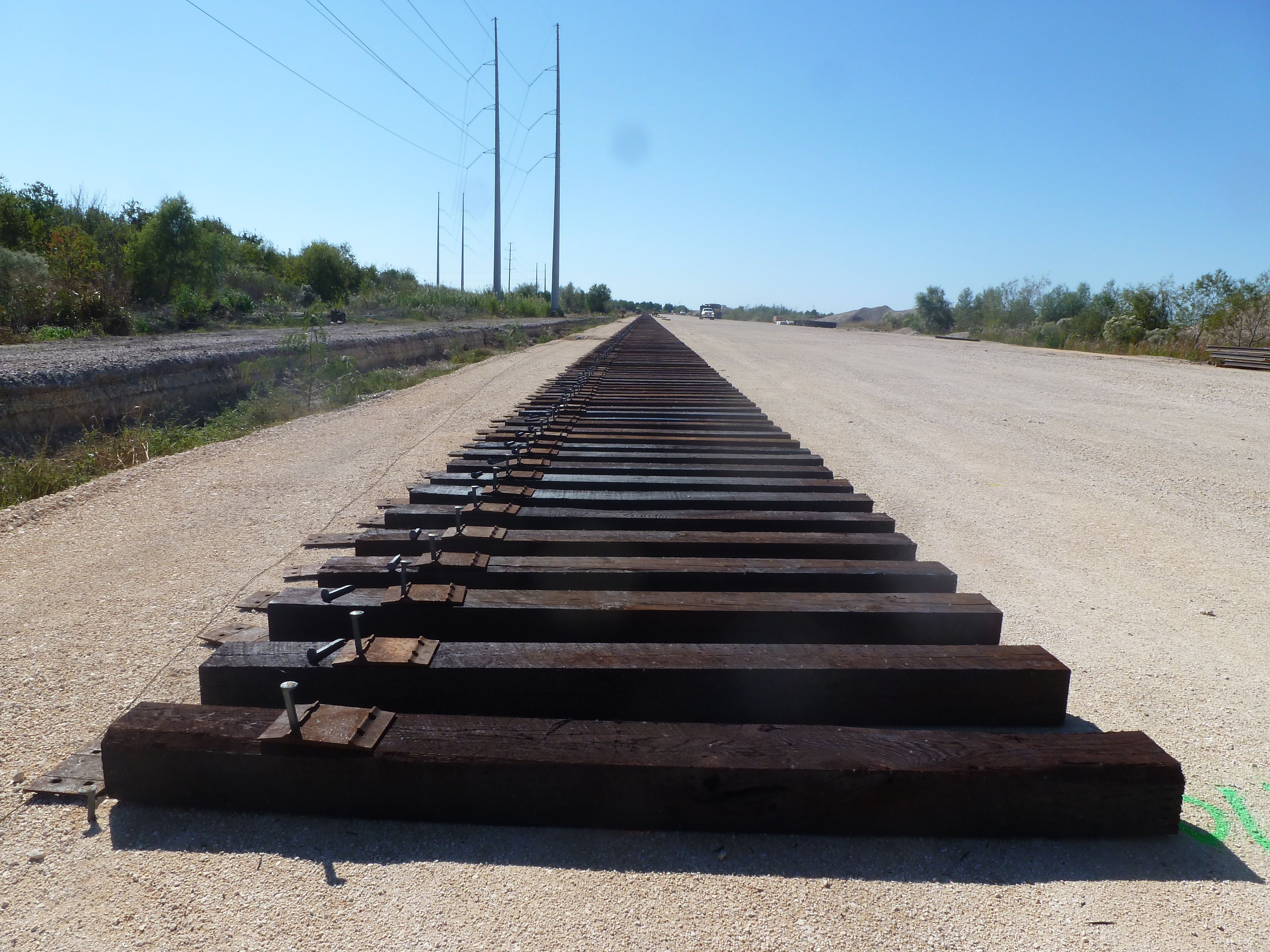
Rail is being laid down to bring oil in and out of Port Arthur, Texas.
Dave Fehling of StateImpact Texas and David Barer of KUT Austin contributed reporting to this article.
It’s not often you find the Tea Party and environmentalists on the same side of an issue. But both are busy this week protesting the Keystone XL pipeline, a 1,700 mile-long project that would bring oil harvested from sand pits in Canada to refineries on the Gulf Coast of Texas.
The Tea Partiers, on the other hand, held a series of press conferences across the state, alleging that the company behind the pipeline is using eminent domain to force landowners to allow the line to be built on their property. The activists have joined forces with other political groups and several landowners who have refused to give the company building the pipeline, TransCanada, permission to go through their land.
Julia Trigg Crawford is one of those landowners. Her family has had a farm in Lamar County, northeast of Dallas, since the forties, where they grow soybeans, corn and wheat. A few years back, TransCanada approached her family about running the Keystone XL pipeline through her farm. “Well, we didn’t sign initially, and it’s kinda drug on and on,” she told StateImpact Texas. “Each year they sent another letter saying there’ll be more money to kinda sweeten the pot.”
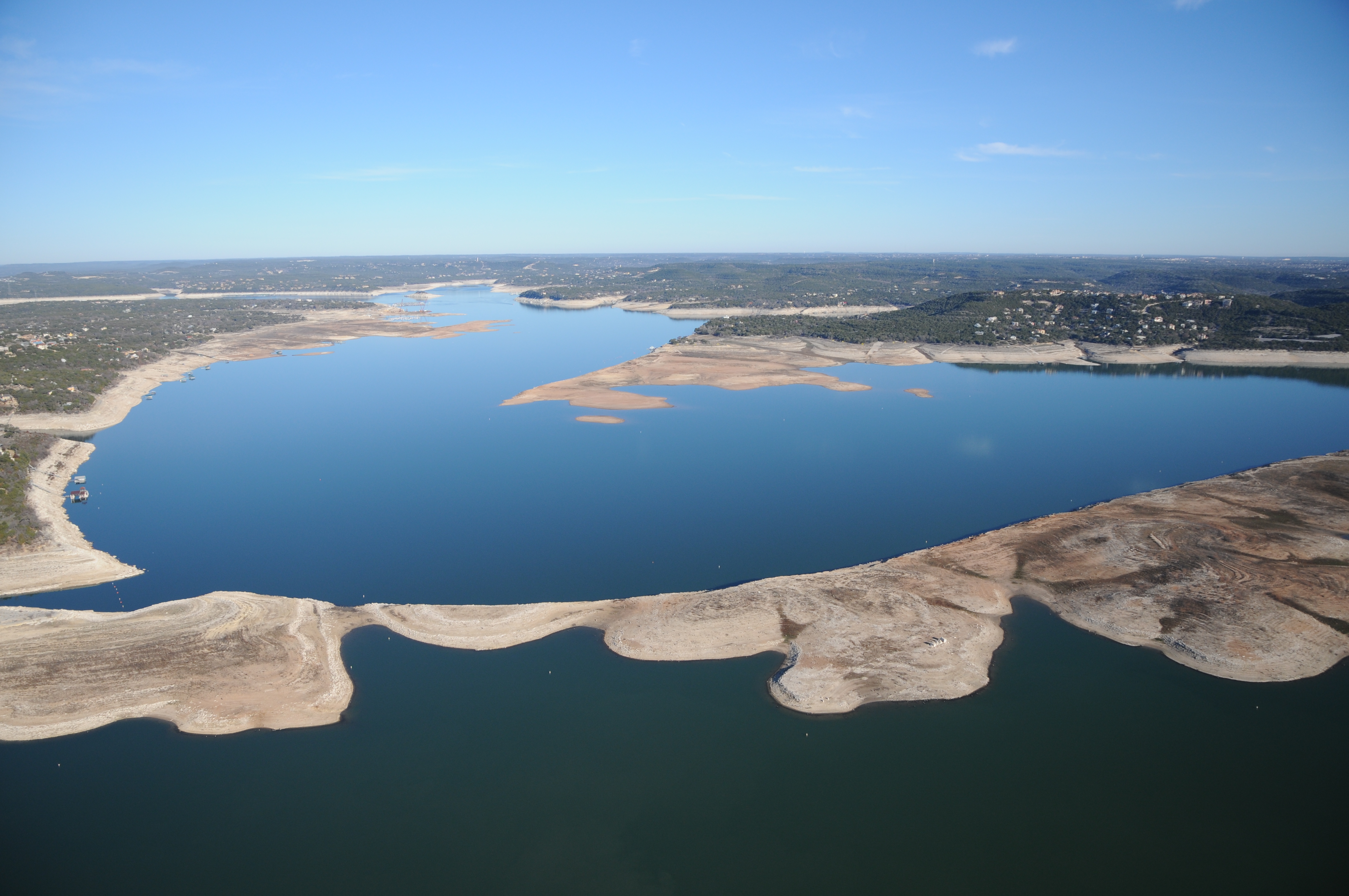
The extreme drought has lowered levels in Lake Travis, exposing formations not seen for some time.
Let’s say you live next to one of the Highland Lakes in Central Texas. And let’s say you have an expansive lawn that needs lots of water. Couldn’t you just run a line from your sprinkler to the lake and pump water out to keep your lawn green? Sure, you could do that. But you’d be breaking state law.
Drawing water from the lakes is a practice that’s been common for some time, but residents may not be able to get away with it for much longer. In a move they hinted at a few weeks back, the Lower Colorado River Authority (LCRA) announced Monday that they are going to “begin reporting residents who pump water from the Highland Lakes without a contract to the Texas Commission on Environmental Quality, which can levy fines for the illegal pumping.”
The LCRA estimates that “5,000 residents use pumps to pull water from the lakes for lawn watering and other uses in or around their homes,” using around 5,000 acre-feet of water a year. That’s over 1.3 billion gallons of water. The community of Spicewood Beach, by comparison, which recently ran dry, used almost 39 million gallons of water last year. The city of Austin used nearly 145,000 acre-feet of water last year, or about 47 billion gallons.
Of those 5,000 people pumping water out of the lake, the LCRA says that 2,000 of them have contracts, but more than 3,000 continue the practice without a contract. It was even worse a few years ago. In 2009, only 60 of those estimated 5,000 people had the proper contracts.
So how are they going to start reporting residents who are sucking water with their own straws? Continue Reading →
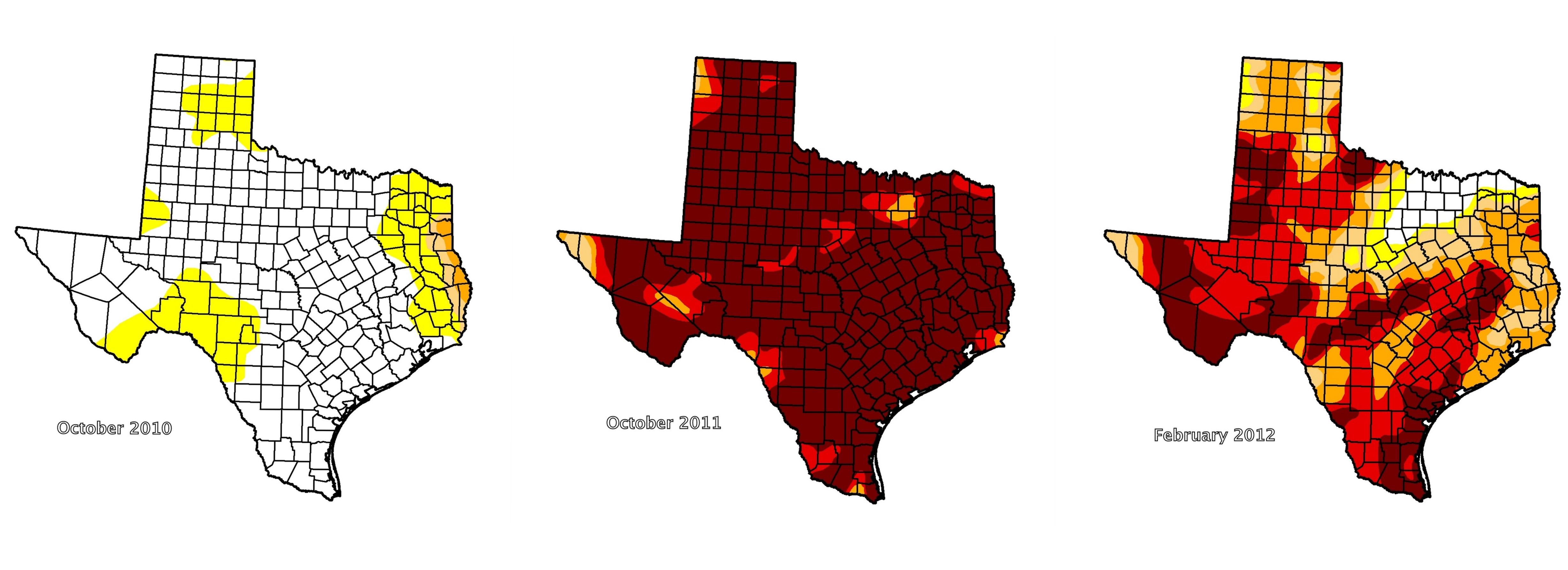
The current drought in Texas, which broke single-year records, has shown dramatic abatement in recent months as rains surprised the state. It was supposed to be a drier-than-average winter, but thankfully forecasts can be wrong.
Maybe you’re curious to see how far Texas has to go before things get back to “normal?” Quite a way. These three maps from the National Drought Monitor show the progression (and, hopefully, regression) of the drought, from its beginning in October 2010, to its arguable peak in October of the following year, to the improved-but-far-from-out-of-the-woods condition we find ourselves in today:
When it comes to beef production, Texas is at the top. There are twice as many cows in the state as Nebraska, the second biggest cattle-producing state. But after the devastating effects of the drought, with agricultural losses estimated in the billions, hay prices nearly tripling and massive selloffs of cattle, will Texas be able to make a comeback?
Ranchers sold off cattle in droves last year, sending prices temporarily lower as beef flooded the market. The United States Department of Agriculture says the number of cattle in Texas dropped by 10 percent in 2011. That’s an especially large decline when you consider Texas is the biggest beef producer in the country.
One livestock economist tells Bernier that there are fewer cows now in the country than there’s been in fifty years. Many cattlemen in Texas are now facing the big question: take their young cows and sell them off, assuming the drought will continue? Or keep them and breed them for more cattle, believing the drought will soon end? Continue Reading →
Dr. Cliff Frohlich of the University of Texas at Austin is researching the links between fracking and earthquakes.
Accidents at drilling sites, new links between fracking and earthquakes, and a farewell party for La Niña (the main culprit behind the current Texas drought) were among our readers’ favorite stories over the last week. In case you missed them, here are the top five new StateImpact Texas stories:
Mark Your Calendars for La Niña’s Farewell Party: When will the drought end? It’s truly too soon to say, but one of the main culprits, La Niña, is going to be leaving us soon. But there’s a catch.
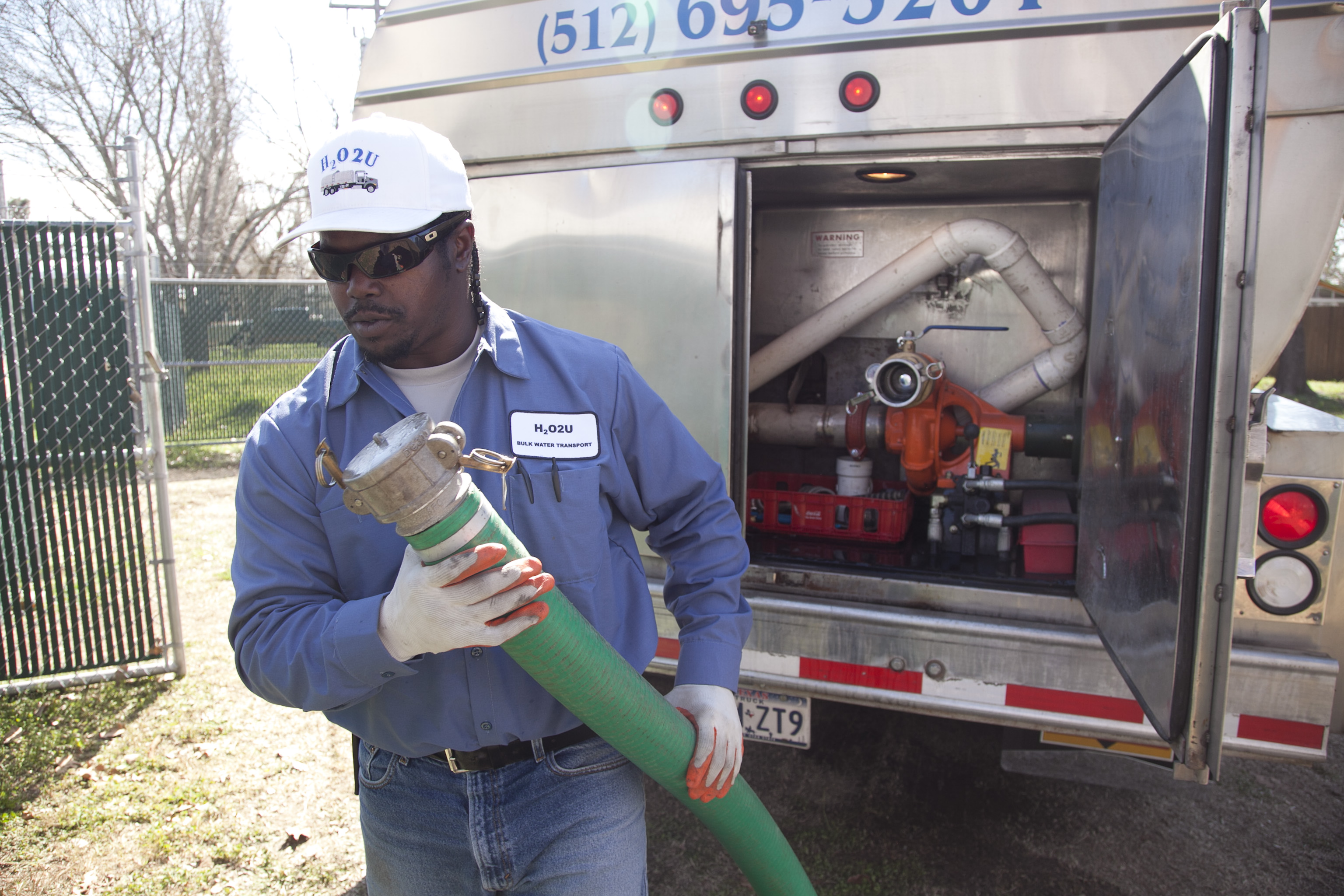
A water hauler readies a pump to hook up to Spicewood Beach's system.
It’s been a few weeks since the small community of Spicewood Beach, which about 1,100 people call home, ran out of water. It was the first town to run dry during the Texas drought.
Since then, the Lower Colorado River Authority (LCRA), which owns and operates the wells in the town, has been paying an outside contracter to truck in water. That cost the LCRA $200 a load, and at anywhere from four to five loads a day, costs were adding up. (The LCRA has come under fire for selling over 1.3 million gallons from the wells last year to water haulers before the wells started to fail.)
But as of today, the LCRA has its own truck. An 18-wheel, 6,000 gallon behemoth that will make its way from a private water system about ten miles away to the tanks in Spicewood. The LCRA has had the truck for a while, but first had to teach its team how to drive it.
“The streets around Spicewood Beach are pretty tight, they’re pretty narrow,” says LCRA Water Operations Manager Ryan Rowney. “I want to make sure that my staff is fully aware and fully versed in how the truck operates, the turning radiuses. Just want to make sure that they feel comfortable operating this bigger truck, cause it’s much bigger than what we’ve been driving around.”
But Spicewood Beach residents are worried that this bigger truck will wreak havoc on their roads and potentially damage their property. Continue Reading →
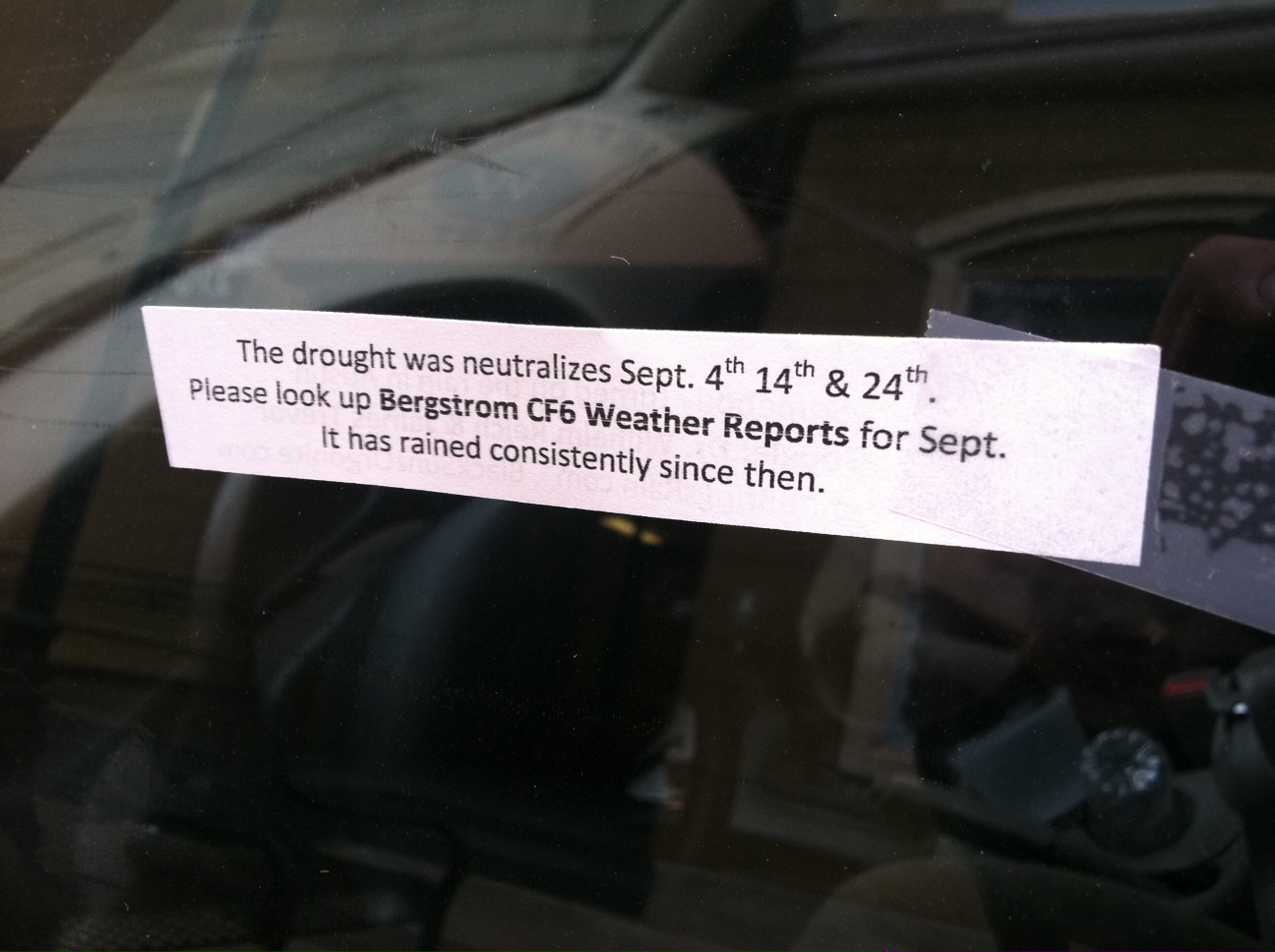
Mysterious messages about the drought popped up around the UT campus Thursday evening.
Yesterday evening on the way home from work, the above note was found on the windshield of one of our cars. Another was found on the car of a KUT News reporter, our local radio partners.
There was 0.01 inches of rain recorded there in September, a big departure from normal. On each of the days listed on the note, there was no rain recorded. On average, ABIA gets about two-and-a-half inches of rain during that month. So to correct our tipster: the drought was in no way “neutralized” in September, though recent rains have allowed much of Travis County to move from “exceptional” and “extreme” to “severe” drought .
But there may be trouble on the horizon. In a news release Thursday, Parks and Wildlife warned of rising detections of a new algae bloom, Dinophysisin Port Aransas. While the bloom is not toxic like red tide, it is consumed by oysters and makes them inedible, according to the department. While that bay is not open to harvesting, the algae has also been found further up the coast.
A dock sits on the dried up bed of the Pedernales River in Travis County, Texas.
Stop me if you’ve heard this question before: When will the drought end?
It’s truly too soon to say, but there are some indicators that one of the main culprits, La Niña, is going to be leaving us soon.
What is La Niña? It’s a weather pattern where the surface temperatures are cooler in the Pacific, which creates drier, warmer weather in the southern U.S. (You may also know her counterpart, El Niño, which generally has the opposite effect.) La Niña sticks around for a year, sometimes longer, and tends to return once every few years. (The last La Niña was in 2007, but it was a much lighter one.)
The National Weather Service says today that a “majority of models predict La Niña to weaken through the rest of the Northern Hemisphere winter 2011-12, and then to dissipate during the spring 2012.” This jibes with previous forecasts.
StateImpact seeks to inform and engage local communities with broadcast and online news focused on how state government decisions affect your lives. Learn More »