Running Dry: How the Drought Hit Texas
Tonight PBS Newshour will a special report on the drought in collaboration with StateImpact Texas. You can tune in to Newshour or watch the segment above. For the full online report, visit PBS Newshour.

Terrence Henry reports on energy and the environment for StateImpact Texas. His radio, print and television work has appeared in the New York Times, The Washington Post, The Atlantic, NPR, The Texas Tribune, The History Channel and other outlets. He has previously worked at The Washington Post and The Atlantic. He earned a Bachelor’s Degree in International Relations from Brigham Young University.
Tonight PBS Newshour will a special report on the drought in collaboration with StateImpact Texas. You can tune in to Newshour or watch the segment above. For the full online report, visit PBS Newshour.

Photo by Tom Pennington/Getty Images
President Obama is visiting Cushing, Oklahoma today as part of a multi-day tour promoting his energy prices in the midst of high gas prices and Republican criticism. Cushing is an interesting stop for the President because it’s a major oil hub and it’s where the southern leg of the Keystone XL pipeline will begin.
That pipeline would take heavy crude harvested from oil sands in Alberta, Canada to refineries on the Gulf Coast of Texas. The President had denied a permit last year for the entire pipeline – part of which went through sensitive aquifer areas of Nebraska. The company behind the pipeline, TransCanada, recently announced that it intended to go ahead and build the Oklahoma-to-Texas leg, which wouldn’t require approval by the State Department. (For a more thorough explainer and background, read our topic page on the Keystone XL pipeline.)
Based on his remarks, Obama is in favor of that plan. Noting that there’s a bottleneck in Cushing of oil, coming in from places like the oil sands of Alberta and the Bakken Shale in North Dakota, the President said that he’s “directing my administration to cut through the red tape, break through the bureaucratic hurdles, and make this project a priority, to go ahead and get it done.”
More from his remarks and some reactions from others: Continue Reading

Photo by Scott Olson/Getty Images
The drought has caused agricultural losses greater than any other in Texas' history.
It’s official: the current Texas drought has been the costliest in history, resulting in $7.62 billion in agricultural losses, according to an update today from the Texas AgriLife Extension Service at Texas A&M University. That’s nearly twice as high as the previous record, $4.1 billion in losses during the 2006 drought, and equal to nearly half of Texas’ agricultural business over the last four years.
“No one alive has seen single-year drought damage to this extent,” Dr. Travis Miller, AgriLife Extension agronomist and a member of the Governor’s Drought Preparedness Council said in a release. “Texas farmers and ranchers are not strangers to drought, but the intensity of the drought, reflected in record high temperatures, record low precipitation, unprecedented winds coupled with duration – all came together to devastate production agriculture.”
Today’s numbers are an update from a previous estimate released in August 2011. The Agrilife Extension service says that there was still some time left in the growing and grazing seasons after that point, hence the updated losses today. Livestock made up the biggest part of the losses, with $3.2 billion lost. With little rain, grass simply didn’t grow, and ranchers had to buy hay at record-high prices from as far away as Montana. Many ranchers sold off their herds, which resulted in the largest decline in the beef cow inventory in Texas history. Continue Reading
One popular solution to running low on water? Drill a well. In Texas alone, there are an estimated million of them.
But with the extreme Texas drought stressing aquifers, while more and more people are sucking water out of them, many wells have ended up being too shallow. In its latest report on the drought – done in collaboration with StateImpact Texas – PBS Newshour looks at how companies that drill wells are keeping busy digging deeper and adding storage tanks for their customers.
Watch the report above or read the full story at PBS Newshour.
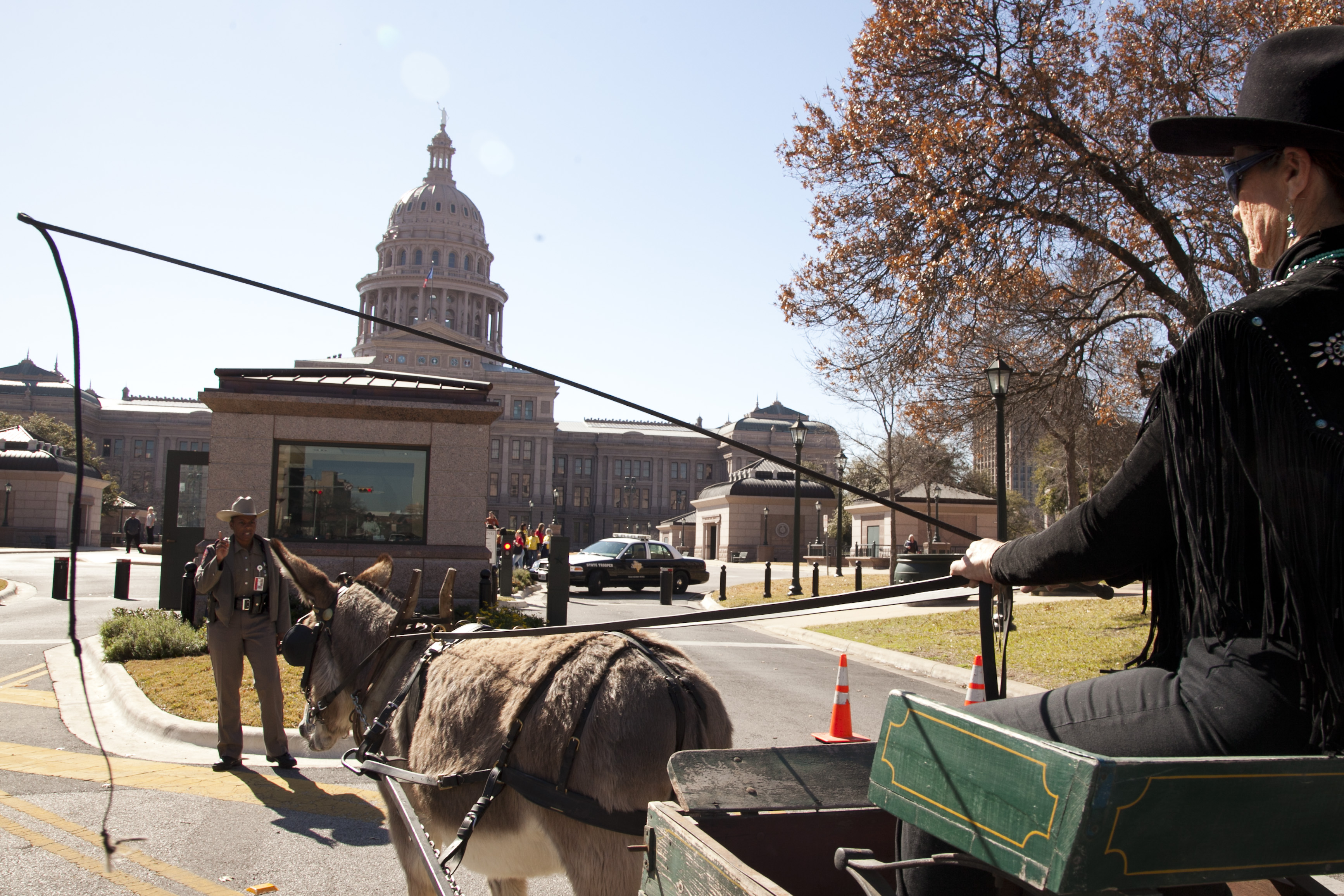
Photo by Jeff Heimsath for KUT News
Marjorie Farabee was stopped from bringing her wagon to the steps of the capitol. But she did deliver around 100,000 signatures collected online to protest the burro killings.
Donkeys in West Texas can bray a little easier today: the Texas Parks and Wildlife Department (TPWD) has announced that they will “not likely” conduct killings of wild burros in the region “until it has been determined whether any non-lethal methods are feasible.”
In a release today, the department says that they are working with the Human Society “to conduct an aerial survey to determine the numbers and locations of burros at the park, an essential first step to assess costs and feasibility of control options. TPWD has agreed to cost-share up to $10,000 to help pay for the survey, which should occur this spring.”
As StateImpact Texas reported in January, Parks and Wildlife sees the wild donkeys as an invasive species, responsible for habitat destruction and the fouling of West Texas water sources. (TPWD even has a webpage devoted to burro droppings found near water wells.) The burros were introduced to Texas by early Spanish colonists in the 1600s.
But some West Texas residents and advocacy groups felt differently, and led a donkey-powered protest on the state capitol in January asking for Parks and Wildlife to change its policy. They collected 100,000 signatures in an online petition protesting the donkey killings. With today’s news, it appears that stubbornness has paid off for the wild donkeys.
When you get a second, step outside. Take a look at your roof. Where you may just see shingles, one Texan sees a new source of water.
Richard Heinichen of Dripping Springs, Texas has built a successful business selling bottled rainwater, and as of late he’s been busy taking that work one step further. He’s building rainwater collection systems for residences that can provide their entire water supply.
Watch the video report from PBS Newshour above, part of a reporting collaboration with StateImpact Texas, to learn how Heinichen is harvesting water from the clouds. And stay tuned for more on how rainwater harvesting can boost water supplies, even in times of drought.
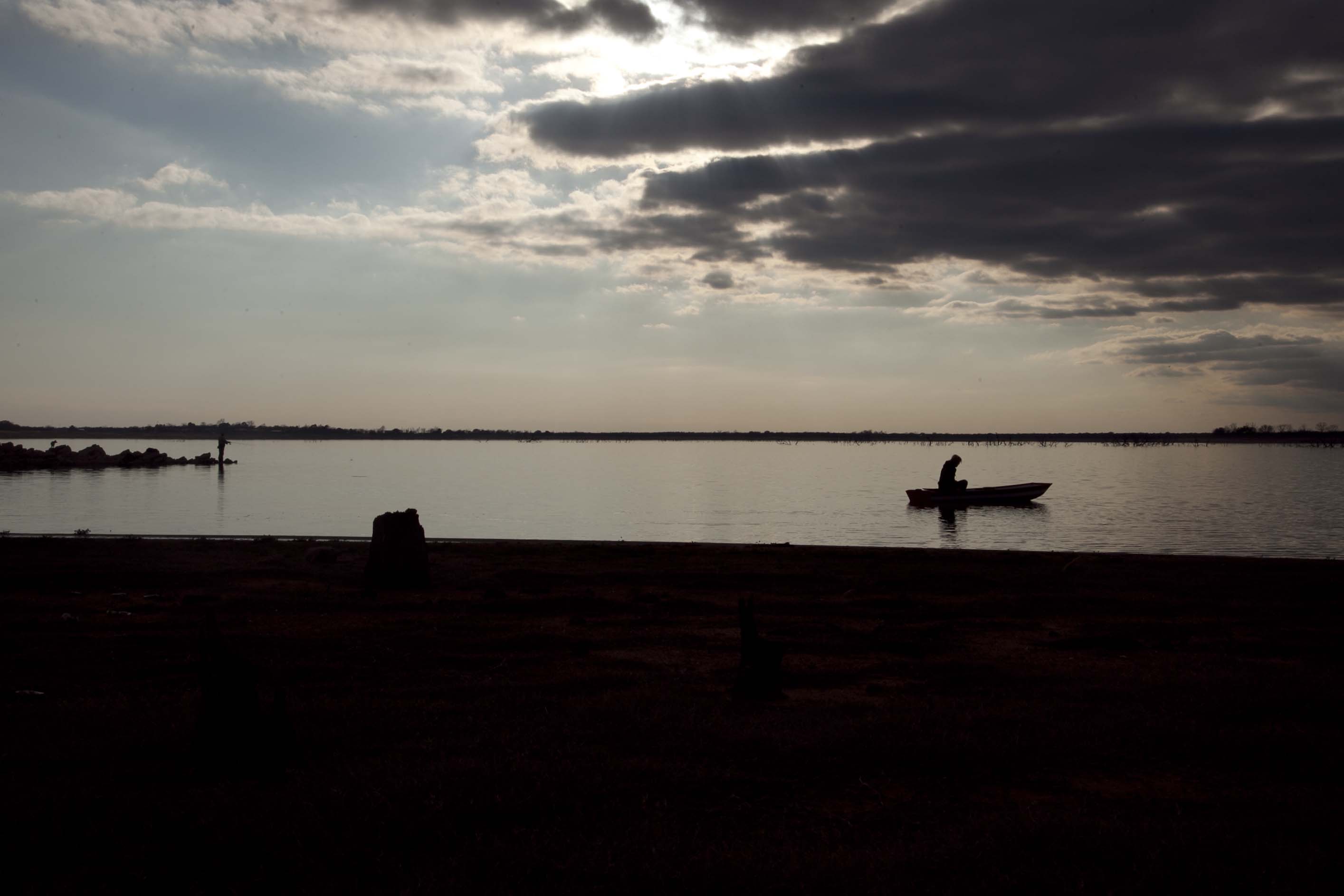
Photo by Jeff Heimsath for StateImpact Texas.
A lone angler fishes Lake Buchanan, February 2012.
The Texas Parks and Wildlife Department announced today that the Dundee State Fish Hatchery in Wichita Falls, Texas, will be “suspended effective immediately” because there isn’t enough water to operate during the ongoing drought.
“Although many parts of the state recently received good rains, the area west of Wichita Falls around Lakes Kemp and Diversion did not,” Todd Engeling, director of hatchery operations for the department, said in a statement. As we reported in February, the hatchery is responsible for much of Texas’ striped bass supply. More from our earlier report:
“There are four hatcheries in the state run by the Texas Parks and Wildlife Department and supplies up to five million striped bass fingerlings (or baby fish) per year. Unlike most other species of sport fish in Texas, striped bass do not naturally procreate in the state. Without the stocking program the populations will steadily decline and disappear in Texas.”
Texas Parks and Wildlife says they will adjust production at their other hatcheries to shift away from largemouth bass “to produce striped bass and hybrid striped bass fingerlings.”
Where do school buses go when they die? It might surprise you to learn that most American school buses don’t die at all; they’re often reborn as public transportation south of the border.
The story of one aging school bus that was sold off and driven to Guatamela to begin a new life as an ornate shuttle is the subject of a new film that premiered at the SXSW Film Festival this week, La Camioneta. Through this one bus, the film examines how one country’s trash becomes another’s treasure, the importance of mass transportation in a country with widespread poverty and how violence and gang warfare threaten the safety and viability of that transportation.

Photo courtesy of EPA
Al Armendariz is the regional administrator for the EPA.
The Environmental Protection Agency (EPA) announced today that it wants to add Willow Park, Texas (a small town east of Fort Worth), to its National Priorities List (NPL) of Superfund sites. Those sites are specially-designated areas of hazardous waste pollution that receive priority funding and cleanup assistance from the federal government.
What happened in Willow Park? Here’s the EPA release:
“In 2006, routine sampling of a well in the city of Willow Park’s water system showed concentrations of trichloroethene (TCE) to be above health-based safety levels. Subsequent tests showed that public water supply and five private wells all had elevated TCE levels. These water sources are all within a one-mile radius of the site, which extends for a half-mile along Russell Road. The city of Willow Park shut down the wells and installed a carbon filter to provide safe drinking water for affected residents. The source of the contamination has not been identified.”
“Today we’re taking an important step toward restoring contaminated property and protecting people’s health and our environment,” EPA Regional Administrator Al Armendariz said in the release. “Cleaning up hazardous waste in our communities and returning properties to environmental and economic vitality are EPA priorities.”
The EPA says they will have a public comment period on the decision for 60 days.
StateImpact seeks to inform and engage local communities with broadcast and online news focused on how state government decisions affect your lives.
Learn More »