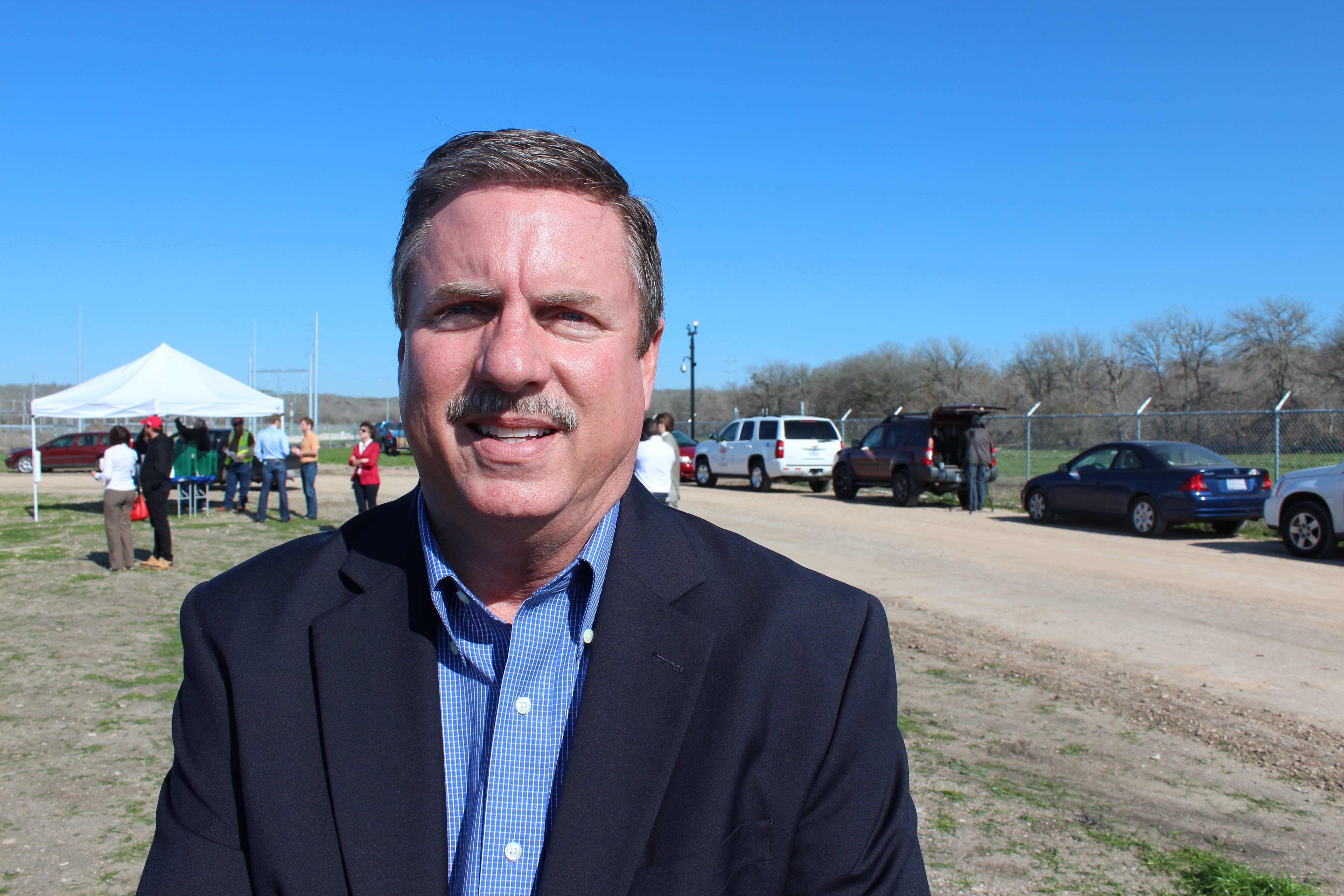
Mose Buchele is the Austin-based broadcast reporter for StateImpact. He has been on staff at KUT 90.5 in Austin since 2009, covering local and state issues. Mose has also worked as a blogger on politics and an education reporter at his hometown paper in Western Massachusetts. He holds masters degrees in Latin American Studies and Journalism from UT Austin.
Plans to revise Texas’ electoral boundaries will affect more than just the House of Representatives’ Republican-Democrat breakdown. But could it affect Texas’ renewable energy policies?
That was the question posed to State Rep. Mark Strama by Stratus Energy’s Mark Bruce at the University of Texas at Austin’s School of Law’s Wind, Solar and Storage conference last week. The answer revealed a lot about how attitudes towards subsidizing can be shaped by region, rather than partisan politics.
Mark Bruce: “How much does the redistricting matter as we go into the next round of Washington congressional action, and in the Texas legislature itself?”
Mark Strama: “In energy policy, what really seems to matter more is the personalities that are involved and where the leadership comes from. We’ve lost some good folks from West Texas. In many cases, [they were] Republicans who had made renewable energy an issue that was really bipartisan because their part of the state was making money from it. And they didn’t see it as this environmental crusade, [but rather] as a way of making money in their hometowns. Continue Reading →
Vickery has spent the past twenty five years working in virtually every area of the TCEQ, including industrial and hazardous waste and municipal solid waste enforcement, waste tires, director of field operations, deputy director office of compliance and enforcement, deputy director office of permitting and registration, deputy executive director. He became the agency’s executive director in 2008.
Most recently, he refused to approve ValeroEnergy Corporation’s request for an environmental tax refund. Valero asked for the money under a state law that says companies don’t have to pay taxes on equipment that reduces on-site pollution. Vickery explained the TCEQ’s decision by citing that the company “does not demonstrate that [their] hydrotreating equipment provides a partial environmental benefit at the site.” Continue Reading →
Photo couresy of Accident on Eclectic via Flickr http://www.flickr.com/photos/nakrnsm/
Striped Bass cannot exist in Texas unless they are bred and stocked in the state's rivers and lakes.
David Barer, an intern at StateImpact Texas, researched and reported this article.
The fish hatchery that supplies much of the striped bass in Texas may be the first state-run hatchery to close due to lack of water. This spring water levels at the Kemp Reservoir, the main source of water for the Dundee Fish hatchery near Wichita Falls, will be too low to support agricultural, municipal and hatchery use.
“We draw water from a public water source; when those water sources are low, for the hatcheries…we can’t draw water into our structures…that will impact our operations tremendously,” Todd Engeling, Texas Parks and Wildlife’s chief of inland fisheries told StateImpact Texas. “Without water we really can’t do anything.” Continue Reading →
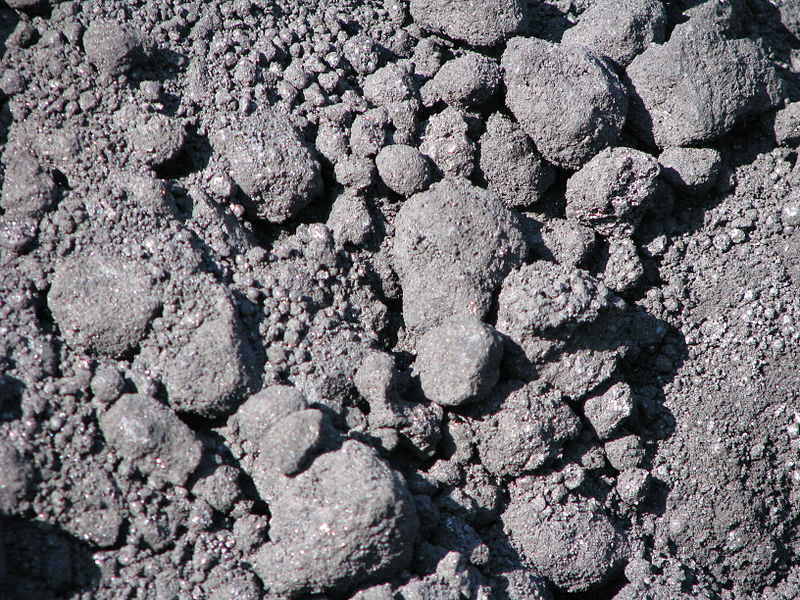
Photo Courtesy of romanm Wikimedia Commons http://en.wikipedia.org/wiki/File:Petrolkoks_IMG_6166.jpg
The plant was going to be fired by petroleum coke, pictured above.
A petroleum coke power plant planned near the Gulf Coast community of Point Comfort has lost its permit to build, according to environmental groups. Petroleum coke is a fossil fuel used like coal.
Today the Sierra Club, Public Citizen and The Sustainable Energy and Economic Development [SEED] Coalition released a statement saying that the Joslin power plant was required to begin construction by February 20th or its air permit would be voided and plant builders would have to reapply.
“[The Plant builders] have exhausted their time line for extending on their permitting, so their time is finally up with the TCEQ.” Karen Hadden, Executive Director of the SEED coalition, told StateImpact Texas. “It seems that the company is more likely looking at a natural gas plant at this time which would have much less pollutants.” Continue Reading →
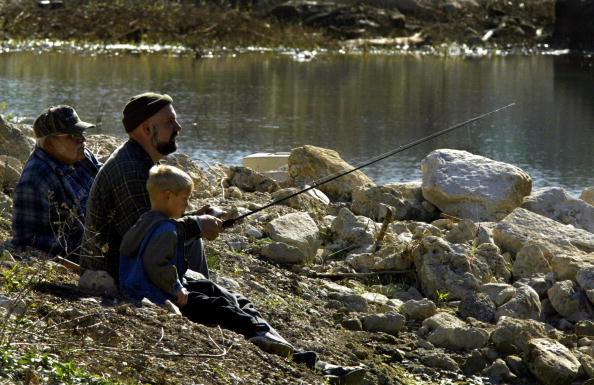
Photo credit should read PAUL J.RICHARDS/AFP/Getty Images
With fishing license sales down, budgets to stock rivers and lakes are being stretched thin.
David Barer, an intern at StateImpact Texas, researched and reported this article.
Derrick Schmalz is lifetime angler who grew up fishing on the Llano River with his grandfather. When it comes to fishing in his home state, he can’t help but show a little Texas pride.
“I’ve fished all over the country, and Texas has one of the best license programs in the nation,” said Schmalz. “Buying a fishing license is a small price to pay to go fishing and enjoy so many of the great resources the state has to offer.”
Schmalz and anglers like him owe some of the pleasure they take from hours on the water to state programs that stock fish in Texas lakes and rivers. But funding for those programs, like the rest of Texas Parks and Wildlife budget, is drying up at an alarming rate.
Sales of fishing licenses are the most important income for the state fish hatcheries, and sales in 2011 were down compared to previous years. Continue Reading →
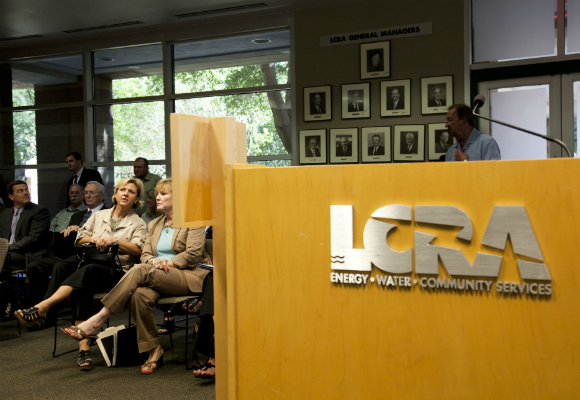
The agency that controls the water flowing from the Highland Lakes to the Gulf Coast is set to approve a new Water Management Plan on Tuesday. But before it makes a final decision, it will hear from the various – often feuding – communities who all rely on the river to support their way of life. None of those groups appear fully supportive of the plan as it has been amended.
The plan offers some new ways for the LCRA to manage the type of extreme drought we’ve seen in the last year. For one thing, lake levels in the Highland Lakes would be checked twice a year to gauge if there’s enough water to send downstream to rice farmers in South Texas. Continue Reading →
Scott Anderson says there are many environmental risks associated with fracking.
A report from UT’s Energy Institute on shale gas drilling found no link between hydraulic fracturing and water contamination, but the findings might not all be good news for oil and gas drilling.
“The report shines a light on the fact that there are a number of aspects of natural gas development that can cause significant environmental risk,” Scott Anderson, a policy advisor for the Environmental Defense Fund, a group that contributed to the study, told StateImpact Texas.
While the study found no direct link between water contamination and fracking itself, it did cite surface spills of fracturing chemicals as a risk to groundwater. It also found blowouts underground during fracking operations have been under-reported. In a blog post yesterday, Anderson enumerated some other continuing concerns.
Late last year the EPA released a draft report on the effects of fracking in Pavillion, Wyoming that appeared to find a link between fracking and water contamination. Continue Reading →
What happens when “drill baby drill” meets peak oil prognostication? An audience found out firsthand this week, when two power policy pugilists faced off at the University of Wisconsin.
In one corner was Texas’ own Dr. Tad Patzek, incoming president of the Association of the Study of Peak Oil, and Chair of UT’s Department of Petroleum & Geosystems Engineering. In the other corner, former CEO of Shell Oil Company and domestic drilling proponent John Hofmeister.
Highlights include Hoffmeister’s prediction that gasoline is likely to reach $5 a gallon this summer, and that America’s energy crunch will lead to new lows in political partisanship. Continue Reading →
The Highland Lakes have come dangerously close to reaching historic lows during the drought.
Thousands of gallons of water are trucked in each day to keep the taps flowing in Spicewood Beach
Although Spicewood Beach sits on Lake Travis, falling lake levels have led the community to run dry.
Longtime resident L.J. Honeycutt says TK.
Receding waters have ravaged communities in the Highland Lakes.
A volunteer “security guard” goes on patrol in Spicewood Beach
Dr. Jack Sharp studies hydrology at UT’s Jackson School.
Will Silver Creek Village be the next town to run dry during the Texas drought?
Nelson Brock works for the community water system in Silver Creek Texas, He’s watched wells dry up as nearby lake Buchanan recedes.
Residents in Silver Creek Village worry their wells, which depend on Lake Buchanan, will soon run dry.
After a year of record-breaking heat and drought, it began to seem inevitable that a town in Texas would run dry. What might have come as a surprise is that the town would have a name like “Spicewood Beach.”
“We didn’t get any warning!” said Robert Salinas on a recent afternoon.
It’s an example of the way the Texas drought is throwing into question the usefulness of old distinctions between surface water from Texas lakes and rivers, and groundwater from Texas wells.
If it happened at Spicewood Beach, could it happen to another Highland Lake well?
Trip Doggett is the President of the Electric Reliability Council of Texas
Yana Skorobogatov contributed reporting to this article.
If the state encounters another scorching hot summer like we had last year, the choice will be between rolling blackouts or ramped-up conservation, said Electric Reliability Council of Texas (ERCOT ) President Tripp Doggett at a State House hearing today.
“If we have the same summer as last summer, we had to have conservation [last summer] and everyone made a tremendous difference during those peaks on the hot summer days of last August. We’d have to have that, plus some [more], to survive this summer without rotating outages,” Doggett testified before the House Committee on State Affairs.
The state grid is expected to have a reserve margin of electricity slightly higher than 13.75 percent this year. That’s the safety cushion of electric capacity that exceeds forecast demand. And that cushion will be thinner this year. Last year, the margin was 17 percent and Texas still came dangerously close to rolling blackouts on two occasions.
Part of the problem the committee is looking into is how to encourage more power plants to be built. That’s difficult in a deregulated maket. When questioned whether state agencies had looked into encouraging public-private partnerships to build more plants Donna Nelson, Chair of the Texas’s Public Utility Commission said “my perception is that our market is premised on private investment… so no we haven’t.”
About StateImpact
StateImpact seeks to inform and engage local communities with broadcast and online news focused on how state government decisions affect your lives. Learn More »