Mose Buchele is the Austin-based broadcast reporter for StateImpact. He has been on staff at KUT 90.5 in Austin since 2009, covering local and state issues. Mose has also worked as a blogger on politics and an education reporter at his hometown paper in Western Massachusetts. He holds masters degrees in Latin American Studies and Journalism from UT Austin.
Last year’s drought forced Texans to take a hard look at their water resources. But in many ways the crisis just underlined a scarcity already looming in the state. Most people in Texas live in urban areas, yet most of the water still goes to rural agriculture.
Where will the state find the water to sustain its booming urban population? Many believe some of it will have to come from agriculture, where farmers and ranchers will have to cut back. Others stress conservation. And some think that Texans should be investing in major infrastructure projects to develop new water supplies, like desalination.
Today we take a look at where the city of Austin fits into all of this. During roughly the same time frame that Texans endured the worst single-year drought in the state’s history, Austin was the second fastest-growing city in the U.S.
Where the Keystone XL pipeline would go through Texas.
UPDATED
An official with the EPA has told StateImpact Texas that the route of the pipeline has changed since the EPA letter was sent in November.
Under the new route the EPA will not be involved in the review.
EARLIER
The U.S. Environmental Protection Agency sent a letter late last year raising concerns that the southern leg of the Keystone XL pipeline might require more stringent permitting than planned by the Army Corp of Engineers, according to a report from the Associated Press. Continue Reading →
The Texas Commission on Environmental Quality is the state agency with final say in the new water management plan.
The Colorado River provides water to cities, towns, industry and agriculture from West Texas to the Gulf Coast. After 18 months of often bitter disagreement, representatives of those interests (referred to as stakeholders) reached a consensus last year for how that water should be managed from the Highland Lakes on down. After further tweaks, the Lower Colorado River Authority (LCRA) approved that Water Management Plan early this year.
Most stakeholders felt short-changed by the final Water Management Plan. But at the time of the LCRA‘s vote, many seemed relieved, at least, that a plan was finally complete.
Then, late last month, a letter arrived at the Texas Commission on Environmental Quality (TCEQ) that could throw everything back into question. That letter includes greivences from downstream rice farmers over how the plan was developed, and changes they would like to see.
Opponents are calling it a “rice farmer manifesto,” but Ed McCarthy, a lawyer representing Lower Colorado rice farmers, describes it differently. Continue Reading →
Photo courtesy of Lunchbox Photography via Flikr's Creative Commons. http://www.flickr.com/photos/jcorduroy/6817020034/
Even Thor's lightening, thunder and rain didn't free Central Texas fully from drought.
The word Thursday derives from the Old Norse thorsdagr, meaning “Thor’s Day.”
But here at StateImpact Texas, Thursday means something else entirely. It’s the day the U.S. drought monitor releases it’s weekly drought map!
Thor was the Norse god of thunder, and parts of Texas saw plenty of storms (and rain) last week, raising hopes that the central part of the state would finally be able to proclaim itself drought free. Unfortunately, those hopes were dashed by the new map which shows the western edges of the Hill Country are still in moderate or severe drought.
Pipe is stacked at the southern site of the Keystone XL pipeline on March 22, 2012 in Cushing, Oklahoma.
The debate over TransCanada’s proposed oil pipeline from the oil sands of Alberta to the Texas Gulf Coast has mostly focused on the environmental and economic impacts. People in favor say it will bring jobs and energy security. Opponents say the pipeline, and the crude it will carry, will harm the earth.
But the project might have another consequence that’s been largely overlooked. Some analysts say it could actually raise gas prices for many American consumers.
Cattle prices are breaking records as ranchers rebuild their herds after the drought.
If you’re getting ready for summer grilling season, be warned. You can expect the price of steaks and hamburgers to be higher this summer. The reason is that cattle prices are nearly double what they were last year.
The drought that struck Texas in 2011 caused the state cattle industry to lose over three billion dollars. With little rain, grass simply didn’t grow, and ranchers had to buy hay at record-high prices from as far away as Montana. Many ranchers sold off their herds, which resulted in the largest decline in the beef cow inventory in Texas history.
But as that dry weather reduced supply, recent wet weather has increased demand. Continue Reading →
This summer may not be nearly as hot as last year, but blackouts aren't completely off the table.
Today the group that monitors the Texas Electric Grid came out with a new assessment of the state’s power reserves heading into the summer. The Electric Reliability Council of Texas (ERCOT) says Texas is still at risk of rolling blackouts. But the likelihood has diminished as conservation has ramped up and more energy companies have brought “mothballed” power plants back online.
Those plants are operating thanks in part to the low cost of natural gas, which makes it economically attractive to run less efficient natural gas power plants. All but one of the state’s mothballed plants that are being brought back online are natural gas-fired plants.
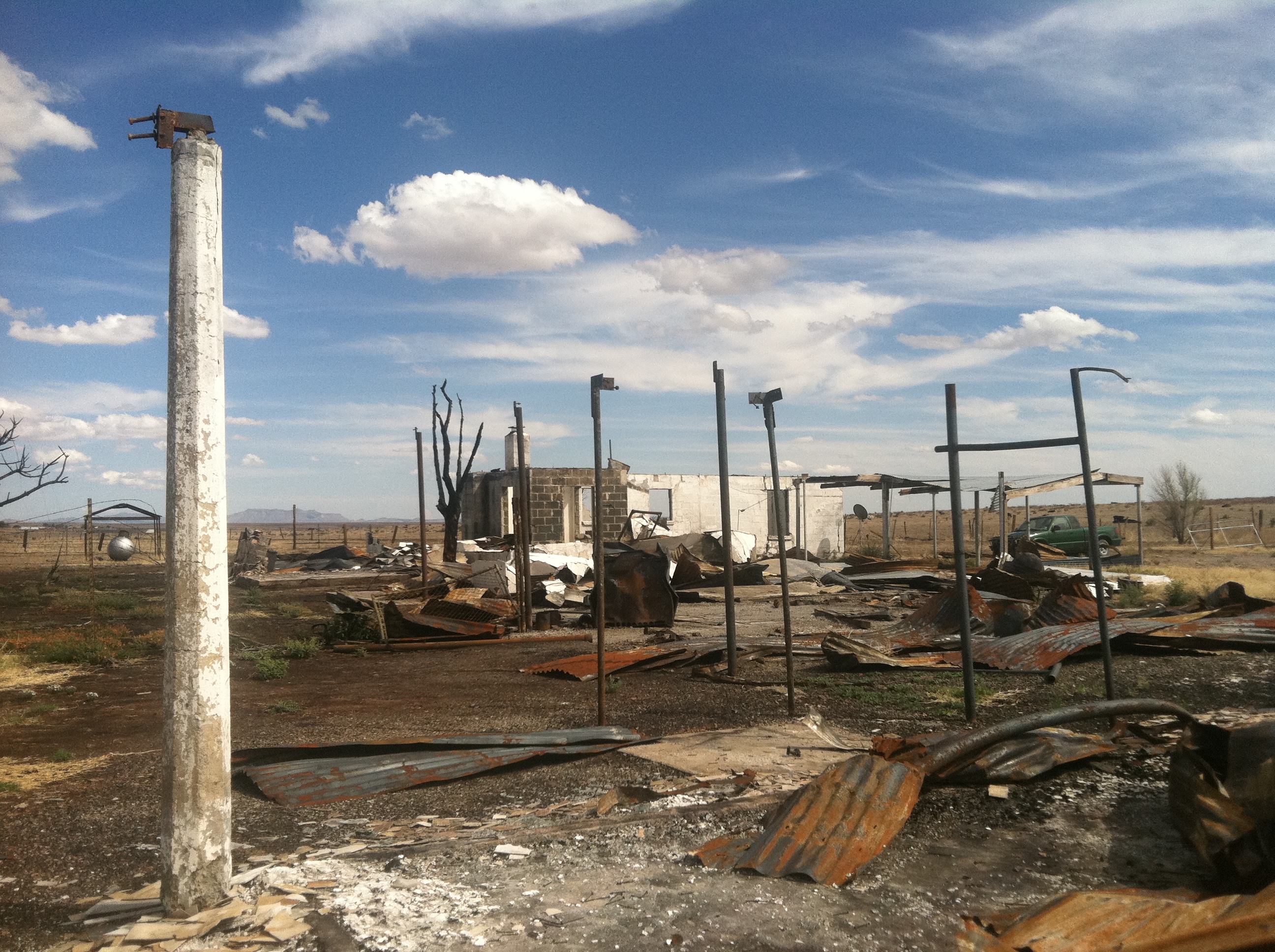
The Rock House fire of 2011 started at this site outside of Valentine, Texas in April of last year. Much of the same area that burned in that fire is burning again today.
Evening Update: In a late afternoon interview the Texas Forest Service put the amount of land burned by both fires in the Livermore Ranch Complex Fire at over 23,000 acres. Reinforcements have arrived and the smaller of the two fires is now 60 percent contained. The larger fire, which continues to threaten the Davis Mountains Resort, is said to be 25 percent contained.
Two massive wildfires scorched over 19,000 acres of land and continue to burn uncontained in far West Texas as of Tuesday morning, said the Texas Forest Service. The fires are burning in roughly the same parts of Jeff Davis County that were scorched close to a year ago by the “Rock House Fire,” a massive blaze that ushered in a year of devastating wildfires throughout the state.
The fires, now jointly called the Livermore Ranch Complex Fire, were sparked by lightning on April 24. They threaten about 150 permanent residents as well as empty vacation structures in the Davis Mountain Resorts. Continue Reading →
Arthur Berman heads Labrynth Consultanting, and is an outspoken critic of how America's natural gas reserves are being developed.
Chesapeake Energy has been getting a lot of attention lately, and not the good kind.
An investigation by Reuters found that its CEO, Aubrey McClendon, had been leveraging his interests in the company’s wells to secure over a billion dollars in personal loans, setting up a possible conflict of interest. After the news broke, Chesapeake’s stock dropped by a quarter, the company’s Board of Directors discontinued the program that gave McClendon a stake in the wells, and the SEC announced it would be investigating the deals.
It seemed like a good time to touch base with Arthur Berman.
Berman is the head of Labryth Consulting, a Houston-based geological consulting firm. He’s developed the reputation of a one-man cloud, raining on the parade of America’s natural gas cheerleaders.
In a nutshell, Berman thinks the industry is over-leveraged, over-hyped and bound for a market “correction.” It should be noted at the outset that many people in the industry disagree with his analysis. But With the McClendon controversy focusing attention on issues Berman has been talking about for years, StateImpact Texas gave him a call to see what he’s thinking:
Q: To begin with could we just get your general impression. What are you thinking when you read the news about Chesapeake and McClendon?
A: None of this comes as a surprise to me. But to me, the takeaway that the average person ought to get is, this is characteristic of how unstable and unsustainable these kinds of propositions are. Continue Reading →
Death has been stalking the Pronghorn of West Texas Their numbers have dropped dramatically in the last five years, leaving people wondering if the species will continue in the region.
If you think pronghorn don’t hold an iconic place in the story of the old west, consider the lyrics to the tune Home on the Range. Remember, “where the deer and the antelope play?”
Those “antelope” you’ve heard about your whole life weren’t really antelope at all. They were pronghorn.
The confusion started with European settlers who mistook them for the old world species. In fact, the pronghorn is a uniquely American creature. The the fastest land mammals in the Western Hemisphere, they are the second fastest in the world after the cheetah. They evolved that way to out run a long-extinct species of North American Cheetah.
Pronghorn once roamed Texas from the Hill Country all the way to the state’s western tip. Today, though they still maintain healthy populations in many parts of the Midwest, their range in Texas is diminished to the point of disappearing.
StateImpact seeks to inform and engage local communities with broadcast and online news focused on how state government decisions affect your lives. Learn More »

 Where will the state find the water to sustain its booming urban population? Many believe some of it will have to come from agriculture, where farmers and ranchers will have to cut back. Others stress conservation. And some think that Texans should be investing in major infrastructure projects to develop new water supplies, like desalination.