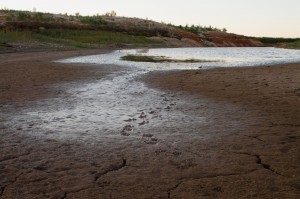
E.V. Spence Reservoir in Robert Lee Texas is running dry. The latest iteration of the Texas Water Plan could help Texas' water supply, if it is funded.
During the worst of the Texas drought, in 2011, when temperatures soared, dessicated lake beds cracked open, rivers dried to a trickle and several towns nearly ran out of water, Texas Governor Rick Perry asked all Texans to pray for rain.
It was not a novel remedy to Texas’ recurring drought problem. Nearly 60 years earlier, in 1953, Governor Allen Shivers asked all of Texas’ ministers to pray for precipitation.
In addition to prayers, the drought of record — as the 1950s drought is known — also spurred Texas officials to write the first State Water Plan, forecasting Texas’ water needs in the coming decades. In November, Texans will decide whether to put $2 billion from the state’s rainy day fund to a contemporary version of that plan. So now may be a good time to look back the history of the water plan, its successes and failures, before making that choice.
Glancing back at those old water plans, one can see a document that shaped enduring features of the Texas landscape. But back when officials wrote the first plan, Texas was a different state, says Andy Sansom, Director of the Meadows Center for Water and the Environment at Texas State University.
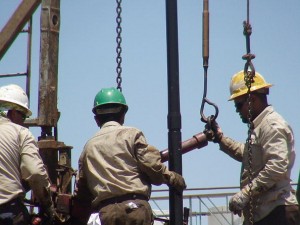
The lead oil and gas regulator in Texas passed new rules for fracking and drilling wells today. (Photo of a Cabot natural gas drill at a fracking site in Pennsylvania.)
The Texas Railroad Commission passed a long-awaited rule on Friday to strengthen the construction of oil and gas wells.
The rule, known as the “well-integrity rule,” passed by a unanimous vote among the three commissioners. It will take effect next January, and will update the commission’s requirements for the process of drilling wells, putting pipe down them and cementing things in place.
“We are sending a strong message to the rest of the states and the federal government that we are doing things right in Texas,” said Commissioner David Porter, in comments shortly before the rule was adopted.
The rule also contains some new requirements for hydraulic fracturing, the water-intensive rock-breaking process that takes place after the well is drilled. Continue Reading →
The Mexican border. More and more pipelines are being built to bring natural gas from Texas into Mexico.
When the U.S. Department of Energy (DOE) announced that it would issue a permit to export liquified natural gas to new markets from a facility in Texas recently, the news was greeted as a game changer. Opening international markets could drive the price of natural gas up domestically, spur a new rush to drill for gas, and stimulate some parts of the economy while disrupting others.
Despite all that excitement, a second, quieter, natural gas export boom is already taking place right under our noses. Mexico is importing a record amount of natural gas to create electricity and feed its growing industrial base. Eighty percent of all the gas Mexico imports comes from the United States, and 60 percent comes directly from pipelines in Texas.
“That’s something that most people probably haven’t been aware of,” David Blackmon, an industry consultant and natural gas advocate told StateImpact Texas. “We’ve always exported natural gas into Mexico, so this whole debate over whether we can export it in liquid form rather than pipelines has always kind of befuddled me.”
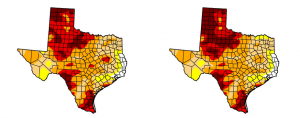
While the overall percentage of the state suffering from drought did not increase from last week, six percent of Texas, mostly in the Panhandle, sunk deeper into it.
U.S. Drought Monitor Archives
The dark red represents the most severe level of drought. It spread to cover more than six percent of the state in the past week, most notably in the panhandle.
State climatologist Dr. John Nielsen-Gammon says that much of the state already suffering from drought will likely experience a hotter-than-normal and drier-than-normal summer.
“Even if we just get normal rainfall it would be great,” Gammon tells StateImpact Texas. “But the trouble is any gaps in rain will cause things to dry out again. It’s more a matter of getting repeated regular rain than any single amount.”
If lawmakers do not act soon, the agency that regulates oil and gas in Texas could disappear.
A legislative review of that agency, the Texas Railroad Commission, failed this session, and a measure that would keep the agency alive until 2015 or later doesn’t include any reference to the agency.
“It means the Railroad Commission will go away,” said state Rep. Dennis Bonnen, R-Angleton.
Bonnen chairs the Sunset Advisory Commission, which is charged with periodically assessing and renewing the charters of state agencies. The RRC’s “sunset” legislation failed in 2011, and lawmakers extended the life of the agency until this year. It didn’t work; the legislation that would have renewed the agency’s charter and made additional changes has already failed again.
What’s more, House Bill 1675, this year’s version of the “safety net” that rescued the RRC and other agencies last year, doesn’t include the Railroad Commission this time. Unless lawmakers add it in the final days of the session, the agency will go out of business. Continue Reading →
Lawmakers made good on a promise to fund the state's water plan, but a crucial part of that plan is subject to voter approval.
After days of negotiations, amendments and Star Wars references, the Texas legislature has finally put together a mechanism to start seriously funding water infrastructure and conservation in the state. But there’s a big “if” — voters still have to approve a crucial part of the plan this November. (For more on the details, read our earlier story on the plan.)
While many legislators and lobbying groups — from farmers to drillers to environmentalists — largely supported the plan to fund water projects, there was opposition from the Tea Party on infrastructure spending. Here’s some of the reactions to the water plan funding from groups for and against:
A new interactive infographic by The Texas Tribune allows users to track campaign contributions from some of the most powerful groups and names in the energy and environmental sectors.
The energy and environmental lobbying tracker shows the dollar amounts in contributions each elected official has received since January 2011. With a drop-down menu, contributions from individual organizations or donors can be viewed as well. Continue Reading →
Photo courtesy of Photomonkey via Flickr's creative commons http://bit.ly/10MHsQP
The House and Senate both advanced measures to fund the State Water Plan, but many hurdles remain.
After days of postponement, arm twisting and behind the scenes negotiation, measures to advance funding for Texas’ State Water Plan were approved in the State Legislature Wednesday.
Lawmakers have been talking about taking money from state’s rainy day fund to improve water infrastructure since at least 2011, when a historic drought gripped the state. Today, members of the House and Senate found the votes to keep that plan alive.
The House voted 130-16 to call for a constitutional amendment to create two accounts from which to loan money for water projects. The Senate passed a supplementary budget bill that would put around $2 billion dollars in that water bank from the state’s rainy day fund with a vote of 29-3.
Because of complicated deal making between the State House and Senate and between Democrats and Republicans, the vote on the constitutional amendment was postponed past a House deadline yesterday while lawmakers waited to make sure the supplementary budget in the Senate contained what they wanted.
Neither chamber would jump first. Wednesday, they held hands and jumped together.
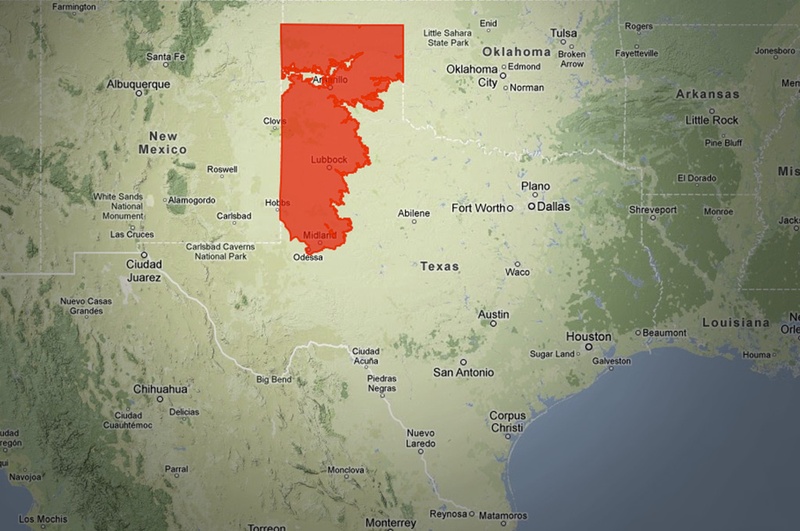
The Ogallala Aquifer suffered its second-worst drop since at least 2000 in a large swath of the Texas Panhandle, new measurements show.
The closely watched figures, published this week by the High Plains Underground Water Conservation District, cover a 16-county area stretching from south of Lubbock to Amarillo. The Ogallala wells measured by the district experienced an average drop of 1.87 feet from 2012 to 2013. That makes it one of the five or 10 worst drops in the district’s more than 60-year history, said Bill Mullican, a hydrogeologist with the district.
“There are some pretty remarkable declines,” Mullican said. One well in the western part of the water district, he said, dropped 19 feet over the year.
The vast majority of Texas is enduring a drought, but the Panhandle has been especially hard hit, causing farmers to pump more water to make up for the lack of rain. That depletes the amount of water stored in the aquifer over the long term, which means future generations will find less water to pump to grow crops.
Recently larval Mexican fruit flies were spotted in Texas.
Don’t let its size fool you, the Mexican Fruit Fly is a serious threat to Texas’ agriculture.
Authorities spotted larval Mexican Fruit Flies in South Texas and quarantined an 85 square mile area to contain the dangerous pest and its insidious larvae, according to the Texas Register.
The quarantine is one of many used over the years as part of a strategy to stave off an infestation of the fly, a pest with the potential to devastate an integral part of the South Texas economy. But while Texas and federal agencies use a variety of methods to keep the little bug at bay, some measures can adversely affect farmers.
“In terms of what the quarantine means, first of all, it’s the extra cost,” says Ray Prewett, President of Texas Citrus Mutual.
A fruit quarantine isn’t like a human quarantine for a disease, Prewett told StateImpact Texas, it’s not as if nothing can leave the quarantine zone. The fruit can leave, but it has to be fumigated or sprayed. That costs money. Also, fumigating the fruit early in the season can cause cosmetic damage to the peel. Fortunately, this year’s quarantine was instituted late in the season so not much fruit will be affected.
StateImpact seeks to inform and engage local communities with broadcast and online news focused on how state government decisions affect your lives. Learn More »