The State Legislature will hear six bills today that would effect several of the state's water issues.
Update: As of Thursday morning none of the bills mentioned in this article had been brought to the floor with the exception of HB2133 and HB1509.
Wednesday, the legislative calendar is inundated with bills that would effect how the state handles its water issues.
In total, six water bills are up for a second reading in the house, three of them authored by State Rep. Lyle Larson, R-San Antonio.
HB 2133, would allow the state to use alternative techniques in water treatment, namely desalination. The bill also promotes water reuse.
Another of Larson’s bills promotes underground storage facilities as an alternative to drawing water from lakes, where more water is lost to evaporation. HB 3013, the aquifer storage and recovery (ASR) bill, also changes the role of the groundwater conservation districts for the future of the state’s water.
The blind salamander is one of Texas' endangered species. A new bill passing through the House could move Texas' endangered species monitoring duties from the Comptroller to the Texas Parks and Wildlife Department.
Earlier: The Texas House could vote today on a bill that would strip the Texas Comptroller’s office of its endangered species monitoring duties and send the job over to the Texas Parks and Wildlife Department.
Advocates of the legislation, like Bill Stevens, a government affairs consultant for the Texas Alliance of Energy Producers who lobbied for the bill, say the switch could help keep potential species off the endangered species list. The listing of species can invite federal intrusion and hinder business.
“We need a more transparent and broader state-government involvement,” Stevens told StateImpact.
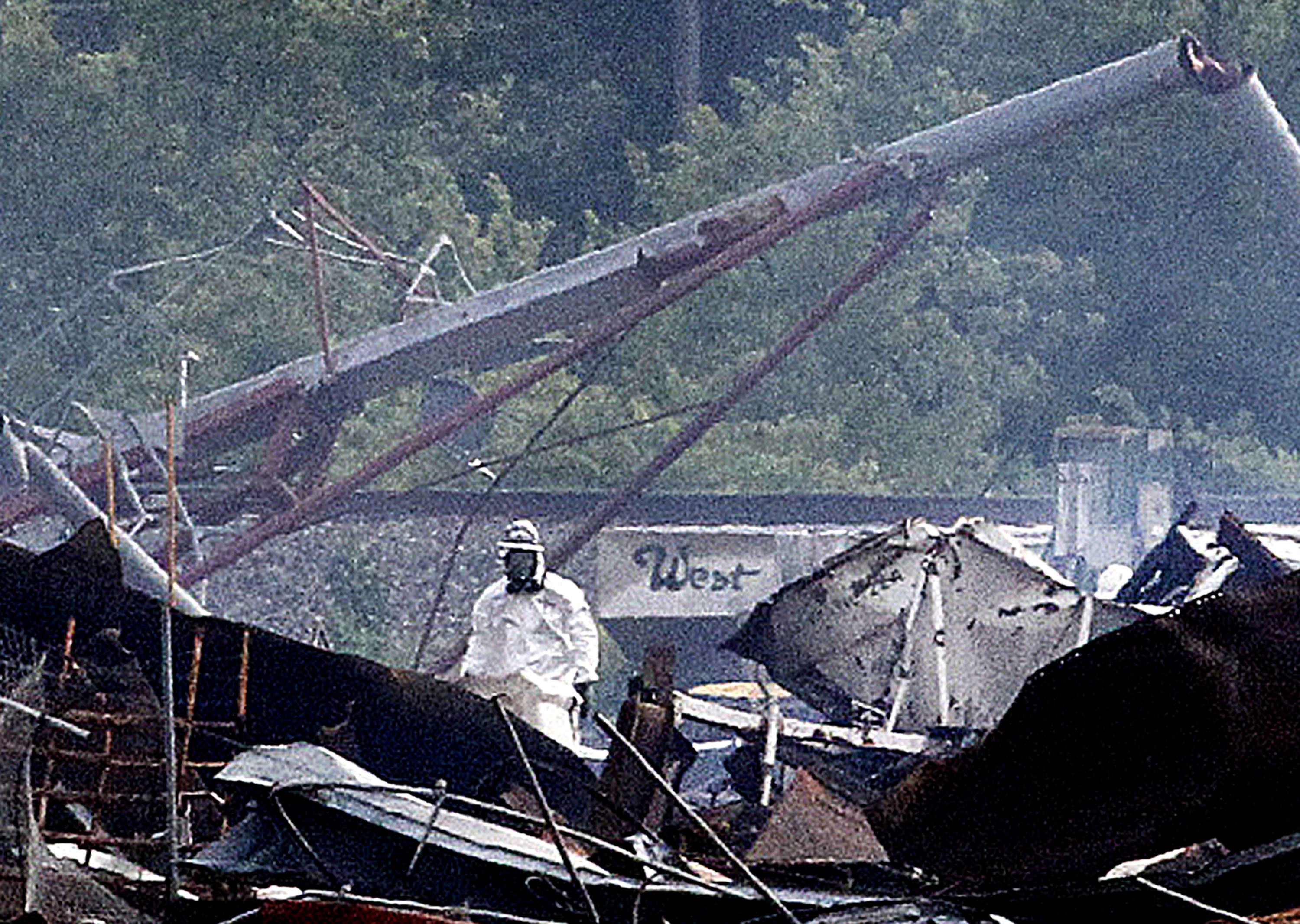
Searchers in protective suits walk through the blast zone of the fertilizer plant that exploded.
Update:House Bill 1714 failed to come up for a vote in the Texas House by the end of the day Thursday, the deadline for bills to pass out of the House. This is first time the bill has not been approved by the house since 2003, when Rep. Wayne Smith first filed it. Previously the bill has always died in the State Senate, according to testimony Rep. Smith gave at an April 9th committee hearing.
Investigators continue to sift through the rubble in West, Texas to learn how a fertilizer plant there exploded, taking 15 lives and destroying nearly two hundred homes. Many state officials deny that environmental regulations, or their absence, had anything to do with the disaster.
But that hasn’t stopped the tragedy from changing the way people talk about environmental regulation this session.
The bill would end a program that grades businesses on environmental compliance and makes those grades public. The bill’s author, state Rep. Wayne Smith, R-Baytown, says the program at the Texas Commission on Environmental Quality (TCEQ) burdens businesses and regulators alike.
Groundwater levels in Texas’ major aquifers dropped considerably between 2010 and 2011, as the state’s drought intensified, according to a report published recently by the Texas Water Development Board.
The report showed significant declines in the Ogallala Aquifer, which underlies much of the Panhandle. The water board monitors 26 wells in the Ogallala, and water levels dropped in all but one during the 2010-11 period. The average drop was 3.5 feet, with a median decline of 1.8 feet.
“This year of a drought — it has affected even the groundwater levels to a greater extent than I’ve ever seen,” said Janie Hopkins, who manages the water board’s groundwater division.
The figures for 2011-12, which will probably be ready for publication around August, are also expected to be gloomy. There will probably be a “continuing downward [trend] in the majority of these wells, but just at a less rapid rate,” Hopkins said. Continue Reading →
Tanker trucks arrive at the disposal well that was site of a 2012 explosion. It's approved to inject 30,000 barrels of wastewater a day.
Some people who live in Pearsall, the South Texas town where country star George Strait grew up, said they learned they had a disposal well nearby when they heard a big boom.
“Then I saw the billows of smoke coming out,” said Henry Martinez, Pearsall’s police chief.
He’s talking about the afternoon in January 2012 when investigators say a welder’s spark ignited oil vapors at a disposal site on the edge of town.Three workers were hurt and OSHA later cited the operator for alleged violations and proposed a $46,200 penalty.
As the legislature enters its final weeks, what are the big energy issues still facing lawmakers? Sunday on KXAN StateImpact Texas’ Mose Buchele joined a panel to discuss how water, drilling and fracking are forcing legislators to make some tough decisions as things get down to the wire. You can watch their discussion in the video above.
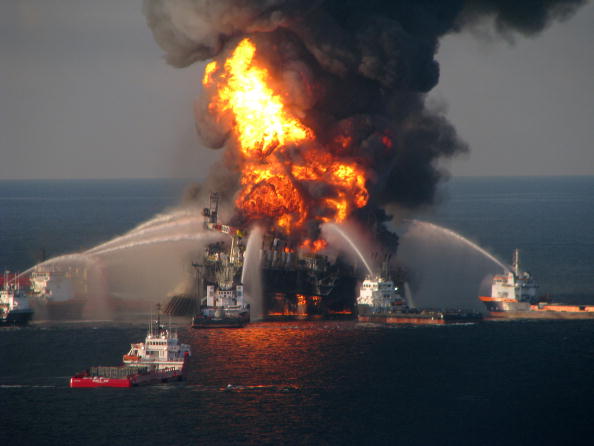
Fire boat response crews battle the blazing remnants of the offshore oil rig Deepwater Horizon in the Gulf of Mexico on April 21, 2010 near New Orleans, Louisiana.
Texas has announced five projects it hopes to fund with money from a settlement from the BP Deepwater Horizon oil spill in 2010. Three of them would aid in building artificial reefs along the Texas Gulf Coast — something that could prove a boon to the fishing industry and tourism.
While Texas was not hit as hard by the oil spill as neighboring Louisiana, its commercial fisheries have suffered in recent years. The spill impacted fishing and tourism in the Gulf. Then in 2011, the state delayed opening its oyster fisheries because of red tide associated with that year’s massive drought. Increased rainfall later put oysters back on the menu, but the precarious future of Texas oysters prompted Parks and Wildlife to boost construction of artificial reefs that can encourage oyster growth.
The three reef projects announced this week include:
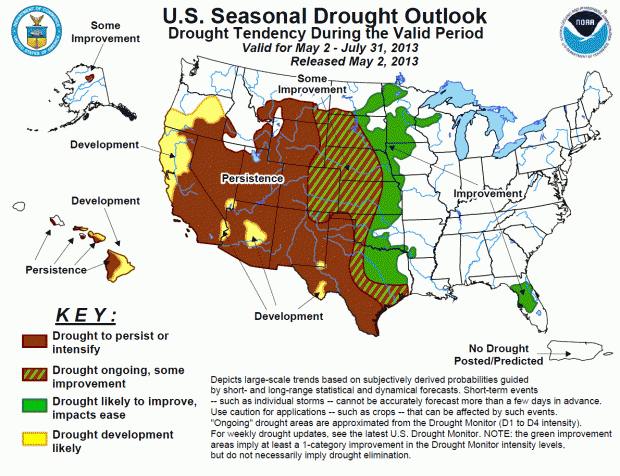
The latest NOAA drought outlook shows possible improvement for a larger part of the state than in the past forecast.
More of Texas could begin to recover from the drought in the coming months, but it may not be soon enough to save many of the state’s crops.
The three-month outlook from the National Oceanic and Atmospheric Administration (NOAA) Climate Prediction Center, released Thursday, shows a larger portion of the state possibly improving than in a previous forecast, with much of East Texas listed as “likely to improve” or having “some improvement,” however the drought is forecast to “persist or intensify” in the Western half of the state.
Though the US Drought Monitor Map released Thursday shows no difference in how much of the state is experiencing drought this week, it does show less of Texas under the two most severe drought stages. Much of this exceptional drought is in deep South Texas, where it is taking a toll on crops. Continue Reading →
After 40 minutes of discussion Thursday about a bill that would rename the Railroad Commission of Texas and make other significant changes to the agency that regulates the oil and gas industry, the Senate passed the measure with a 21-0 vote.
Senate Bill 212, carried by state Sen. Robert Nichols, R-Jacksonville, would rename the agency the Texas Energy Resources Commission. That would reflect its current duties, which no longer include railroads .
A companion bill, House Bill 2166, is moving through the House. This morning the House Energy Resources Committee voted to forward the measure to the full House.
SB 212 would also tighten some of the ethics rules governing the Railroad Commission. The commission is headed by three elected officials, who get many of their contributions from the oil and gas groups, despite also regulating them. Continue Reading →
Each day, dozens of trucks hook up to the Gulf Coast-run fracking fluid disposal well site near Gonzales, TX. A new bill would make it easier to transfer the wastewater by pipeline instead of by truck, potentially reducing roadway damage.
Update: The Senate unanimously approved SB 514 from the floor this afternoon, according to a representative from Sen. Davis’ office.
Original Story: A bill that would reform how fracking wastewater moves to disposal wells could pass through the state Senate today.
SB 514, introduced by state Sen. Wendy Davis, D- Fort Worth, would expand the use of pipelines to transport oil and gas waste to disposal wells. The bill was designed to ease the strain tanker trucks transporting waste can cause on some roads.
In the drilling process known as hydraulic fracturing, or “fracking,” millions of gallons of water (along with sand and chemicals) are sent deep underground to break up oil and gas deposits trapped in rock. Some of that fluid comes back up, along with high-salinity water also trapped int those formations. Since it is too dirty to drink, drillers often dispose of it by sending it back underground in a disposal well.
StateImpact seeks to inform and engage local communities with broadcast and online news focused on how state government decisions affect your lives. Learn More »