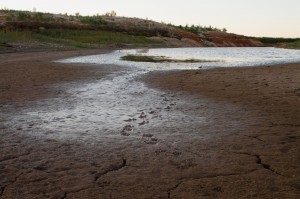
Lake Meredith is currently at a level too low for municipalities to draw water from it, according to Dr. David Brauer with the Ogallala Aquifer Research Project.
Heavy rains over Memorial Day weekend helped pull more of the state from the depths of an ongoing drought. Parts of Northeast Texas along the Red River joined the Houston area as the three percent of the state no longer under abnormally dry or drought conditions.
Dr. David Brauer, a USDA researcher who manages the Ogallala Aquifer Research Project, says the continuance of the drought is taking a major toll on the region’s already stressed water resources. Continue Reading →
Hurricane Sandy strikes the East Coast on October 28, 2012. Forecasters are predicting an active hurricane season this year.
Tomorrow marks the beginning of the six-month Atlantic hurricane season, and forecasters think it might be a doozy.
The National Oceanic and Atmospheric Administration (NOAA) predicts this coming season will produce more than 13 named storms. An average season produces 12, but the amount of hurricanes and major hurricanes is predicted to be above average as well.
Dr. Gerry Bell, lead seasonal hurricane forecaster at NOAA says this summer will have at least two of the three main factors that lead meteorologists to predict a strong season. Continue Reading →
Tesla plans to have six super-charging stations in Texas within the next six months, with more to come.
The luxury electric car company Tesla announced plans today to rapidly expand its network of “super-charging stations” across the country, including a number of spots in Texas. But the company still can’t sell to consumers in Texas directly, despite a strong effort to lobby state lawmakers to change the rules.
The charging stations are meant to allow drivers to go from city to city, and the company is planning to put them outside of Austin, Dallas, San Antonio and Houston. In fact, the company plans to add so many charging stations that within six months, they say it will be possible to travel from Los Angeles to New York in a Tesla. The stations charge a car for 20 to 30 minutes, allowing a Tesla S to run for around three hours of driving, and are free for Tesla owners. (Other electric cars, however, cannot charge at the stations.) That’s significantly faster than existing public charging stations in Texas, but Tesla’s East Coast network of charging stations was negatively reviewed in the New York Times earlier this year. And that review was subsequently criticized by the paper’s public editor. Regardless, the controversy doesn’t appear to have slowed Tesla down: the company posted its first profitable quarter recently, earned a near-perfect score from Consumer Reports for the Model S, and paid off its federal loans nine years early.
Water was one of the big topics this legislative session, as a growing state faced strained supplies and year after year of drought. Well before things kicked off this year, a plan surfaced to take $2 billion from the state’s Rainy Day Fund to start a water bank that would fund pipelines, reservoirs, conservation and more. That plan had widespread support, yet still faced opposition from Tea Party conservatives in the House. Ultimately, a mix of bills was put together to start the water bank and reform the agency that will oversee it, the Texas Water Development Board (TWDB). But not so fast.
While Governor Rick Perry signed off on a big part of the plan earlier this week with HB 4, there’s one catch: in order for the bank to get up and running, voters will have to approve it. There wasn’t enough will in the legislature to break the state’s spending cap and spend the money themselves, so instead voters will be making that decision on the ballot this November.
How’d we get to this California-esque decision? KUT’s Ben Philpott tells the tale of how Texas lawmakers decided to take a gamble and put the choice to voters this fall in what’s likely to be a low-turnout, off-year election: Continue Reading →
Just as Gov. Rick Perry and lawmakers finalize plans to spend $2 billion on water-supply projects around the state, a court decision could force Texas to rethink its water-planning process.
Last week, Texas’ 11th Court of Appeals ruled that two regional plans feeding into the 2012 state water plan — a 300-page document that underlies the Legislature’s new water initiatives — contained conflicting recommendations.
In the case, Texas Water Development Board v. Ward Timber, the appellate court upheld a lower court’s decision and ruled against the Texas Water Development Board, the architect of the state water plan.
It ruled in favor of landowners concerned about the proposed construction of a reservoir on their property, and urged the water board to come up with a “a more considered plan.”
The water board could appeal to the Texas Supreme Court. But if the ruling is upheld, the upshot, according to some water experts, is that Texas’ water planning process is now far more open to legal challenges. Continue Reading →
Fracking seems to be the gift that keeps on giving to Texans of all pay grades. Not only are roughnecks and engineers in big demand, so are lawyers who specialize in oil & gas. At the biggest firms, young lawyers can start at $160,000 a year. For top partners, their time can be billed at a rate of up $1,000 an hour according to the American Bar Association.
“The different clients that I have, fortunately enough, were all driven by fracking because without that technology that market would never have opened,” said James Collura.
Dave Fehling / StateImpact
James Collura is an oil & gas lawyer in Houston.
Collura is an oil & gas attorney with the Houston firm of Coats Rose. It’s not one of those “big” firms and says it prides itself on keeping costs low.
Nonetheless, Collura said his firm is paying higher starting salaries despite what has been happening in other states where hiring is down dramatically. Continue Reading →
E.V. Spence Reservoir in Robert Lee Texas is running dry. The latest iteration of the Texas Water Plan could help Texas' water supply, if it is funded.
During the worst of the Texas drought, in 2011, when temperatures soared, dessicated lake beds cracked open, rivers dried to a trickle and several towns nearly ran out of water, Texas Governor Rick Perry asked all Texans to pray for rain.
It was not a novel remedy to Texas’ recurring drought problem. Nearly 60 years earlier, in 1953, Governor Allen Shivers asked all of Texas’ ministers to pray for precipitation.
In addition to prayers, the drought of record — as the 1950s drought is known — also spurred Texas officials to write the first State Water Plan, forecasting Texas’ water needs in the coming decades. In November, Texans will decide whether to put $2 billion from the state’s rainy day fund to a contemporary version of that plan. So now may be a good time to look back the history of the water plan, its successes and failures, before making that choice.
Glancing back at those old water plans, one can see a document that shaped enduring features of the Texas landscape. But back when officials wrote the first plan, Texas was a different state, says Andy Sansom, Director of the Meadows Center for Water and the Environment at Texas State University.
The lead oil and gas regulator in Texas passed new rules for fracking and drilling wells today. (Photo of a Cabot natural gas drill at a fracking site in Pennsylvania.)
The Texas Railroad Commission passed a long-awaited rule on Friday to strengthen the construction of oil and gas wells.
The rule, known as the “well-integrity rule,” passed by a unanimous vote among the three commissioners. It will take effect next January, and will update the commission’s requirements for the process of drilling wells, putting pipe down them and cementing things in place.
“We are sending a strong message to the rest of the states and the federal government that we are doing things right in Texas,” said Commissioner David Porter, in comments shortly before the rule was adopted.
The rule also contains some new requirements for hydraulic fracturing, the water-intensive rock-breaking process that takes place after the well is drilled. Continue Reading →
The Mexican border. More and more pipelines are being built to bring natural gas from Texas into Mexico.
When the U.S. Department of Energy (DOE) announced that it would issue a permit to export liquified natural gas to new markets from a facility in Texas recently, the news was greeted as a game changer. Opening international markets could drive the price of natural gas up domestically, spur a new rush to drill for gas, and stimulate some parts of the economy while disrupting others.
Despite all that excitement, a second, quieter, natural gas export boom is already taking place right under our noses. Mexico is importing a record amount of natural gas to create electricity and feed its growing industrial base. Eighty percent of all the gas Mexico imports comes from the United States, and 60 percent comes directly from pipelines in Texas.
“That’s something that most people probably haven’t been aware of,” David Blackmon, an industry consultant and natural gas advocate told StateImpact Texas. “We’ve always exported natural gas into Mexico, so this whole debate over whether we can export it in liquid form rather than pipelines has always kind of befuddled me.”
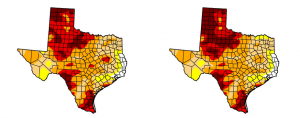
While the overall percentage of the state suffering from drought did not increase from last week, six percent of Texas, mostly in the Panhandle, sunk deeper into it.
U.S. Drought Monitor Archives
The dark red represents the most severe level of drought. It spread to cover more than six percent of the state in the past week, most notably in the panhandle.
State climatologist Dr. John Nielsen-Gammon says that much of the state already suffering from drought will likely experience a hotter-than-normal and drier-than-normal summer.
“Even if we just get normal rainfall it would be great,” Gammon tells StateImpact Texas. “But the trouble is any gaps in rain will cause things to dry out again. It’s more a matter of getting repeated regular rain than any single amount.”
StateImpact seeks to inform and engage local communities with broadcast and online news focused on how state government decisions affect your lives. Learn More »