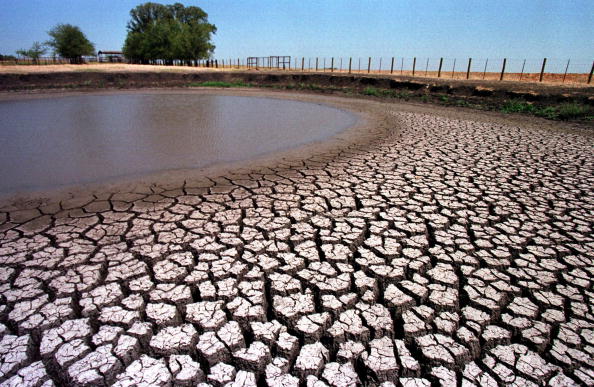
A stock pond south of Dallas, TX, dries up due to drought.
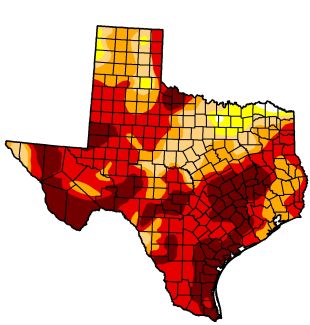
Some drought news from across the state today (95 percent of which is still in drought):
Houston (specifically, all of Harris County) has been lifted out of the most severe stage of drought, “exceptional” for the first time since March. An “exceptional” level of drought means “widespread crop/pasture losses; shortages of water in reservoirs, streams, and wells creating water emergencies” according to the US drought monitor.
But the western half of Harris County is still in “extreme” drought, and the other half is only one level better, “severe,” according to Eric Berger of the Houston Chronicle.
The burn ban that had been lifted for several weeks in Travis County (where Austin is located) has been reinstated. “At their meeting this morning, the Travis County Commissioners approved a recommendation from county Fire Marshall Hershel Lee to reinstate the ban,” StateImpact partner KUT News reports. Continue Reading →
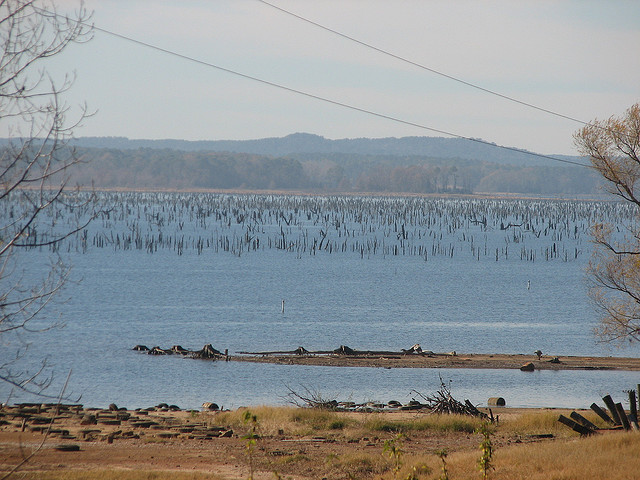
A Great Egret on the shores of the Toledo Bend Reservoir
Just hours after the Sabine River Authority of Louisiana called off a plan to sell massive amounts of water to Texas, its chairman resigned. Robert Conyer had been on the board for four and half years, and told the Town Talk that he was “frustrated” at the board’s inability to get things done. “Working through politics became the most frustrating thing I’ve ever done in my life,” Conyer told the paper.
The Sabine River Authority of Louisiana, which regulates the Louisiana side of the lake, held a meeting late last week and decided to call off the proposed water deal until the board develops a comprehensive water plan. While Conyer supported the decision to end the proposed water deal, which would have sold water from the Toledo Bend Reservoir to Texas, he wasn’t happy with how the decision went down.
“Commissioners said they had decided prior to Thursday’s meeting to end the water sales talks. Opposition from citizens, civic groups and local governing bodies had been growing in recent weeks, even though the SRA had been talking about the proposal by Toledo Bend Partners LP proposal for most of 2011 and took the first official vote in its favor in August.”
May 2010: Shrimp boat deploys oil boom around slick in Gulf of Mexico
The Federal government’s Bureau of Ocean Energy Management (BOEM) held a public hearing last week in Houston on the environmental impact of its plan to sell more leases to drill in the Gulf of Mexico off the coast of Texas. But almost nobody showed up to testify.
A plan to suck massive amounts of water from a Louisiana lake and sell it to Texas is off, the Shreveport Times reports. The Sabine River Authority of Louisiana, which regulates the Louisiana side of the lake, held a meeting late last week and “voted to suspend out of state water sales until a comprehensive water plan for Louisiana has been developed.” Some 300 people had gathered at the meeting, and when the vote against the sale went through, it was met “with applause, whoops of joy, and a few offered a hearty “Amen,” the paper reports.
What exactly was the plan? For starters, one of its financial backers was University of Texas alum and businessman Red McCombs. Forrest Wilder of the Texas Observer has the details: Continue Reading →
Photo Courtesy of Jim Gossen, Louisiana Foods - Global Seafood Source
An Asian Tiger Prawn caught last September near Little Lake in Larose, LA
It was a varied week of reporting for our StateImpact Texas readers over the last week, with articles on the drought, tax breaks, solar farms and tiger prawns. In case you missed any of them, here are the top five StateImpact Texas articles published since last week:
The Rain in Texas is Mostly… Well, Everywhere: Massive rains hit Houston last week, causing flooding and even a few tornadoes. And much of the state has seen above-average rainfall in recent months. So is the drought on its way out? Not even close.
Texas and the Terrible, Horrible, No Good, Very Bad Year: New year-end data and maps from the government show what a year 2011 was for heat and drought in Texas. Records were broken across the state, as extreme weather reached levels never seen before.
Tiger Prawns Roar Into the Gulf of Mexico: The Asian Tiger Prawn — which can grow over a foot long — is from the Western Pacific Ocean and first showed up off the coast of Alabama in 2006, when a single, solitary prawn was reported. If the story ended there, we wouldn’t have much to talk about.
And not just any butter, but a large sculpture of it “showing a boy leading his prize-winning calf through a county fair,” according to our sister site StateImpact Pennsylvania. The sculpture is an annual tradition at the Pennsylvania Farm Show, and this year a farmer is taking the butter, converting it to methane, and running his home and farm off of the energy for three days.
“Turns out, butter becomes gas through the work of a methane digester. Glenn Cauffman, the manager of Penn State University’s Farm Operations, said the butter will be dumped into a big heated tank where microorganisms will feast on it. “Those microorganisms can break those fat molecules apart into the less complex molecules,” he explained. “Then further take that to produce a gas called methane, which burns readily in an engine, and can be converted into…electricity.””
This week comes news that Valero will not seek an appeal of the TCEQ’s decision. In an email to StateImpact Texas, Valero spokesperson Bill Day says that “we did not appeal the TCEQ decision.” He had no other statement beyond that, but did tell Matthew Tresaugue of the Houston Chronicle that:
“Valero spokesman Bill Day said the company no longer would seek the exemption because it had reached agreements with appraisal districts for lower valuations on their refineries in all but one county where the company operates. Negotiations are ongoing with Moore County, Day said.”
It appears that the case is closed. The request was originally made in 2007, when Valero bought the equipment. The money, potentially as much as $92 million, would have come from property tax refunds in appraisal districts, which means it would have been taken back from cities and schools that are already struggling. The request for the tax break drew protests from community leaders, schools and environmental groups.
The 380-acre Webberville Solar Farm outside of Austin will power 5,000 homes.
Just days after the ribbon was cut on the largest solar farm in Texas outside Austin, San Antonio has announced a new solar project that would dwarf its neighbor to the North: a 400 megawatt solar project that would be twice as large as any solar farm currently runningin the world.
Some key points:
There are about 717,000 people who get power from CPS energy, the city-owned electric utility in San Antonio, which uses around 7,500 megawatts of power. So this 400-megawatt project would provide power to about five percent of San Antonio. (The Webberville solar project in Austin, by comparison, will produce up to 30 megawatts of power.)
The company behind the project, OCI Solar Power, is a South Korean subsidiary, and will be moving its headquarters to San Antonio as a result of the agreement. In a press release, the company says the project will result in “800-plus professional and technical jobs” with a payroll of nearly $40 million, and “more than $1 billion in construction investment.”
The agreement is for 25 years, and will allow San Antonio to reach its goal of sourcing 20 percent of its energy from renewable energy by 2020.
So does this mark the beginning of a “solar war” between Austin and San Antonio? Continue Reading →
The drought in the South has taken an enormous toll on the states of Texas, Oklahoma, Louisiana and New Mexico. In Texas alone, the state has lost billions of dollars and counting. The drought has affected many parts of everyday life: burgers, peanut butter, even Christmas trees were hurt.
Where is that land of normalcy, you ask? They’re those specks of white on the map to the the right. Along the Red River at the Northeast border between Texas and Oklahoma, and also in parts of Wise and Denton counties, some Texans are actually living drought-free.
StateImpact seeks to inform and engage local communities with broadcast and online news focused on how state government decisions affect your lives. Learn More »