Deep in the Heart of Texas Oil: an Italian restaurant has pulse of industry
Barbie Lomonte works in a part of Houston that has one of its biggest concentrations of oil and gas companies. She knows a lot about the industry and what the price for a barrel of oil means to it.
“Business has been wonderful, oil and gas are doing well and I have nothing to complain about,” said Lamonte as her employees bustled around her, filling orders.
She herself isn’t an oil trader nor does her company do any drilling. But it does use lots of oil. But of the olive variety, not Texas tea. She owns Lomonte’s Italian Restaurant.
“We’re right in the middle of the Energy Corridor,” said Lomonte.
The Energy Corridor is what the locals call a strip along Interstate 10 that runs west out of Houston. From Lomonte’s restaurant, you can drive less than two miles and pass the headquarters of ConocoPhillips, BP America and CITGO. At lunch time, a shuttle bus brings geologists, oil engineers, and accountants by the dozens to Lomonte’s and several other eateries clustered under big live oaks.
Lomonte has run the restaurant for over two decades and has shared the roller-coaster ride that is the oil business in Texas.
Photo courtesy of Roland Sledge for Railroad Commissioner
Candidate Roland Sledge says he's "gaining momentum" from an online ad that went viral.
The Railroad Commission of Texas, which, despite its name, actually oversees oil and gas drilling in the state, has two seats up for election this fall. One of them will likely be re-taken by its current inhabitant (and chairman of the commission), incumbent Barry Smitherman.
But the other seat is wide open after Elizabeth Ames Jones resigned from the commission earlier this year to run for state Senate. (In the interim, Governor Perry’s appointee Buddy Garcia is occupying the seat until the election.) There’s a close race for it in the Republican Primary between Rep. Warren Chisum, R-Pampa and Austin attorney Christi Craddick, daughter of state Rep. Tom Craddick. (There are several others running for the seat but without much traction, with one exception, which you can read about below.)
Both seats will be determined in the General Election this fall when the Republican and Democratic primary winners face off (the open seat has only one Democratic candidate running unopposed in the primary; Smitherman’s seat has no Democratic challenger). With that out of the way, let’s take a look at some of the video ads the candidates have put forward.
As much as three inches of rain have fallen on the state in the last 24 hours
Blue skies over a lake outside of Houston, Texas
The National Weather Service is predicting more rain today
Water trickles down from Clear Lake in Houston
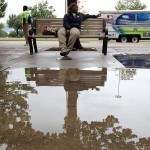
A fan waits after Game Two of the American League Championship Series at Rangers Ballpark in Arlington was postponed due to inclement weather on October 9, 2011 in Arlington, Texas.
Cattle stand in high water on a flooded farm after Hurricane Ike hit September 15, 2008 in Winnie, Texas. Ike caused extensive damage along the Texas Gold Coast, leaving millions without power.
A steer is reflected in water as it sits on the high ground of Rt 10 because pastures are filled with brackish flood waters from the storm surge of Hurricane Ike September 17, 2008 in Jefferson County Texas, Texas. Hundreds of cattle have died and more are expected die after drinking the brackish water. Hurricane Ike caused wide spread damage and power outages on the Texas coast.
Cattle stand in high water on a flooded farm after Hurricane Ike hit September 15, 2008 in Winnie, Texas. Ike caused extensive damage along the Texas Gold Coast, leaving millions without power.
A young boy cools off in the Volcano Lake slide, July 20, 2000, at the Wet ”N” Wild Waterworld in Anthony, Texas. A heat wave that stretches from Arizona to the southeast coast, is being blamed for at least 12 deaths in Texas and another six in Alabama and Louisiana. Health officials in some states say they won”t know how many people have died from sweltering temperatures until autopsies are complete. High humidity is making heat in the Southeast even deadlier than the dry heat of the Southwest.
It’s raining (and in some cases, flooding) across Texas. A popular question this morning will be: Is the Drought Over? And the answer to that largely depends on where you are. If you’re in East Texas, the answer is a qualified yes. (Many reservoirs still haven’t recovered.) In West Texas? There’s still a ways to go.
But regardless of whether or not the drought is technically abating, the issues behind it are here to stay. Texas is growing rapidly, and will not have enough water to meet its needs unless changes are made. (For an invigorating discussion of those issues, check out this Twitter chat from earlier in the week.)
For now, it’s nice to take a breath and appreciate the wet winter behind us and the hopefully-wet Spring/Summer ahead. Above is a slideshow of scenes of water in Texas to feast your eyes on in the meantime.
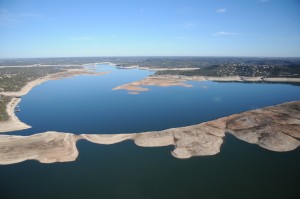
The extreme drought lowered levels in Lake Travis, revealing formations not seen above water in some time.
A reader asked us this question today: as rain is falling and more is in the forecast, just how much would it take to get the Highland Lakes full again? Those lakes, Buchanan and Travis, are vital source of water for Central Texas, and are currently less than half full (or more than half empty, depending on your outlook).
The lakes neared historic lows during the drought last year, as massive amounts of water were sent to rice farmers downstream; as it got hotter and drier, more water evaporated out of the lakes than the City of Austin used in the entire year. So what would it take to get them back up?
“In order to fill Lake Travis, it’s going to take a really significant storm system, or series of storms,” Bob Rose, meteorologist for the Lower Colorado River Authority (LCRA), tells StateImpact Texas. “Because, you gotta remember, Lake Travis is 41 feet below full right now. So you’d have to generate a lot of water across the Hill Country to make this happen.” Lake Buchanan would be an easier fix, as that’s only 17 feet below average.
Rose says a storm system somewhere between fifteen to eighteen inches could completely fill the lake. But there’s no “magic number,” he says, because it depends on where exactly the heavy rain would fall.
“An individual rain storm like that would likely cause some catastrophic flooding,” Rose says. “Spread out over two or three storms would be much better.”
But a massive deluge like that wouldn’t be unprecedented. Continue Reading →
Is it legal to kill Bigfoot in Texas? Parks and Wildlife has given an official, unequivocal answer.
We’ve been talking a lot about invasive species in Texas as of late, paying special attention to the issue of feral hogs, which are growing in number and cause widespread damage (but taste delicious). Texas has responded by making it very, very easy to kill feral hogs. You can hunt them with a handgun. You can hunt them whenever, regardless of the season. And you can even hunt them from the skies (an undertaking known as “pork chopping”), if that’s your thing.
But what about that most legendary of invasive species, Bigfoot?
Yes, someone actually asked Texas Parks and Wildlife Department, which regulates hunting in the state, whether or not it would be legal to capture and kill Bigfoot.
As the state grows and it seems to rain less and less, where are our water supplies going to come from? The three tackled the issues of desalination, water used in fracking and wastewater reuse during the half-hour chat. Plenty of other tweeters joined in, and for a while there #texaswater was trending in Austin.
Cattle prices are breaking records as ranchers rebuild their herds after the drought.
If you’re getting ready for summer grilling season, be warned. You can expect the price of steaks and hamburgers to be higher this summer. The reason is that cattle prices are nearly double what they were last year.
The drought that struck Texas in 2011 caused the state cattle industry to lose over three billion dollars. With little rain, grass simply didn’t grow, and ranchers had to buy hay at record-high prices from as far away as Montana. Many ranchers sold off their herds, which resulted in the largest decline in the beef cow inventory in Texas history.
But as that dry weather reduced supply, recent wet weather has increased demand. Continue Reading →
Break out the jorts and put away the turtlenecks, because the U.S. just ended the warmest 12-month period in its entire history, according to new numbers from the National Oceanic and Atmospheric Administration (NOAA). Naturally, Texas was no exception. The state had its second hottest May to April ever, and twenty-two other states had their hottest years on record. Overall, the country was 2.8 degrees hotter than normal over the last twelve months.
The report also says that last month was the third warmest April on record for Texas, with an average temperature of over seventy degrees. And it was dry. NOAA says that “many stations reported only five percent of normal precipitation or less” in Texas. The state got an average rainfall total of only 1.39 inches for the month.
But despite a relatively dry April, drought conditions in Texas and the south improved overall, according to NOAA. The report says that “the amount of extreme drought has been decreased by approximately six percent,” with much of that happening in western and southern Texas. Rains are either falling or forecast for much of the state this week, and the weather pattern mostly responsible for the drought, La Nina, has left the building. Fingers are crossed, but it could be a wetter, cooler summer this year.
The National Weather Service says the state could see significant rains between now and Sunday.
It’s been raining across Texas, and more is on the way. In the map to the right from the National Weather Service, you can see predictions for rainfall between three to five inches through Sunday this week for much of the state.
It’s welcome news for West Texas, which continues to struggle with the ongoing drought, while the eastern half has greatly (though not completely) recovered. A new report by the Texas Agrilife Extension at Texas A&M University sheds some light on why one half of Texas has suffered more than the other.
“The thing that was unexpected was having East Texas not be in an extreme drought right now,” Dr. John Nielsen-Gammon, state climatologist, told Agrilife Extension. “We had a second year of La Niña last winter. It just finally ended officially last month. And normally – four years out of five – you end up with a dry winter. So things have worked out as well as possibly can be expected for East Texas.” But West Texas, Nielsen-Gammon said, is now in its second year of major drought. And above-normal temperatures aren’t helping. Continue Reading →
And one of the best solutions is to simply put them on the table. That’s the preferred option with one of the more destructive invasive species in Texas, feral hogs.
“How would I solve the problem?” posited hunter, forager and chef Jessie Griffiths of Dai Due Austin. “Tiger prawns, wrapped in feral hog bacon, and then grilled over mesquite.” Griffiths serves wild boar tacos at an Austin-area farmers market and leads hunts for feral hogs in northeast Texas. Continue Reading →
About StateImpact
StateImpact seeks to inform and engage local communities with broadcast and online news focused on how state government decisions affect your lives. Learn More »