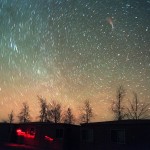
Leonid Multi-Instrument Aircraft Campaign captured this image during the 1999 Leonid meteor storm
AZRAK, JORDAN: Photo dated 18 November 1999 shows a Leonid meteor storm over the Azrak desert, 90km east of Amman. The storm packed up to some 1,500 meteros per hour visible with the eye. The Leonids – so called because they appear in the sky in the region of the constellation of Leo – are a stream of minute dust particles trailing behind the Tempel-Tuttle comet, which is visible from earth every 33 years.
Image was taken during the 1999 Leonid meteor storm as part of NASA’s Leonid Multi-Instrument Aircraft Campaign
Four Views Of The Leonid Meteor Shower Of 1966, A Peak Year For This Active Yearly Shower. The Next Leonid Peak Is In The Years 1998 To 2000. The Leonids Make Their Appearance, And Take Their Name, From A Point In The Constellation Leo. These Pictures Were Taken On November 18Th, 1966, From The Kitt Peak National Observatory Near Tucson, Arizona.
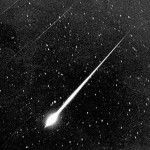
SHERBORN, UNITED STATES: The green streak of a meteor seen in the southern sky of New England photographed in Sherborn, Massachusetts early 18 November, 2001 and was one of thousands that entered the earth’s atmosphere during a major meteor shower. The shower, which occurs over several days every mid-November, is called the Leonids because it appears to come from the constellation of Leo.
This Bright Leonid Fireball Is Shown During The Storm Of 1966 In The Sky Above Wrightwood, Calif. The Leonids Occur Every Year On Or About Nov. 18Th And Stargazers Are Tempted With A Drizzle Of 10 Or 20 Meteors Fizzing Across The Horizon Every Hour. But Every 33 Years A Rare And Dazzling Leonids Storm Can Occur But, Astronomers Believe The 1999 Edition Of The Leonids Probably Won’T Equal 1966, Which Peaked At 144,000 Meteors Per Hour.
Stars of the racetrack won’t be the only lights in the firmament this weekend. It’s also peak time for viewing the Leonid meteor shower. “The shower should produce perhaps a dozen or so “shooting stars” per hour,” UT’s StarDate at McDonald Observatory writes. “The best view comes in the wee hours of the morning, as your part of Earth turns most directly into the meteor stream.”
Peak viewing times should be between midnight and dawn Saturday night.
“Just remember, a meteor shower peak prediction is not an ironclad guarantee,” EarthSky writes. “If it’s clear, you might see nearly as many meteors in the predawn darkness on Friday, November 16 or Sunday, November 18. The days before and after that might feature meteors as well, as we pass through the Leonid meteor stream in space.”
If you were making your way across parts of Texas last year, you would be forgiven for wondering if it all wouldn’t simply burn up and turn to dust. A new documentary shows how that literally happened to a wide swath of the country during the thirties because of human actions.
“The dust bowl was the greatest manmade ecological disaster in the history of the United States, and perhaps the world,” says documentary filmmaker Ken Burns, who has a new two-part series on the dust bowl airing Sunday and Monday on PBS. In Texas, the dust bowl hit the panhandle hard. And during the drought last year, dust storms once again kicked up around Lubbock, with an amazing intensity you have to see to believe.
In the interview above with Inside Climate News, Burns talks about some of the lessons to be learned as we enter a new era where manmade activity is once again changing the climate.
Fire boat response crews battle the blazing remnants of the off shore oil rig Deepwater Horizon in the Gulf of Mexico on April 21, 2010 near New Orleans, Louisiana.
In the largest criminal penalty in history, BP will pay $4.5 billion to settle a federal case over the April, 2010 Deepwater Horizon oil spill.
The settlement will resolve numerous criminal claims against BP brought by the Department of Justice (DOJ) and the Securities and Exchange Commission (SEC). As part of the agreement, BP also agreed to plead guilty to 11 felony counts related to the 11 workers killed in the disaster, two misdemeanors, and one additional felony count for obstruction of Congress. Announcing the deal on its website, BP says that all but one of these charges “are based on the negligent misrepresentation of the negative pressure test conducted on board the Deepwater Horizon.” BP says they acknowledged this two years ago when they released an internal investigation of the disaster.
There’s still the open question of ongoing civil claims against BP for the spill, as well as several outstanding state and private claims. BP says in a statement today that it will “vigorously defend itself against remaining civil claims” and that they weren’t “grossly negligent.”
So where will those billions go, and when does BP pay them?
A Red Bull Racing car wins the Korean Formula One Grand Prix in October.
Three model cars sit side-by-side on the windowsill of Zach Baumer’s office in East Austin, memories of a childhood spent with his family at Indy 500 races.
“Growing up in Indianapolis, I just have sort of a thing for cars,” he says. “Not that I think we should be driving single occupancy vehicles! But … it is what it is.”
There’s a reason Baumer might sound quick to qualify his fondness for horsepower and tight turns. As manager of the city’s Climate Protection Program he’s in charge of mitigating the environmental impact of another well known car race taking place in Austin this fall: the Formula One Grand Prix.
A proposed rate increase could cause water bills in San Antonio to go up over eleven percent.
A proposed rate increase will hike up water bills for folks in San Antonio; one man is trying to use mini solar power units to help those still without power after Hurricane Sandy; and eight environmental rules to watch out for after the election, all in your morning Meter Reading:
If At First You Don’t Succeed … Kate Sheppard reports in Mother Jones on eight environmental rules that didn’t get passed in President Obama’s first term and environmental groups are pressuring to move forward in the second. It’s a handy list of federal regulations to keep an eye on, including finalizing greenhouse gas emissions rules and new regs for coal ash disposal.
The Sunny Side of Sandy: Forbes tells the story of a man who runs a solar powered-generator business and how he’s gone to some of the areas hit the hardest by Hurricane Sandy to help provide power. Continue Reading →
Johnny Cecotto Jr. of Venezuela and testing for Scuderia Toro Rosso participates in the F1 Young Driver Test at Yas Marina Circuit on November 7, 2012 in Abu Dhabi.
More than a hundred thousand visitors are descending upon Austin this weekend for the Formula One race. Increased air traffic has some worrying about the carbon footprint of the event, but there’s one plane that may seem out of place.
It belongs to the Environmental Protection Agency (EPA), and it will take to the skies today and throughout the weekend to monitor chemical and radiation levels in town and around the track.
Why? The agency says is for security and to monitory air quality. Today’s flight will get a baseline reading, and if levels go up, the EPA will know it.
“For large event there is always a concern of terrorism,” Lisa Block, a public information officer with Travis County Emergency Services tells StateImpact Texas’ lead station, KUT. Continue Reading →
Many rice mills and drying and storage facilities won't see much work this year.
Today the board of the Lower Colorado River Authority (LCRA) approved a second year of emergency drought measures for some of the major water supplies in Central Texas, and under the new rules many will have to keep an eye on both the weather and the calendar to see how it all plays out. Rice farmers could be cut off for a second year in a row, or they could end up receiving water, sending the Highland Lakes to possibly historic low levels.
The LCRA is the quasi-state agency that manages the Highland Lakes and the Lower Colorado River. It’s in charge of the two main reservoirs of Lakes Buchanan and Travis, which provide drinking water to the people of Austin and other municipalities, as well as industrial customers. But the lion’s share of the water (roughly two-thirds of it) collected by those lakes goes downstream to grow rice in Texas.
Today’s emergency plan could result in a curtailment of that water for rice farming, but it depends on how much water is in the lakes come January (and again in March).
Here’s the new plan: If on January 1, 2013, Lakes Buchanan and Travis have less than 775,000 acre-feet of water in them (or are roughly 39 percent full), then water will not be sent downstream to three of the four irrigation districts serving rice farmers downstream in South Texas. (An acre-foot is a unit of measurement for water: how much water it would take to fill up an acre of land one feet deep, equal to 325,851 gallons.)
Coal miners look on as Republican presidential candidate and former Massachusetts Governor Mitt Romney speaks during a campaign rally at American Energy Corportation on August 14, 2012 in Beallsville, Ohio.
The ‘Golden State’ launches a massive initiative to go green today; a big coal company made some big campaign contributions before laying off workers; and some skepticism on how long the U.S. will hold the crown of ‘Oil King;’ plus more, in this morning’s Meter Reading:
Sorry, I’m Going to Have to Let You Go (Right After This Campaign Donation): Murray Energy, the nation’s largest privately-held coal company and a major contributor to the campaign of Mitt Romney, announced shortly after the election that they’d have to lay off 163 workers because of potential new regulations during President Obama’s second term. But in September, the company made $100,000 in donations to a Republican Super PAC, Politicoreports, and a total of $2.8 million in donations and lobbying by the company and its employees during the election.
Quid Pro Coal: California begins the nation’s first carbon swap today, and many eyes are on the state to see how it will work. NPR’s Christopher Joyce breaks down the plan: “Big companies must limit the greenhouse gases they emit — from smokestacks to tailpipes — and they have to get permits for those emissions. The clock starts Jan. 1.” Continue Reading →
Receding waters have ravaged communities in the Highland Lakes.
Update: The LCRA Board approved the emergency plan with some last-minute tweaks on Wednesday. Read the details here.
Original Story: The LCRA’s plan for emergency drought relief revealed Monday at a board meeting in Fredricksberg has left many upstream interests with a bad taste in their mouths.
The plan is itself a change from an earlier LCRA staff recommendation to not seek drought relief this year. That reversal had buoyed hopes in many Central Texas communities that water would stay in the Highland Lakes as long as they sat depleted from last year’s record drought. But as details of the plan emerged, it became clear that Highland Lake interests had not gotten the plan they wanted.
The lakes are currently only 43 percent full. Under the staff plan unveiled Tuesday, around 145,000 acre feet of water will be released to rice farmers downstream on January 1, as long as the lakes sit around 38 percent full on January first. A second water release could be approved in March if water levels remain at or above that 38 percent level.
Snow falls on flowers in the East Village neighborhood of Manhattan on October 29, 2011 in New York City. In the past 135 years there have been just three days of measurable snowfall in October in New York City's Central Park.
This week the International Energy Agency (IEA) released their annual ‘World Energy Outlook,’ and it’s getting a lot of attention for its predictions that the U.S. will soon outpace Saudi Arabia as a producer of oil.
That’s projected to happen by 2020, according to the report, thanks to a hydraulic fracturing-led boom in domestic drilling. Reserves of oil and gas in the U.S. and Canada once considered impossible to reach are now just a frack job away. But there’s a downside to this boom that hasn’t garnered much attention in the coverage of the report: climate change could be exacerbated as a result.
“The world is still failing to put the global energy system onto a more sustainable path,” the report says. The IEA says that factoring in emissions from new energy development will lead to a “long-term average global temperature increase of 3.6 degrees Celsius.” That’s largely due to the fact that increased drilling will meet new demand in China, India and the Middle East. As natural gas replaces coal in the U.S., that coal is being shipped to Europe, where gas is expensive. The fossil fuel industry enjoyed $523 billion in subsidies last year, the report says, more than six times the amount offered to renewables. The deck appears stacked in favor of continued reliance on fossil fuels. Continue Reading →
About StateImpact
StateImpact seeks to inform and engage local communities with broadcast and online news focused on how state government decisions affect your lives. Learn More »