Ron Curry has been appointed as the new regional administrator of the EPA.
The Environmental Protection Agency (EPA) has appointed Ron Curry, a former New Mexico Environment Department official, as the new regional administrator of Region Six of the EPA. That area covers Texas, Oklahoma, Arkansas, Louisiana and New Mexico.
In an email to StateImpact Texas, a spokesperson for Region Six of the EPA says that “will provide valuable insight into the public health and environmental challenges facing Region Six, and will be able to offer a state’s perspective within the Agency.”
Curry served as Cabinet Secretary of the New Mexico Environment Department from January 2003 thru December 2010.
Texas Governor Rick Perry speaks to an estimated 30,000 attendees at the non-denominational prayer and fasting event, "The Response," on August 6, 2011 in Houston, Texas.
Texas has come a long way in recovering from the devastating single-year drought of 2011. The latest US Drought Monitor Map out this week shows that more than 11 percent of the state is completely drought-free. And less than 5 percent of the state is in the worst stage of drought. By comparison, a year ago, more than 88 percent of the state was in that “exceptional” drought stage.
Since then, things have drastically improved. And during a conference call this week with the prayer campaign 40 Days to Save America, former pastor and Christian fundamentalist Rick Scarborough credited Texas Governor’s Rick Perry’s call to prayer a year ago for ending the drought. Last August, Perry led a prayer and Bible reading at ‘The Response,’ a prayer meeting of some 30,000 to 40,000 people at the massive Reliant Stadium in Houston. And apparently it worked?
“The press was willing to mock the prayer and fasting,” Scarborough says in the call featuring Perry, which you can listen to here, “but failed to document that — what everyone had thought would take years — to replenish our lakes and streams — almost happened in three months.” Scarborough says farmers have had a record year of hay harvest (actually, they haven’t) and that it all goes back “to the courageous call of a governor of a state to the people to pray and fast.”
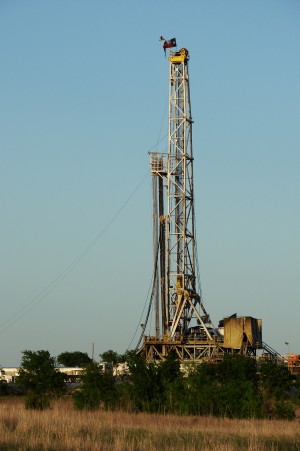
A hydraulic fracking operation in the Barnett Shale.
It’s nothing new to hear environmental groups raise concerns over the health dangers of hydraulic fracturing – that’s all in a days work. But a new report from Environment Texas questions one aspect of fracking that rarely comes under scrutiny: its supposed economic benefit.
“The Costs of Fracking” collects data from academic and government studies to paint a picture of an industry that may be a bigger drain on state tax money than previously thought. The report looks at things like damage to roads, increased cost for water infrastructure projects, and drilling’s impact on property values in the Dallas-Fort Worth area. Continue Reading →
Cedar Photo courtesy flickr.com/79666107@N00 bullseye image edited by KUT News.
The Ashe juniper goes by several names.
When people complain about cedar trees in Texas, they’re usually talking about allergies: the dreaded “cedar fever” that makes life a nightmare for millions of sufferers throughout large swaths of the state. But at the Texas Capital last week, lawmakers were talking about cedars for other, very elemental, reasons: water and fire.
Ashe Junipers, commonly called “cedar trees” in Texas, do a good job of drinking one and spreading the other according to testimony before the House Committee on Agriculture and Livestock.
A radioactive rod has gone missing somewhere in West Texas. Sounds like a job for Radioactive Man.
Somebody call Radioactive Man and Fallout Boy. A radioactive rod is missing in the West Texas desert.
Sometime last Monday, September 11, a three-man team of Halliburton oilfield workers lost a radioactive rod used in hydraulic fracturing, or “fracking.” The crew believes it was lost in an area of about 130 squaremiles, somewhere between a well site in Pecos and the crew’s destination south of Odessa. The tool was in the back of their truck, and at some point they noticed that the truck’s lock wasn’t in place (it was in the back of the truck) and the rod was missing. They went back to Pecos to see if it had been left at the drilling site, but it wasn’t there.
A judge hears argument in Beaumont, Texas over TransCanda's right to condemn land to build a pipeline.
When a North Texas Judge ruled in favor of TransCanda in its legal battle with landowner Julia Trigg Crawford last August, representatives for the Canadian pipeline company were, understandably, happy with the outcome.
“This ruling reaffirms that TransCanada has — and continues — to follow all state and federal laws and regulations as we move forward with the construction of the Gulf Coast Project,” TransCanada spokesman Grady Semmens told the New York Times.
Now the company is facing another legal challenge, from another Texas farmer, on similar grounds to the Crawford case.
Given all those similarities it makes sense to ask: what chance could the new challengers possibly have?
Lone Camp Volunteer Fire Department fire fighter Ted Hale fights a wildfire on September 1, 2011 in Graford, Texas.
Wildfire season across the American West is getting longer, and more destructive year by year, according to a new report from the research organization Climate Central.
Noting that the total area burned in the American West this year is 30 percent larger than average, the report blames recent ferociously destructive fire seasons on a variety of factors: fire suppression and forest growth have created more fuel for fires; and a gradual warming in global temperatures that’s creating longer and longer wildfire seasons.
“We can’t discount the importance of the broader climate context,” Dr. Heidi Cullen, Climate Central’s Chief Climatologists, said in a conference call presenting the report. Continue Reading →
“You know, the majority of water and wastewater plants throughout Texas and neighboring states have been funded or partially funded with federal financing that came through the EPA,” Armendariz said.
Greg Creacy is responsible for prescribed burning in Texas State Parks. He believes the benefits of the program are visible in the aftermath of the Bastrop County Complex Fire. In this photo, you can see forest hit by the Bastrop wildfire. On the left side, an area that had seen prescribed burns before the fire. On the right, an area that did not have prescribed burns before the fire.
Imagine that you’re in a house in the country. There’s a frantic knock at the door. You open it to find a group of men and women wearing fireproof gear, asking permission to fight a raging wildfire on your property.
“But there’s no fire here,” you respond in confusion.
“You don’t understand,” they say, “the fire won’t be here for another few years, but we need to fight it now!”
The scenario might sound fantastic, but it makes perfect sense to Larry Joe Doherty.
“That is precisely the whole point of prescribed burning,” he said recently over a lunch of red beans and rice at his Washington County ranch. “You wait around for an emergency and it’s too late!” Continue Reading →
About StateImpact
StateImpact seeks to inform and engage local communities with broadcast and online news focused on how state government decisions affect your lives. Learn More »