A cleanup team walks through the oily surf at Naked Island on Prince Williams Sound, a week after the Exxon Valdez oil tanker ran aground in March 1989 and spilled 11 million gallons of crude oil.
In his new book, ‘Private Empire: ExxonMobil and American Power‘, reporter Steve Coll takes a look inside the largest oil company in the world, a juggernaut with annual revenues of 450 billion dollars. “That’s more than economic activity of most countries,” Coll says in the first part of our interview. In part two, we talk to Coll about how the company reacted to both disasters.
Q: One of the things you talk about in the book about the corporate culture at ExxonMobil. It’s clouded in secrecy; it almost resembles a cult. And you’re saying that culture came out of the aftermath of the Exxon Valdez spill.
A: If we follow the metaphor that ExxonMobil is like a state, then the Valdez spill is kind of like 9/11 for them. It was a huge shock, it cost them their reputation overnight. Fifteen years later, they would run focus groups on why they were so hated, and they’d enter into wordplay games and say: ‘I’ll say Exxon,’ and all of their subjects would immediately say: ‘Valdez.’
So it was a huge stain on their reputation and their sense of themselves. Economically, it was costly, but they have the cash flow to deal with the settlements. But afterwards they undertook a series of sweeping reforms to try, essentially, to achieve a day-to-day practice in which nothing like that could happen again. Their goal was, basically, to ring all human fallibility out of their enormous daily industrial operations, whether at refineries, offshore oil platforms, or gas drilling. Everything.
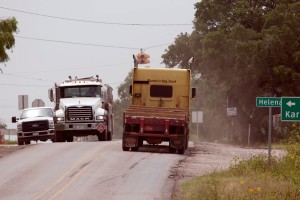
Photo courtesy Texas Department of Transportation.
Truck traffic on FM 81 in the Eagle Ford Shale formation area.
The Eagle Ford shale’s development in Texas is growing stronger from increasing production, as crude oil growth overtakes natural gas production. And with more production comes more profitability, according to a new report by GlobalData, a business research company.
The shale’s liquid production has increased nearly sixfold, going from 10.8 million barrels of oil in 2010 to 57.5 million barrels in 2011. With almost 6,000 drilling permits distributed since the beginning of 2011, the total gross production from the Eagle Ford shale is expected to reach 207.3 million barrels in 2012, and stabilize at 1,386.3 million barrels in 2020, according to the report. But with that growth comes a price.
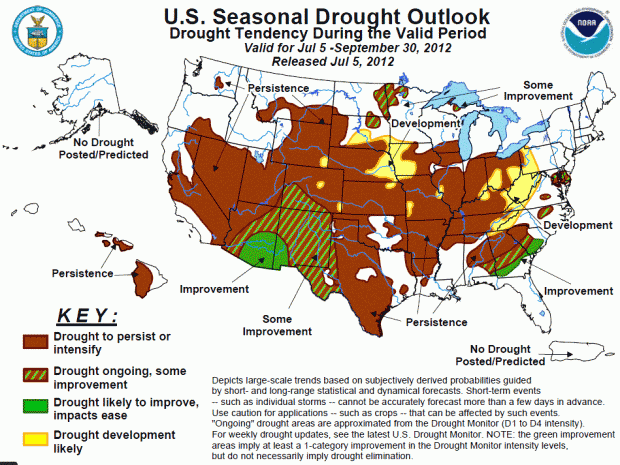
The National Weather Service’s Climate Prediction Center released the latest drought outlook this week. This is a prediction of what lays ahead in the next three months, and the news for Texas isn’t great: for much of the state, the drought is expected to “persist or intensify.”
It was a different story this spring. In the March 15 outlook, the drought was predicted to improve. And that’s largely what it did. Back then, over twenty percent of the state was in “exceptional” drought, the worst stage. And over 40 percent was in the next worst stage, “extreme.” Today only nine percent of the state is at that level, and none of the state is in “exceptional” drought.
But the new report shows that for the summer, a lot of Texas, and much of the rest of the country, is likely to see ongoing drought conditions. Here’s hoping that the predicted arrival of El Nino in the fall will bring rain.
It’s a typical summer in Texas: hot and dry with occasional bursts of scattered showers. But as the state continues to recover from a historic drought, more than typical weather is needed.
yum9me / Flickr/Creative Commons
An action figure of X-Men's Storm. Her ability to conjure up powerful storms would be highly coveted in drought-stricken Texas.
One way the state can receive precipitation during the summer’s dog days is a tropical storm. Of course, such an event can do as much harm as good. And absent the talents of the X-Men’s Storm, there’s no way to conjure up such an event.
Bob Rose, meteorologist at the Lower Colorado River Authority (LCRA), explains what a heat-beating storm would look like: “If we could somehow get a weak tropical storm, or a tropical depression, to come inland maybe along the lower or middle Texas coast, and work its way into Central Texas,” he says, that would be “our perfect mix for bringing significant rain and cooler temperatures.”
Victor Murphy of the National Weather Service agrees with the nourishing potential of a tropical storm. He says that “a tropical cyclone or at the very least a tropical disturbance” would be “the only shot for significant widespread improvement until the fall.” The downside, Murphy explains, is that there is often no way to confirm that a storm is headed toward Texas until, at most, a week out from its landing.
Absent the perfect storm, does Texas have any hopes of breaking the drought anytime soon? Continue Reading →
The Lower Colorado river is suffering from low oxygen levels. Is the drought to blame?
Some high school ecological enthusiasts have collected new data showing the Lower Colorado river ecosystem might be in jeopardy.
The river not only supplies much of Texas with its drinking water, it’s also a cherished destination for summer recreation. But all is not well on the Colorado, and authorities might not have known about the scope of the river’s troubles without the students’ research.
For about 20 years, the Austin Youth River Watch, an environmental education program, has organized groups of teens to monitor the water quality of the Colorado. Every week they check water at different parts of the river and its tributaries. And lately they’ve been getting some unusual readings.
“We’ve been picking up low levels of oxygen over the past few weeks and we’re pretty concerned,” says Brent Lyles, Executive Director of River Watch. He says the group is working with the City of Austin and the Lower Colorado River Authority to figure out why oxygen levels might be dropping. “If not for our students’ work, I’m not sure anyone would know this is happening,” he says.
Less oxygen could spell trouble for fish and other wildlife. And the group has already observed a large number of dead Asian clams in the river, a troubling sign of what happens when oxygen levels get low. Continue Reading →
Victoria Hogue helps to move cattle into pens after they had been sold at the Abilene Livestock Auction in July 2011. The drought caused shortages of grass, hay and water forcing ranchers to thin their herds.
Yes, grass initially came back on the ranches of Central and East Texas, but it’s been a dry few months. “The hay fields aren’t doing any good at all,” says Elgin rancher Brent Johnson. “I mean, you know, you’re lucky to get a 50 percent production off of ’em at best, and that’s probably even stretching it.” But because there are less cows this year after last year’s sell-off, the little hay production Johnson does have can cover his herd for now.
“Most of the state is out of exceptional drought now,” says Gene Hall with the Texas Farm Bureau. “But the real problem is going to be feed, growing enough grass, [and] putting enough hay away to matter.”
Some think the state’s cattle industry may never fully recover from the drought. But Hall says the cattle business is cyclical. “You can track it over time,” Hall says. “The beef economists, the cattle economists can look at it and show you okay, cattle numbers will build to the point where prices decline, they sell off, and then they start building again. Ranchers want to be building their herds now.” Continue Reading →
Steve Coll has traveled the world reporting on nuclear weapons, the CIA, and terrorists in the Middle East for The New Yorker and Washington Post. But he may have found his biggest reporting challenge yet right here in Texas.
In his new book, ‘Private Empire: ExxonMobil and American Power,’ Coll takes a close look at how the oil giant has become one of the most powerful organizations in the world. We recently spoke to Coll about his new book.
Q: So tell us why you decided to look into this company.
A: What’s so fascinating about ExxonMobil is their sheer scale. 450 billion dollars-plus in revenues last year, that’s more than the economic activity of most countries. But they’re rarely scrutinized by anyone, compared to the governmental departments that we cover in Washington as reporters. I worked on this project for four years and there was really no one in my side-view mirrors.
Q: How did you go about investigating them? What were some of the difficulties you came across?
A: It’s an outside-in process, when you take on a big, large, closed subject like this. And I find that, especially at the beginning, I have to do everything all at once. Explore all channels. Continue Reading →
When hot temperatures cause evaporation, salt remains, and that increases the salinity of the water in Texas bays. “You definitely saw the salinities were really high [during the drought],” says Leslie Hartman, the Matagorda Bay ecosystem leader of the Texas Parks and Wildlife Department. “They were actually oceanic levels of salinity last year, and not all fish are comfortable when there’s that much salt in the water.” Bays like Matagorda, with a mix of fresh river water and salty ocean water, need a balanced mix of the two in order for fish and wildlife to thrive.
On the other hand, too much rainfall can cause pollution to run off into the rivers, and eventually threaten the state’s bays and beaches. Continue Reading →
When water became scarce in Texas last year, scrutiny quickly fell on the state’s burgeoning energy industry. Proposed new coal plants had trouble getting water permits. And hydraulic fracturing drillers faced accusations of groundwater contamination and excessive water use.
But at the House joint hearing on energy and natural resources held last Wednesday, industry leaders gave representatives their side of the story.
“Even if we didn’t use another drop of water for drilling operations, water is still going to be an issue because of the drought and our state’s tremendous population growth. I want to be very clear. Hydraulic fracturing should not be the scapegoat for the water shortage in Texas,” said Porter. Continue Reading →
Along the Texas Gulf coast in cities where the skylines are formed by the stacks of refineries, they’re talking about a perfect storm headed their way. But this storm has nothing to do with the tropics and everything to do with natural gas.
“It’s almost a perfect storm of low energy costs, low financing costs, low construction costs,” said Bob Lieper, the city manager of Baytown.
StateImpact seeks to inform and engage local communities with broadcast and online news focused on how state government decisions affect your lives. Learn More »