The remains of a structure on the Gulf shore Galveston, Texas. Hurricane Ike changed the landscape of the region in September 2008.
Texans certainly have a love for private property. 95 percent of Texas land is privately owned. But earlier this week the state house Committee of Land and Resource Management heard invited testimony on a couple of situations that may call for Texas to take over a little more land by eminent domain.
The second case poses a more pertinent challenge for Texas representatives. Representative Rene Oliveira, chairman of the Land and Resource Management committee, says they must find a balance between landowner rights and the needs of the oil and gas industry. Currently, companies are required only to fill out a simple form, checking a box that says they’ll be “common carriers,” meaning they’ll allow other companies to use their pipelines. Continue Reading →
Photo courtesy of the University of Texas at Austin's Energy Institute
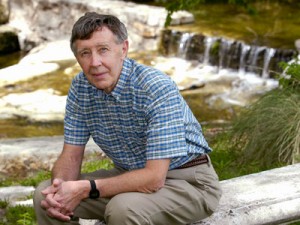
Dr. Charles "Chip" Groat, a professor at the University of Texas at Austin, has come under scrutiny for failing to disclose financial ties to the drilling industry.
University Will Have Outside Review of Fracking Study
A University of Texas at Austin professor came under scrutiny yesterday after revelations that he did not disclose significant financial ties to a drilling company while leading an academic study of hydraulic fracturing (also known as “fracking”).
A report by the Public Accountability Initiative, a non-profit watchdog group, revealed that Dr. Charles “Chip” Groat, professor at the Jackson School of Geosciences at UT Austin, also sits on the board of Plains Exploration and Production Company. That company conducts fracking operations in Texas and elsewhere in the country, including the Haynesville Shale of Louisiana, one of the drilling areas examined in the study. Since 2007, Groat has received cash and stock compensation from Plains Exploration and Production totaling over $1.5 million.
So the questions remaining are: Why didn’t Groat disclose this in the study? And did he fail to tell anyone at the University about it?
The professor would not agree to an interview, but in an email to StateImpact Texas he says the Public Accountability Initiative report is “a mixture of truths, half truths, and unfounded conclusions based [on] incorrect interpretations of information. I don’t want to discuss it.”
The University of Texas requires that financial conflicts of interest be disclosed by employees when it has “potential for directly and significantly affecting the design, conduct, or reporting of … research or is in an entity whose financial interest appears to be affected by that research.”
Dean Sharon Mosher of the Jackson School of Geosciences says that Groat submitted the financial conflict of interest form to her office in previous years, but that he had not done so this year. “I was not aware that he was still a member of the board,” Mosher tells StateImpact Texas. “Had I known he was still a member of the board and being paid, I would have insisted that he disclosed it.”
And she says the forms Groat did submit in the past do not indicate how much he was being paid by Plains Exploration and Production. “The level of compensation, I think, is unusual for someone at UT,” she tells StateImpact Texas. So why didn’t Groat disclose a major financial tie to a drilling company in the report? Continue Reading →
Land set aside as part of the USDA's Conservation Reserve Program will be used to produce hay under the new plan.
Farmers and ranchers will be allowed to graze cattle and grow hay on land typically reserved for conservation under an initiative announced by the US Department of Agriculture on Monday. US Secretary of Agriculture Tom Vilsack told reporters that the move aims to increase the food supply for cattle in parts of the country gripped by this year’s drought .
Under the initiative, land that is part of the USDA’s Conservation Reserve Program [CRP] in counties designated as drought-stricken or abnormally dry can be used to produce cattle feed. That’s an expansion of an emergency drought plan announced last week that opened up CRP land in areas stricken by severe drought.
“All counties in the country which are currently on the drought monitor as being somewhere between abnormally dry to extremely dry will now be included in the emergency haying and grazing effort,” Vilsack told reporters.
Sandstorm: dust rises during off-loading at drilling site
Federal workplace watchdogs are warning that the boom in “fracking” is now exposing oilfield workers to hazards they can inhale. It’s an additonal risk for roughnecks and service company crews working in an industry that already has a much-higher-than average injury rate.
Photo courtesy of the University of Texas at Austin
Dr. Charles "Chip" Groat, who led a study on fracking and groundwater contamination, didn't disclose over a million dollars in compensation and stock from a drilling company.
But according to a new report out today by the Public Accountablitiy Initiative (PAI), a nonprofit watchdog group, the conclusions in Groat’s report aren’t as clear cut as initially reported. And Groat himself did not disclose significant financial ties to the fracking industry.
Groat, a former Director of the U.S. Geological Survey and professor at the Jackson School of Geosciences at the University of Texas at Austin, also sits on the board of Plains Exploration and Production Company, a Houston-based company that conducts drilling and fracking in Texas and other parts of the country. According to the new report (and a review of the company’s financial reports by Bloomberg) Groat received more than $400,000 from the drilling company last year alone, more than double his salary at the University. And one of the shales examined in Groat’s fracking study is currently being drilled by the company, the report says.
Since 2007, Groat has received over $1.5 million in cash and stock awards from the company, and he currently holds over $1.6 million in company stock, according to the PAI report. (Update: we clarified with PAI, and that $1.6 million in stock comes from the stock awards over the years. PAI says Groat’s total compensation from the company is close to $2 million.) Continue Reading →
Photo by Flickr user GrungeTextures/Creative Commons
The Texas drought has killed an estimated 5.6 million urban trees and 500 million forest trees, roughly 10 percent of the trees in Texas.
The numbers of trees estimated to have been lost to last year’s drought were, in a word, troubling. Up to ten percent of Texas’ urban trees were thought to be lost, a total of up to five million. In the forests the situation was the same, with up to ten percent — 500 million — of Texas’ trees estimated to be lost.
But the drought may not be entirely to blame, according to a new report by the Agrlifie Extension Service at Texas A&M University.
“Drought is the primary contributor to tree kill, but it may not be exactly the way you might be thinking,” Dr. Eric Taylor, Texas AgriLife Extension Service forestry specialist, Overton, says in the report. “You may find this hard to believe, but relatively few trees likely died directly from dehydration in 2011. Instead, the 2011 drought severely weakened mature trees, making them susceptible to opportunistic pathogens like hypoxylon canker and insects like pine bark engraver beetles.”
As the extreme heat and drought of stressed-out older trees, they stood less of a chance against the opposition. “Just like humans, a healthy organism is able to fight off the problems that are trying to come in and attack them,” says Jim Hauser, a Forest Health Coordinator with the Texas Forest Service.
It was a line of questioning straight out of the Barry Smitherman for Railroad Commission of Texas campaign last night on the faux news show ‘Colbert Report.’ Lisa Jackson, Administrator of the Environmental Protection Agency (EPA), was a guest on the show. And host Stephen Colbert brought the tough questions. Tough questions like “Why do we collectively have to worry about all of the environment? That sounds socialist.”
Photo courtesy of Barry Smitherman for Railroad Commission of Texas
A campaign ad from Railroad Commission Chair Barry Smitherman's Facebook page.
It would be funnier if the questions weren’t so familiar. Distrust and outright disdain is the status quo between much of the Texas oil and gas industry (and its state regulators) and the EPA. Smitherman, chair of the Railroad Commission, is running for re-election with campaign slogans like ‘Send the EPA Packing‘ and ‘Liberty First: Stand Against the EPA’s Growing Threat to Our Freedoms.’ For many on the right, despite the fact that EPA regulation has been virtually the same under Republican and Democratic administrations, the agency has become a convenient political punching bag, especially during an election year.
“The EPA’s been around 41 years,” Jackson noted to Colbert. “We were started by Richard Nixon.”
Dr. Robert Hebner has pioneered a method of extracting oil from algae.
Algae. It’s smelly, but a new study from the University of Texas at Austin says it could be a significant source of energy. A team of researchers found that, theoretically, it’s possible algae could produce 500 times more energy than it takes to grow it.
That’s an important number, because the efficiency of fuel depends on how much energy it takes to produce it. Oil and gas, for instance, creates 30 to 40 times as much energy as it takes to produce (i.e. drill) them. “But it’s getting harder and harder to get fossil fuels out of the ground,” Robert Hebner, a professor in the Cockrell School of Engineering and director of the Center for Electromechanics, said in a release accompanying the report. “With algae, the theoretical maximum is extremely positive.”
But don’t get too excited about algae yet. Another study from the same group at the University, emphasized that this level of efficiency is still theoretical. Currently, algae produces only one-five hundredth the amount of energy that it takes to grow it. Continue Reading →
The US Drought Monitor Map of July 19 shows marked success for Central and East Texas after just one week of strong rains.
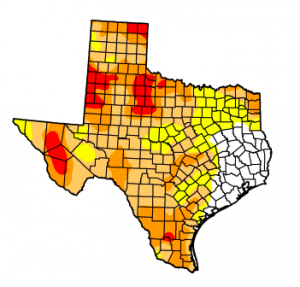
Extra! Extra! It’s the Drought Monitor Map we’ve been waiting for – the one that tallies last week’s plentiful rains. As expected, much progress was made. Perhaps the most notable change on the map: almost all of Southeast Texas is in the white, meaning completely drought-free and likely to stay that way.
In addition, the rains were so strong in Central Texas that parts of the area moved down a whole drought stage in just one week. Travis County, which contains Austin, moved from Stage 2 of the drought to mostly Stage 1. (There is still a small sliver in the northwestern part of the county in Stage 2.) Williamson County, directly north of Travis County, moved from mostly Stage 3 to mostly Stage 2. Several counties west of San Antonio moved from Stage 2 to Stage 1 in just one week as well.
As Texas gradually pries itself out of drought, much of the rest of the country delves deeper into it. According to the National Climactic Data Center, 56 percent of the US is now facing drought conditions. This is significant because it is the largest percentage of area since the infamous drought period of the 1950s. Since much of this is taking place in America’s Corn Belt, officials are concerned about the increase in the price of grain, especially corn.
Back in Texas, progress was real and rapid last week, but do residents of the state no longer need worry about the drought? The consensus amongst some of the state’s meteorologists: the rainfall was great, but it’s gonna take a lot more than a week’s worth of rain to get out of a two-year long record drought. Continue Reading →
It’s a heavy question: Where is all of our energy going to come from? That puzzle is at the center of a new film and education project, ‘Switch,’ featuring Scott Tinker, Director of the Bureau of Economic Geology at the University of Texas at Austin.
“The world’s population just passed seven billion,” Tinker said at a presentation on the film earlier this year. “And we’re adding a billion people every thirteen years.” As that population grows, energy demands grow with it. While developed nations’ energy use will flatten, Tinker said more and more countries are industrializing, which means more power demands. “There are several billion people just getting access to energy for the first time.”
So where’s all that energy waiting? In the film and presentation, Tinker looks at all of the options: coal, oil, natural gas and renewables. Let’s start with coal. “Coal is available, affordable and reliable,” Tinker said. “But it’s also dirty.”
StateImpact seeks to inform and engage local communities with broadcast and online news focused on how state government decisions affect your lives. Learn More »