And not just any butter, but a large sculpture of it “showing a boy leading his prize-winning calf through a county fair,” according to our sister site StateImpact Pennsylvania. The sculpture is an annual tradition at the Pennsylvania Farm Show, and this year a farmer is taking the butter, converting it to methane, and running his home and farm off of the energy for three days.
“Turns out, butter becomes gas through the work of a methane digester. Glenn Cauffman, the manager of Penn State University’s Farm Operations, said the butter will be dumped into a big heated tank where microorganisms will feast on it. “Those microorganisms can break those fat molecules apart into the less complex molecules,” he explained. “Then further take that to produce a gas called methane, which burns readily in an engine, and can be converted into…electricity.””
This week comes news that Valero will not seek an appeal of the TCEQ’s decision. In an email to StateImpact Texas, Valero spokesperson Bill Day says that “we did not appeal the TCEQ decision.” He had no other statement beyond that, but did tell Matthew Tresaugue of the Houston Chronicle that:
“Valero spokesman Bill Day said the company no longer would seek the exemption because it had reached agreements with appraisal districts for lower valuations on their refineries in all but one county where the company operates. Negotiations are ongoing with Moore County, Day said.”
It appears that the case is closed. The request was originally made in 2007, when Valero bought the equipment. The money, potentially as much as $92 million, would have come from property tax refunds in appraisal districts, which means it would have been taken back from cities and schools that are already struggling. The request for the tax break drew protests from community leaders, schools and environmental groups.
The 380-acre Webberville Solar Farm outside of Austin will power 5,000 homes.
Just days after the ribbon was cut on the largest solar farm in Texas outside Austin, San Antonio has announced a new solar project that would dwarf its neighbor to the North: a 400 megawatt solar project that would be twice as large as any solar farm currently runningin the world.
Some key points:
There are about 717,000 people who get power from CPS energy, the city-owned electric utility in San Antonio, which uses around 7,500 megawatts of power. So this 400-megawatt project would provide power to about five percent of San Antonio. (The Webberville solar project in Austin, by comparison, will produce up to 30 megawatts of power.)
The company behind the project, OCI Solar Power, is a South Korean subsidiary, and will be moving its headquarters to San Antonio as a result of the agreement. In a press release, the company says the project will result in “800-plus professional and technical jobs” with a payroll of nearly $40 million, and “more than $1 billion in construction investment.”
The agreement is for 25 years, and will allow San Antonio to reach its goal of sourcing 20 percent of its energy from renewable energy by 2020.
So does this mark the beginning of a “solar war” between Austin and San Antonio? Continue Reading →
The drought in the South has taken an enormous toll on the states of Texas, Oklahoma, Louisiana and New Mexico. In Texas alone, the state has lost billions of dollars and counting. The drought has affected many parts of everyday life: burgers, peanut butter, even Christmas trees were hurt.
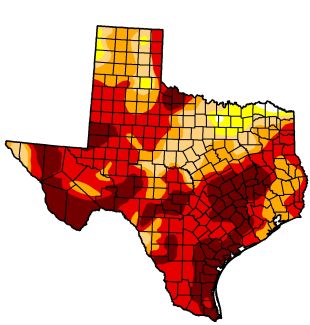
Where is that land of normalcy, you ask? They’re those specks of white on the map to the the right. Along the Red River at the Northeast border between Texas and Oklahoma, and also in parts of Wise and Denton counties, some Texans are actually living drought-free.
The Environmental Protection Agency has released a new interactive map today that allows you to explore greenhouse gas emissions throughout the country for 2010. Here’s a snapshot of Texas that links to the map:
Clusters of Greenhouse Gas Emitters in Texas (Map by EPA)
The largest emitter of greenhouse gases in the state for that year? The Luminant Martin Lake power plant, which mostly burns lignite. It released 18.7 million metric tons of greenhouse gases into the atmosphere last year and is the fourth largest emitter of greenhouse gases in the country.
Texas has 673 facilities reporting greenhouse gas emissions to the EPA, more than any other state. (California, in second, has 456.)Continue Reading →
New year-end data and maps from the government show what a year 2011 was for heat and drought in Texas. Records were broken across the state, as extreme weather reached levels never seen before.
First, Texas was truly a red state last year, winning the distinction of being the driest state in the nation. States in the northeast, however, had their wettest years ever:
Map by NOAA
Some more detailed data gives a sense of how intense the drought was for all of Texas and portions of surrounding states: Continue Reading →
The Texas Senate Business and Commerce committee heard testimony from state agencies, scientists, environmental groups and others Tuesday about how an extended drought might affect the state’s power grid. There was talk of cloud seeding, demand response, and even input from the ambassador to Australia on how to best generate power during a drought.
The meeting went for hours, and while it didn’t yield any direct results, there were plenty of ideas for dealing with the drought. It will be interesting to see which of them the committee picks to present before the next session of the state legislature in 2013.
Rays of Hope
State meteorologist George Bomar testified on where things may be headed, saying that “we have just come through the worst one-year drought in Texas history and it’s not over.” He said the current drought is a “once in a lifetime experience” and that lakes and reservoirs have reached alarmingly low levels. His testimony hit notes of both pessimism and hope: Continue Reading →
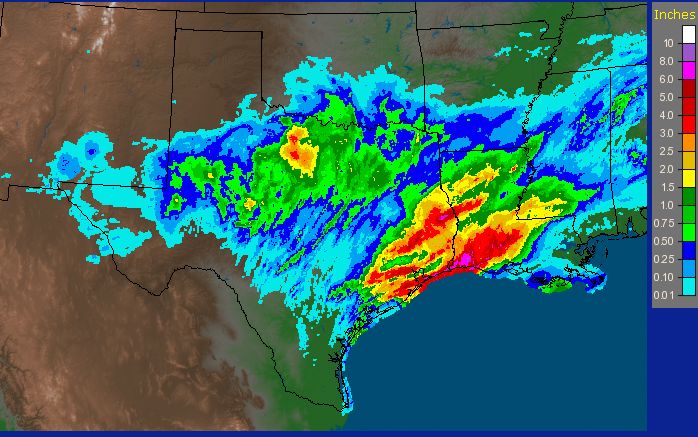
So we’re happy today to share a map of a different color. Here’s the rainfall in Texas from Monday, according to the National Oceanic and Atmospheric Administration (NOAA):
Map by NOAA
Rainfall in Texas over the last 24 hours
But the rain isn’t necessarily all-around great news. Continue Reading →
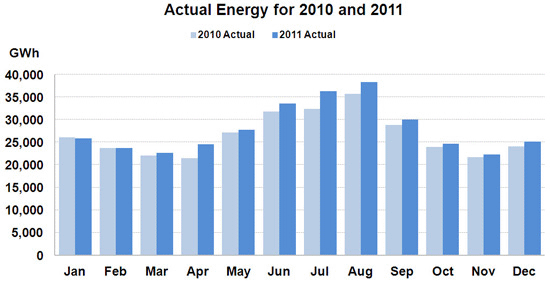
The numbers are in for electricity use for Texas in 2011 (more specifically, the 85 percent of the state in the Electric Reliability Council of Texas grid), and there are some interesting takeaways. It’s not surprising that with extreme heat and drought, energy demand increased in 2011:
Energy use was up 5 percent over last year.
The grid used less coal last year, and more natural gas and wind. Coal was down 0.5 percent, natural gas use was up 2.2 percent and wind use was up almost 1 percent.
Nuclear power as a percentage of the grid was down 1.2 percent.
Wind has shown the greatest gains over the last five years, going from 2.9 percent of the grid in 2007 to 8.5 percent in 2011. The only other energy source that has increased as part of the grid’s energy makeup during the last five years is coal, which increased a total of 1.6 percent.
Surprisingly, given the boom in shale drilling, natural gas use as a percentage of the grid has decreased since 2007, going from 45.5 percent of the grid to 40.4 percent last year.
About StateImpact
StateImpact seeks to inform and engage local communities with broadcast and online news focused on how state government decisions affect your lives. Learn More »