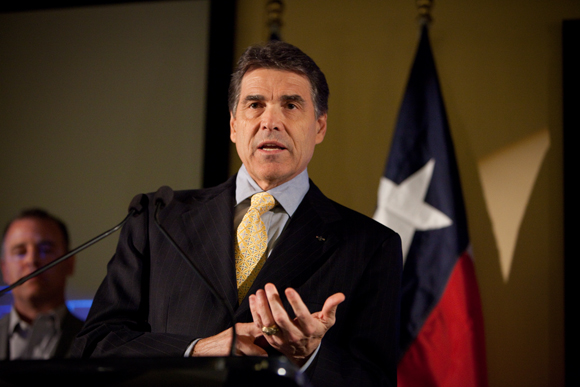
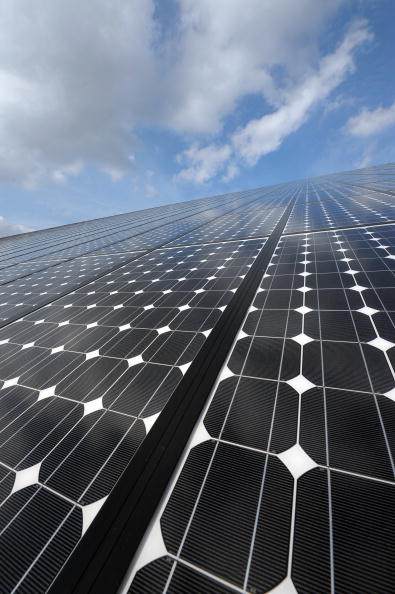
SunPower, a company that benefited from Gov. Perry's Texas Enterprise Fund, has announced cut backs.
Last November, the California-based solar power giant SunPower announced it was moving to Austin. Taking advantage of $2.5 million from Governor Perry’s Texas Enterprise Fund, the company promised to create 450 jobs in the Texas capital and make Texas its third largest office location.
Fast forward about a year: SunPower is downsizing.
In a statement, Thursday the company says it will cut operating costs by up to ten percent in the face of slowing demand for solar panels and competition from China. Continue Reading →
Last week we reported on the top 25 water users in Austin, with a map showing where the biggest consumers are located (shown below). On the list were familiar names like Lance Armstrong, Cedric Benson and Roy Spence. Coming in at number seven was Congressman Michael McCaul, who lives in Westlake. He used 1.4 million gallons of water last year, with a water bill of at least $13,300.
Today the Texas Tribune reports that according to McCaul, it’s just a leak. Mike Rosen, the congressman’s spokesman, explains:
[McCaul] has dealt with a “series of leaks over last two to three years,” and “the leaks for the most part have gone undetected for a long time,” because they were not visible on the surface. He said one leak involved a swimming pool and another, which would have affected the recent numbers, involved a busted pipe related to a contractor’s work for a neighbor’s realtor.
That is a serious leak. But according to Austin Water Utility, that excuse may not hold water. Continue Reading →
Protesters against a proposed tax break for Valero gathered outside the Texas Commission on Environmental Quality today.
Groups arrived in large buses from Houston and surrounding areas like Pasadena.
Parker, from Houston, said “Rick Perry oughta be ashamed. We need children to have a vibrant education without big interests in their pocket.”
Juan and Emilia Portia, their son Miguel, and daughter Jennifer Lopez were very vocal at the protest.
“Just Say No to Valero!” was a popular chant at the protest.
“There are too many dropouts right now,” Chad and Crystal’s mother, Leila Mikel, said. “Kids need to go to school to get a diploma. Without that piece of paper, they can’t make a living.”
A woman protests against the proposed tax exemptions for Valero Energy Corporation
The daughter of Marta Corona, a Houston area parent, looks up at Alain Cisneros, a protest organizer
A protester speaks to members of the TCEQ to oppose the proposed tax break
Gonzales, a 13-year old student in the Pasadena Independent School District in Houston, testified in front of the TCEQ. She spoke of her asthma, which she believes is caused by emissions from nearby refineries.
Texas Governor Rick Perry appointed the three members of the TCEQ board, who will decide on the proposed Valero tax exemption
Early Wednesday morning, a caravan of buses set out from the Houston area, headed for Austin and the headquarters of the Texas Commission on Environmental Quality. Their goal? To protest a request from Valero Energy Corp. for tax breaks for some of its oil refineries through a system that could give millions of dollars back to one of Texas’s most profitable corporations.
So far this year Valero has earned more than $2 billion. That makes the possible millions Valero wants in tax exemptions kind of seem like small potatoes.
But that, in turn, might be what has the 150 community activists and environmentalists chanting “Say ‘no’ to Valero” in front of TCEQ headquarters on Wednesday so angry. Continue Reading →
The Obama administration announced last week that 445 square miles of the West — more than 285,000 acres — will be zoned for solar energy development. Across parts of Arizona, California, Colorado, Nevada, New Mexico and Utah, the government is essentially fast-tracking large tracts of land managed by the Bureau of Land Management (BLM) for solar energy development. The BLM has done the research and surveys, now companies can start applying for permits to build solar energy farms. It can shave one to two years off the approval process. The areas are called Solar Energy Zones (SEZs), and they represent an important step forward in the development of solar energy.
But Texas wasn’t on the list. Why? I put the question to Megan Stouffer, the State Planning and Environmental Coordinator for BLM New Mexico, which manages agency projects in that state as well as Texas, Oklahoma and Kansas.
It was hammer time this week at a joint meeting of the Texas Senate Committee of Agricultural and Rural Affairs and the Committee on Natural Resources.
Lawmakers were there to hear about the impact of the ongoing drought on the state. It’s already the worst single-year drought in Texas history, and could become a new drought of record if the dry weather continues.That prompted state Senator Troy Fraser (R-Horseshoe Bay), who chairs the panel, to wonder how the state can enforce water conservation if it needs to. Continue Reading →
Yesterday we reported on Valero Energy Corporation’s attempts to get a tax exemption from the state of Texas for upgrades it made to its refineries. The money comes in the form of a property tax exemption from local appraisal districts, which could mean money lost from already-short school and city budgets. Looking at the arguments for and against, we examined Valero’s financial earnings and concluded that one of the arguments against is that they might not need the money in the first place.
Today, Valero announced earnings for the third quarter of 2011, and they are having a banner year thus far. Their net income was reported at $1.2 billion, as opposed to $303 million for the same quarter last year. For this year so far, they have a net income of $2.1 billion. These were Valero’s best quarterly results in over four years, according to the company’s CEO and Chairman, Bill Klesse.
The Eagle Ford Shale formation in South Texas has made headlines for its abundance of natural gas, but the formation doesn’t end at the Rio Grande. That fact is not lost on the Mexican government.
This rig uses hydraulic fracturing to obtain gas from Texas' Barnett Shale formation. Photo courtesy of KUT News.
Last week, the Mexican Minister of Energy proposed ramping up hydraulic fracturing operations in Northern Mexico. The announcement wasn’t especially newsworthy for many this side of the border, but down South?
“It’s huge! It’s huge!” said Jaime Williams, president of the energy and climate change commission of CONCAMIN in Monterrey, which is akin to Mexico’s industrial chamber of commerce.
“We are the interested party! The industrial sector, the private sector is the interested party in it,” Williams told KUT News.
Williams said the maquilas (factories) in Mexican border states use a lot of electricity. They’ve been importing more and more natural gas from Texas just to keep the lights on in recent years.
Green industries promise new jobs but Texas is still dominated by traditional energy.
Federal funds would be better spent on traditional jobs rather than those in “green energy” businesses, according to economists with the University of Texas Bureau of Economic Geology.
“We looked as objectively as we could,” said Michelle Foss, Chief Energy Economist with the Bureau. “And for quite a long time, for the foreseeable future, (Texas) would be losing more than gaining from any policy that caused a diversion of investment away from our traditional energy businesses and towards green energy businesses.”
Take a look at this satellite image of the Caribbean island of Hispaniola. Haiti’s on the western side, the Dominican Republic is on the east. Now look at the border dividing those counties and you notice a troubling detail. In many places, the forests on the Haitian side disappear:
“Ninety-five percent of Haiti’s virgin forests, which used to be 100 percent forested and was one of the richest, most verdant forests in the face of the earth, is gone,” Lewis Lucke, former U.S. ambassador to Haiti, told StateImpact Texas. “And the reason it’s gone is because of the manufacture of charcoal.”
There’s a request for a tax refund currently under consideration by the Texas Commission on Environmental Quality (TCEQ) from the Valero Energy Corporation, one of the world’s largest oil refiners. Valero is asking for money under a state law that says companies don’t have to pay taxes on equipment (in this case, something called a hydrotreater) that reduces on-site pollution. The request was originally made in 2007, when Valero bought the equipment. The catch? The property tax refunds would come from appraisal districts, which means money taken back from cities and schools that are already struggling.
StateImpact seeks to inform and engage local communities with broadcast and online news focused on how state government decisions affect your lives. Learn More »