Florida

Putting Education Reform To The Test

Monthly Archives: July 2012

How Florida Reacted To Education Commissioner’s Resignation

eldh / Flickr

News of Gerard Robinson's resignation spread quickly on Twitter.

Education Commissioner Gerard Robinson announced Tuesday evening he is stepping down at the end of August.

Board of Education chairman Kathleen Shanahan told the Orlando Sentinel that Robinson was commuting to Virginia, where his wife works as a law school professor. The strain had become too much.

Robinson had also been criticized by school boards, educators and parents for changes to state tests and the school grading system.

We’ve gathered some of the reaction to Robinson’s surprise announcement from Twitter, after the jump. We’ll update it as more folks weigh in:

Continue Reading

Florida Education Commissioner Submits Resignation

Florida Education Commissioner Gerard Robinson has submitted his resignation after a tumultuous year.

Florida Education Commissioner Gerard Robinson will resign his position on August 31, the Department of Education announced this evening.

Robinson became Florida’s top education official about a year ago. He has faced growing criticism from school boards, teachers and parents about the state’s standardized testing regimen and school grading system.

Board of Education chairman Kathleen Shanahan said in a statement that Robinson’s decision was related to his family.

Shanahan praised Robinson’s efforts in pushing to toughen state testing standards and leading Florida’s efforts to implement a waiver from federal No Child Left Behind requirements.

“The board is extremely grateful for Gerard’s leadership this past year,” said State Board of Education Chair Kathleen Shanahan. “He has worked with the board as we have raised standards for our students and our schools. He is a leader who embodies and understands the importance of education reform.”

The Secret Lives of Students: Why Not Everyone Is Ready for Virtual Classes

Breakthrough Miami students and their teacher interns with StateImpact Florida reporter Sarah Gonzalez (left) at the WLRN-Miami Herald studios.

For today’s installment in our series, The Secret Lives of Students, we hear from a rising 9th grade student about to enroll in a mandatory virtual class. 

Editor’s note: This post was written by high school student Jennifer Lopez. 

By Jennifer Lopez, 14

A year-old law in Florida has made virtual courses mandatory for ninth grade students.

These virtual courses are to be taken in the school that the students attend.

Most students that are going in to ninth grade are still children in mind. For this reason, I think students should be in a class room with teacher to have face to face interaction, to help them in the specific area that they have chosen is hard for them. Continue Reading

Schools Spend 1 Percent Of Instructional Time On FCAT? ‘False’ Says PolitiFact

Florida Department of Education

Education Commissioner Gerard Robinson says Florida schools spend just 1 percent of "instruction time" on the FCAT. PolitiFact says 'false."

Education Commissioner Gerard Robinson has defended the state’s standardized testing regimen by arguing the state spends just 1 percent of “instructional time” on the exams.

But a new PolitiFact analysis rates Robinson’s claim “false.”

Much of the ruling hinges on the phrase “instructional time.”

The state Department of Education analysis Robinson based his statement upon counted only time taking the test. But PoltiFact argues that time spent prepping students for the test should be considered “instructional time.”

Continue Reading

Georgia Wants To Track Student Data Through Graduate School

NASA Goddard Space Flight Center / Flickr

Georgia is building a new database that will gather student information from Kindergarten through graduate school.

Georgia is taking tracking student progress to the next level. The state is working on a system that will keep track of student data from pre-K through graduate school.

Georgia is using a federal Race To The Top grant to create a statewide database.

Researchers will look for trends – good or bad – as students move to the next grade level. Information will be shared among seven agencies.

Continue Reading

The Secret Lives of Students: Proper Fuel Needed To Reach For The Stars

Webber J. Charles / Breakthrough Miami

David Cardenas Rios (right) and Tony Delgado dressed as Super heroes during Breakthrough Miami's spirit week at the Ransom Everglades school campus.

For today’s installment in our series, The Secret Lives of Students, we hear how one student would improve class learning. 

Editor’s note: This post was written by middle school student David Cardenas. 

By David Cardenas, 13

School lunches are an interesting topic. Many people think that school lunches are not so great and they’re right. The majority of students are used to having bad school lunches, so we as students don’t think that telling other students, teachers, and adults won’t make such a big difference if anything.

But I’m not like other students, I fortunately have a great and healthy family and group of friends that are looking out for me. They taught me to stand up for what I believe in.

And so, I think that these school lunches are not adequate.

The government is giving so many ideas to provide healthcare and insurance for today’s generation, but the government is not worrying enough about its next generation. Continue Reading

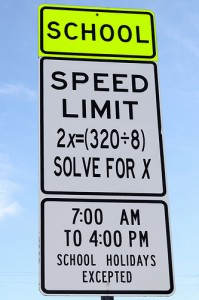
Should Algebra Remain Part Of The Graduation Equation?

ajaxofsalamis / Flickr

Should algebra remain a requirement to graduate from U.S. schools?

Is there a growing push to trim advanced math requirements for students who won’t use the lessons in “the real world?”

City University of New York political science professor Andrew Hacker authored a Sunday op-ed in the New York Times which questions whether U.S. schools should require students to pass algebra in order to graduate.

Algebra is the foundation for most higher math, including trigonometry and calculus. And the application of advanced math helps explain physics, geometry, biology and how the world works in general.

But Hacker argues not every student is cut out for advanced math, and most will not use it once out of school. He notes that in some states more than one in three students failed required algebra exams (42 percent of those taking Florida’s algebra exam for the first time in Spring 2012 failed it).

Continue Reading

The Secret Lives of Students: “Dear Future Teacher…”

Breakthrough Miami

Teley Laporte, 10, says teachers need to add a little "magic" to their lesson plans.

For today’s installment in our series, The Secret Lives of Students, students write a letter to their future teachers. 

Editor’s note: This post was written by rising middle school students Teley Laporte and Joshua Partridge.

By Teley Laporte, 11

Dear future teacher,

Good listening skills are very important when teaching a group of students.

You should be open to new ideas from students.

You should give quizzes if needed.

Being funny is not that important, but don’t be so strict.

Some kids are very sensitive.

You need to know what’s in style in the kids’ world so you can be familiar with it and have something in common with them.

Make up consequences for when students misbehave.

Continue Reading

StudentsFirst Asks Florida Allies To Hit The Blogs, Win A Gift Card

DouG!! / Flickr

Pick a card, any card.

Bob Sikes over at Scathing Purple Musings got his hands on an email from Florida’s StudentsFirst rep urging allies to get out and comment on blogs.

The email from StudentsFirst regional outreach manager Catherine Robinson says there’s a contest for the best “rapid response” and included links to some recent stories. The winner gets a “gift card to the restaurant or store of choice.”

A copy of the email was passed along to us, and a couple of StateImpact Florida posts with references to the parent trigger were on their recommended commenting list.

The parent trigger was narrowly defeated during the legislative session earlier this year and allies, such as former Gov. Jeb Bush, vow that the bill will be back. StudentsFirst spent a lot of time and effort urging lawmakers to approve the bill this year.

We love reader feedback, so we’ll make this easy. For all our parent trigger stories, click here and comment away.

We’ve already gotten two comments…

Panel Recommends Lowering Passing Score For FCAT Writing, But Will Education Commissioner Agree?

Southworth Sailor/flickr

A team of educators and community leaders gathered this week to set standards for FCAT 2.0 writing.

The panel went through a lot of data before settling on a school grade writing performance level of 3.5. That means students would need to score 3.5 out of a possible 6 to pass.

The recommendation would lower the cut score from a 4. Writing test results plummeted this year because of the passing score of 4 and the tougher grading standards.

The number is used to determine who passes FCAT writing in grades 4, 8, and 10.

Continue Reading

About StateImpact

StateImpact seeks to inform and engage local communities with broadcast and online news focused on how state government decisions affect your lives.
Learn More »

Economy
Education