Terrence Henry reports on energy and the environment for StateImpact Texas. His radio, print and television work has appeared in the New York Times, The Washington Post, The Atlantic, NPR, The Texas Tribune, The History Channel and other outlets.
He has previously worked at The Washington Post and The Atlantic. He earned a Bachelor’s Degree in International Relations from Brigham Young University.
A warning sign along the shore of the dried O.C. Fisher Lake this summer in San Angelo, Texas.
The top five new stories of last week from StateImpact Texas, in case you missed them:
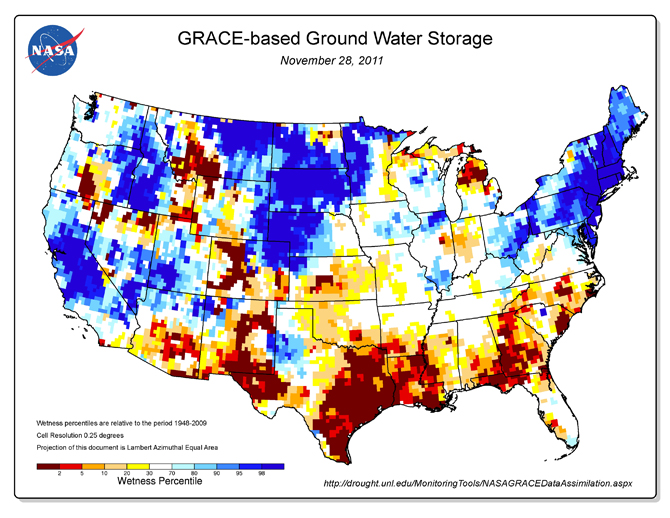
The Texas Drought, as Seen from Space (Things Don’t Look Good). During a drought, it feels like all you can do is wait and wait for rain. Well, we may have to wait a little longer. A new NASA map shows that groundwater and soil moisture levels in Texas are at their “lowest levels seen in more than 60 years.”
While rain is making its way across of much of Texas this weekend, it will likely not be enough to bring the state out of its record one-year drought. All of Texas east of Interstate 35, the highway that runs through the middle of the state, needs between eight to twenty more inches of rain to get things back to normal.
“Normal” has become a relative term in the past year. Scientists say the drought is not likely to end until at least next spring, and could continue well into next year or even beyond.
The Texas Parks and Wildlife Department has put together a new “Drought Survival Kit” to help everyday Texans weather the lack of rain. It has some helpful ideas for things you can do that can make life in the drought a little easier: Continue Reading →
A fire yesterday at a refinery in San Antonio was a result of vaporizing kerosene, according to owners of the plant. The company says that a contractor was installing drain tubing and dislodged a valve, “which allowed a small quantity of kerosene to spray.” That kerosene vaporized and caught fire.
“The fire was completely contained within the crude unit,” Mary Rose Brown, Senior Vice President of Administration at NuStar Energy, which owns the refinery, said in an emailed statement. “Fortunately, we were able to begin spraying the unit with water immediately and the the San Antonio Fire Department arrived within five minutes and quickly extinguished the fire.”
The company and San Antonio Fire Department say there were no injuries. NuStar said that the refinery will remain closed for now, but that when it re-opens they’ll send an update. NuStar purchased the refinery from AGE earlier this year. Continue Reading →
Former Enron CEO Jeffrey Skilling outside court in Houston in 2006. He was sentenced to 24 years and four months in prison for his role in deceiving investors.
This week marks the tenth anniversary of Enron’s collapse. The Houston energy company took down thousands of jobs, billions of dollars, and a good chunk of the stock market with it.
But as Andrew Schneider reports for StateImpact Texas radio partner KUHF this week, Enron did a lot of good before things went bad. “It was a major benefactor for Houston charities,” Schneider reports. “It helped build the Houston Holocaust Museum and expand the Houston Museum of Fine Arts. And Ken Lay led the effort to build the Astros a new ballpark and keep them from leaving the city.” Enron built towering new office buildings and put thousands of people to work. Continue Reading →
Two new reports were released today by the Electric Reliability Council of Texas (ERCOT), which operates the state’s power grid. The reports look at both the upcoming winter in Texas as well as a ten-year outlook and what sort of risks are in store for the energy grid.
In both cases, the outlook is not good. This winter the grid could find itself strained again as it did during the blackouts earlier this year. “Our assessment indicates a concern if we experience a simultaneous occurrence of extreme weather and worst-case generation outages, much like February of this year,” Trip Doggett, the CEO of ERCOT, said in a release accompanying the reports.
And in the next ten years, the state will find itself with less power and more demand. Starting next summer, the state’s reserves to avoid outages “will likely fall below the minimum target beginning next summer.” This number is known as the “reserve margin.” It’s ERCOT’s extra capacity to handle peak times of energy demand avoid outages.
“We are very concerned about the significant drop in the reserve margin,” Doggett said in a release accompanying the report. “If we stay in the current cycle of hot and dry summers, we will be very tight on capacity next summer and have a repeat of this year’s emergency procedures and conservation appeals.”
A drought is a strange type of disaster. While hurricanes, tornadoes and floods do their damage quickly and dramatically, drought is like a slow death, a drying out of life and land. A house can be rebuilt after a flood recedes, but with a drought all you can do is wait for rain. And wait.
An explosion occurred at a refinery in San Antonio earlier today, according to the city’s fire department and news reports. Firefighters battled a fire that began after an explosion this afternoon at the AGE Refinery. Local news station WOAI reports that “the San Antonio Fire Department has confirmed a type of diesel jet fuel is burning. Crews have been using an extinguisher system at the refinery to help put out the fire.” The station says that the fire “appeared to be out as of 1:15 pm, and that workers were evacuated from the building.”
UPDATE: StateImpact Texas spoke by phone with Deborah Foster, Public Information Officer with the San Antonio Fire Department. She says that “they had a large explosion that was called into dispatch [at the fire department] about 25 minutes ago. ” Foster says firefighters knocked down the fire fairly quickly, and that now “we have everything under control.” Right now firefighters at the refinery are continuing to spray water on the tanks “to make sure they’re cool,” she says, “but the fire is knocked down and there were no injuries.
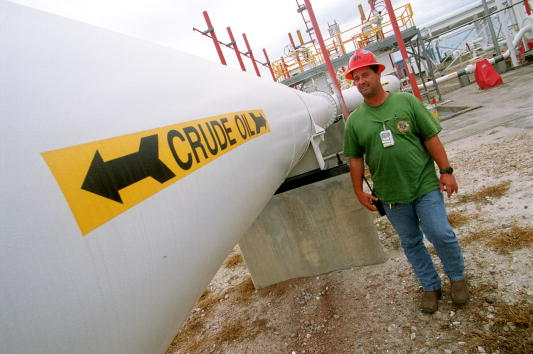
An oil worker at the Big Hill oil reserve in Beaumont, Texas.
A milestone has been crossed in the production of energy in the country, according to a report today in the Wall Street Journal. Because of increased oil and gas drilling and production, the U.S. could end up exporting more fuels this year than it imported. Continue Reading →
County Sheriff Gary Painter stands next to a pump jack outside of Midland, Texas in 2008
Are you curious how many new wells went into the ground over the last year in Texas? How much oil and gas was taken out of it? New numbers from the Railroad Commission of Texas, which oversees drilling in the state, were released today:
More Permits, More Wells. The commission approved 1,771 drilling permits last month, compared to 1,515 last October. That includes “1,567 permits to drill new oil and gas wells, 57 to re-enter existing well bores, and 147 for re-completions,” according to a commission press release.
Oil Production is Up. The daily average for oil production in Texas was 1.01 million barrels a day for September. For the month, 30.33 million barrels of crude oil were produced, compared with 28.15 million barrels of crude the September before. Continue Reading →
A warning sign along the shore of the dried O.C. Fisher Lake this summer in San Angelo, Texas.
What was it like to be there for the first drought in Texas? Does the past have anything to tell us about our future? A new timeline of droughts and heat in Texas has some answers.
The list, put together by the Texas Water Resources Institute (TWRI), the state’s water research group at Texas A&M University, takes a thorough look at the history water in the state. It’s been a scarcity since the settlers arrived, and there’s some fascinating material on the early days of water rights, extreme temperatures and the development of our water infrastructure.
“We went and gathered a lot of information from different sources,” says TWRI Communications Manager Kathy Wythe, who created the timeline. Looking at the history, it’s clear that drought and extreme weather are nothing new to Texas. “There’s a lot of talk about the drought of the 1950s,” she says, “but we’ve periodically had them over the last hundred years.” Wythe finds it interesting that the droughts since the 50s have been a lot shorter, however. A severe drought in 2007 ended abruptly in 2008. Continue Reading →
About StateImpact
StateImpact seeks to inform and engage local communities with broadcast and online news focused on how state government decisions affect your lives. Learn More »