Terrence Henry reports on energy and the environment for StateImpact Texas. His radio, print and television work has appeared in the New York Times, The Washington Post, The Atlantic, NPR, The Texas Tribune, The History Channel and other outlets.
He has previously worked at The Washington Post and The Atlantic. He earned a Bachelor’s Degree in International Relations from Brigham Young University.
A weed grows out of the dry cracked bed of O.C. Fisher Lake in July. The drought has taken a severe toll on Texas' lakes and rivers and is estimated to have cost billions in agricultural losses.
When Dallas Flushes, Houston Drinks: It’s long been a joke based on facts: take a drink from a tap in Houston and say ‘thank you’ to your friends in Dallas for flushing their toilets.
The Top 25 Water Users in Austin: Why is Lance Armstrong using 1.3 million gallons of water a year? We look at list of the top users of water in Austin, where you can also find a Congressman and pro football player.
Things Get Testy Between Rice Professor and Alaskan Congressman: A heated exchange over drilling in the Arctic National Wildlife Refuge results in a congressman telling a university professor to “just be quiet.” His response? “You don’t own me. I pay your salary.”
Thanks for reading and we look forward to a new year of sharing more stories with you.
The latest drought monitor from the National Drought Mitigation Center was released Thursday, and, while it showed much of Texas is slowly inching its way out of extreme drought, some other numbers give cause for concern.
While rains have blessed much of the state this month, many lakes, reservoirs and aquifers are not refilling and show only modest signs of rising. Case in point: Lake Buchanan, an important water source for Central Texas. It currently sits at 988 feet above sea level, some 23 feet below where it usually is in December. Combined with Lake Travis, the other important water reservoir for Central Texas, the two lakes are at 37 percent of their water capacity.
The Canadian company behind the proposed Keystone XL pipeline, which would bring crude from the country’s oil sands to refineries in Texas, got a little gift to end out the year from the Nebraska government this week: a map of where not to put the pipeline.
The pipeline ran into a snag earlier this year after Nebraska lawmakers opposed the route planned by the company, TransCanada, which would have gone through an environmentally-sensitive region known as the Nebraska Sandhills. The Sandhills are home to a giant freshwater aquifer that is used for water supply. (The pipeline also met with opposition from several environmental groups, who said it would increase reliance on fossil fuels.)
The ground is so thin in some parts of the area that groundwater on occasion rises to the surface. Water there is used primarily for irrigation, but it’s also used for drinking water by some 2 million people, according to the US Geological Survey.
Nebraska lawmakers passed legislation in November saying an alternative route that avoids the Sandhills must be found in order for the project to go forward. With the release of this map, it seems Nebraska wants to give the pipeline company that opportunity. Continue Reading →
This rig uses hydraulic fracturing to obtain gas from Texas' Barnett Shale formation. Photo by KUT News.
It’s been a booming year for drilling in Texas, with more new wells drilled than last year and 381 million barrels of oil produced. The companies behind this drilling have found fortune not only in the ground but also in the stock market. USA Today looks at the top ten corporate stocks for the year and finds that several are energy companies based in Texas. While stocks overall had a rough year (the paper notes that the Standard & Poor’s 500 index was down 0.6% for the year), the market was very good to companies that frack for oil and gas.
Taking the top spot for the year is Cabot Oil & Gas, a natural gas drilling company headquartered in Houston with a heavy fracking presence in the Eagle Ford shale in Texas as well as the Marcellus shale in Pennsylvania. Their stock more than doubled this year, going from $38.46 to $76.41. Continue Reading →
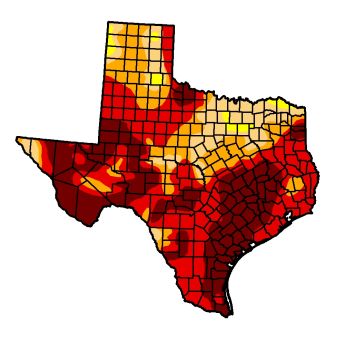
The latest map of drought in Texas from the U.S. Drought Monitor
It’s Thursday, which means a new drought monitor has been released from the National Drought Mitigation Center, and there’s some good news as Texas heads into the new year:
32 percent of the state is in the highest level of drought, “exceptional,” down from 39 percent just last week and 86 percent of Texas three months ago.
67 percent of Texas is in “extreme” drought or worse, down two percent from last week and 97 percent three months ago.
0.01 percent of Texas is still drought-free. As state climatologist John Nielsen-Gammon wrote recently of the small sliver along the Texas-Oklahoma border: “To the thirty or so people living there, I say, “Congratulations!””
A new television ad from oil giant BP is getting some extra attention this week after viewers noticed an unexpected cameo.
As part of a campaign to promote the company’s work to clean up areas affected by the Deepwater Horizon oil spill of 2010, which released nearly five million barrels of oil into the Gulf, the company released a new ad Monday. It’s the first time BP has run an ad nationally since late last year. The company says it released the ad this week, because “the cleanup phase of the Gulf of Mexico oil spill response is nearing completion and the first set of early restoration projects is preparing to move forward.”
But some unexpected guests are diverting attention away from the ad’s message and onto a group of protesters. Continue Reading →
As shiny new electronics are being plugged in all across the country this week, many old items are being thrown out. A lot of consumers choose to recycle their old televisions, computers and other gadgets at electronic waste recycling centers, in an effort to prevent all of those plastics and chips from clogging up landfills and leaking waste into the ground.
But let’s say you drop off that old PlayStation at one of those recycling centers. Where does it go from there?
A map of the existing and proposed Keystone XL pipelines
Just what happened that led to the delay of the Keystone XL pipeline? Views are mixed, not surprisingly, but as Toronto’s Globe and Mail reports, a real sticking point, in addition to those of ideology or politics, was simply geography.
The route of the proposed pipeline would have gone from Canada right through the “boiling sands” of Nebraska to refineries in Texas. The paper reports that these boiling sands are areas of sandy soil where the ground is so thin that “groundwater can bubble up through it to the surface.” Nebraska’s boiling sands in the Sand Hills region sit over a giant freshwater aquifer called the Ogallala.
So, how do you dig trenches and anchor the pipeline in such an environmentally sensitive area? Continue Reading →
Two new books on drought and water in the Southwest are out.
As 2011 winds down, the environmental story of the year for Texas is undoubtedly the drought. The last year has seen record heat, record dryness, devastating wildfires, and widespread losses of crops and cattle.
There are two new books on drought and water in the Southwest that may provide some insight as we head into a 2012, where the drought is likely to continue at least until the spring.
The first is “A Great Aridness,” by New Mexico conservationist William deBuys from Oxford University Press. It tells the story of development in the Southwest, a period that coincided with relatively wet weather for the region, and how it will have to deal with the return to “normal” currently under way. Water shortages, wildfires, droughts and extreme heat are just a few of the possible outcomes examined in the book. Continue Reading →
You’re probably recovering from too much nog and eating leftover ham sandwiches, but in case you missed it, here’s out top five new posts from the last week:
Due to Drought, Houston Drinking More Dallas Wastewater: It’s long been a joke based on facts: take a drink from a tap in Houston and say ‘thank you’ to your friends in Dallas for flushing their toilets. We explain what’s exactly coming out of your faucet.
Fracking Company Goes on the Offensive Against EPA Report: The company behind a fracking well in Wyoming that the Environmental Protection Agency (EPA) says may have contaminated water sources isn’t taking the agency’s accusations lying down.
What is Santa’s Carbon Footprint? Yes, someone actually took the time to calculate Santa’s impact on the atmosphere. While we all know he brings plenty of cheer, a new infographic shows his operation has a carbon footprint much bigger than a lump of coal.
Texas Wildfires Scattered Birds to the Wind: During a year of exceptional drought, heat and wildfires, conservationists across Texas are paying close attention to the welfare of local bird populations.
StateImpact seeks to inform and engage local communities with broadcast and online news focused on how state government decisions affect your lives. Learn More »