Terrence Henry reports on energy and the environment for StateImpact Texas. His radio, print and television work has appeared in the New York Times, The Washington Post, The Atlantic, NPR, The Texas Tribune, The History Channel and other outlets.
He has previously worked at The Washington Post and The Atlantic. He earned a Bachelor’s Degree in International Relations from Brigham Young University.
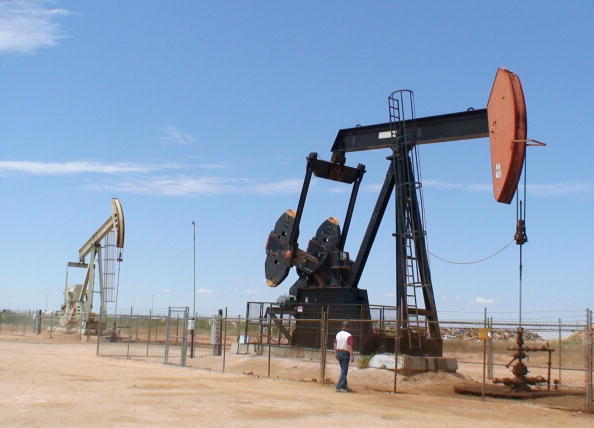
New numbers were released by the Railroad Commission of Texas this week, which oversees oil and gas drilling in the state. And not surprisingly, they show growth in drilling in Texas.
Here are some of the big takeaways from the latest numbers:
Drilling permits are up over last year, with 1,581 issued in January versus 1,484 during the same month last year.
Crude oil production is up, with 32.4 million barrels produced in December 2011, up from 29.2 million in the same month in 2010.
But natural gas production is down, at 530.8 million Mcf (thousand cubic feet) in December 2011 versus 559.4 Mcf in the same month in 2010.
The shift to more oil production and less natural gas is very apparent. In January, there were 765 oil wells completed and only 234 gas wells completed. Last January, there were 368 oil wells completed and 286 gas wells. So you’re seeing more oil wells go in, and fewer gas wells. Continue Reading →
Barry Smitherman is the new chair of the Railroad Commission of Texas
In a unanimous vote this morning, the Railroad Commission of Texas elected a new chairman, commissioner Barry Smitherman. He’s been a member of the commission, which regulates oil and gas drilling in the state, since July 2011, when he was first appointed by Governor Rick Perry. Smitherman will run for re-election to the commission this year.
Smitherman wasted little time during the announcement before going after federal regulation of the oil and gas industry. “As Texas energy production is increasing at an unprecedented rate, the Railroad Commission must continue to maintain a fair and predictable regulatory climate in this state,” he said in a release.
“As Chairman, I will continue to ensure that we meet the unscientific, politically-motivated decisions coming out of Washington, D.C. with science-backed, factually correct responses. We must not let the political appointees in Washington kill our economic engine and kill our jobs,” he said.
Smitherman has an outspoken disdain for any outside regulation of the oil and gas industry in Texas. In a guest column for the Texas Tribune on the Keystone XL pipeline in January, he called President Obama our “Dear Leader” (an overt reference to the now-deceased North Korean dictator Kim Jong-Il), and said the rejection of the pipeline was a big win for the “communist Chinese government” and “dictator Hugo Chavez.” He ended by saying that Obama “clearly lives in a fantasy land.” The company behind the pipeline announced Monday that they intend to go ahead and construct the portion from Cushing, Oklahoma to refineries on the gulf coast of Texas. Continue Reading →
Haskell Simon represents rice famers in Bay City, Texas.
If you’re a rice farmer in southeast Texas, chances are you’re taking a close look at the level of the Highland Lakes a few hundred miles away. If those lakes aren’t at a certain level by midnight on Thursday, there will be almost no water sent downstream for rice farmers this year.
Under an emergency water plan adopted by the Lower Colorado River Authority (LCRA) in late September in response to the drought, the combined storage of Lakes Buchanan and Travis has to be at 850,000 acre-feet by midnight on the night of March 1st in order for water to be sent downstream. (One acre-foot equals around 325,850 gallons of water.) Just weeks ago they were at 767,000 acre-feet, but after heavy rains they began to rise, and today sit at 842,000 acre-feet, or 42 percent of their capacity. Now around a billion gallons of water are standing between the farmers and the loss of a season. (Update: as of Wednesday morning, the LCRA says the lakes are at a combined 846,000 acre-feet, even closer to the cutoff point.)
That’s put some Highland Lakes residents and business owners in an unique position. “We were praying to not have too much rain,” says David Lindsay, a board member of the Central Texas Water Coalition, which represents lake interests. “Isn’t that perverse? Because we saw the wolf that would generate. If you release [that water] and we kept going into a drought like last year, then we truly could start to talk about putting the drinking water at risk.” Continue Reading →
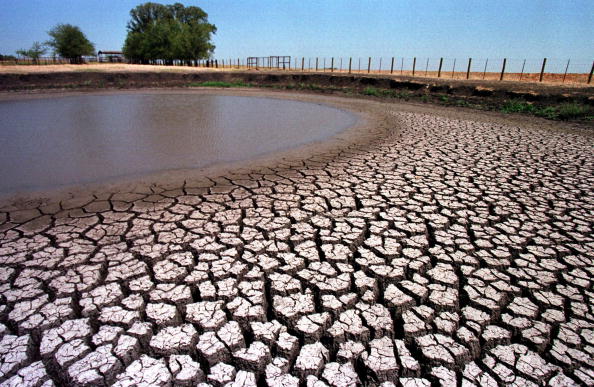
A stock pond south of Dallas, TX, dries up due to drought.
The drought has meant different things for different people in Texas. For many, it meant a brown lawn and fewer trips to the car wash. For others, it meant the loss of a crop, the sale of a ranch, or the disappearance of a lake. A new report gives us the opportunity to look at some of the science behind the drought that affected every Texan, and what may lie ahead in the future.
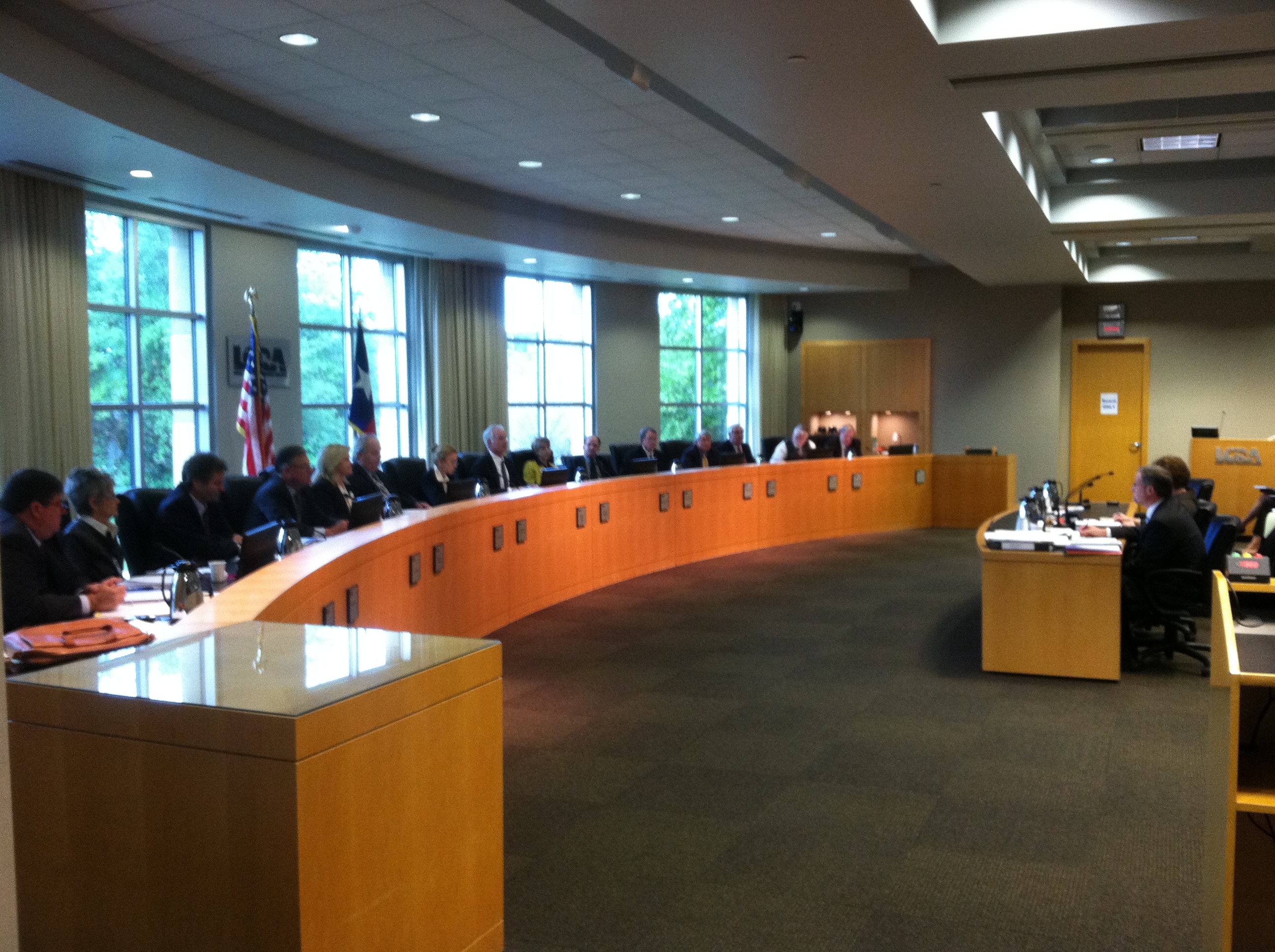
At a meeting of the board of the Lower Colorado River Authority (LCRA) last week, Bob Rose, LCRA’s meteorologist, presented a report on the drought and his forecasts for the months ahead.
Texas had its driest year on record in 2011, he said, with an average of 14.88 inches of rain. It was also the driest the state has been in nearly a hundred years: the previous record was set in 1917 with 14.99 inches. It was also the second hottest year on record, with an average temperature of 67.2 degrees. The hottest year ever in Texas also came nearly a century ago, in 1921. Continue Reading →
What was once a marina is now a cliff overlooking a dry riverbed in Spicewood Beach
To get to Spicewood Beach from Austin, you first drive through the Hill Country. You’ll pass a parcel of land scorched by wildfire and drive over a Pedernales River that has been reduced to a trickle, with docks awkwardly resting on the dry riverbed. When you get to the rusty barbecue smoker with the Confederate flag waving from its stack, you’re almost there.
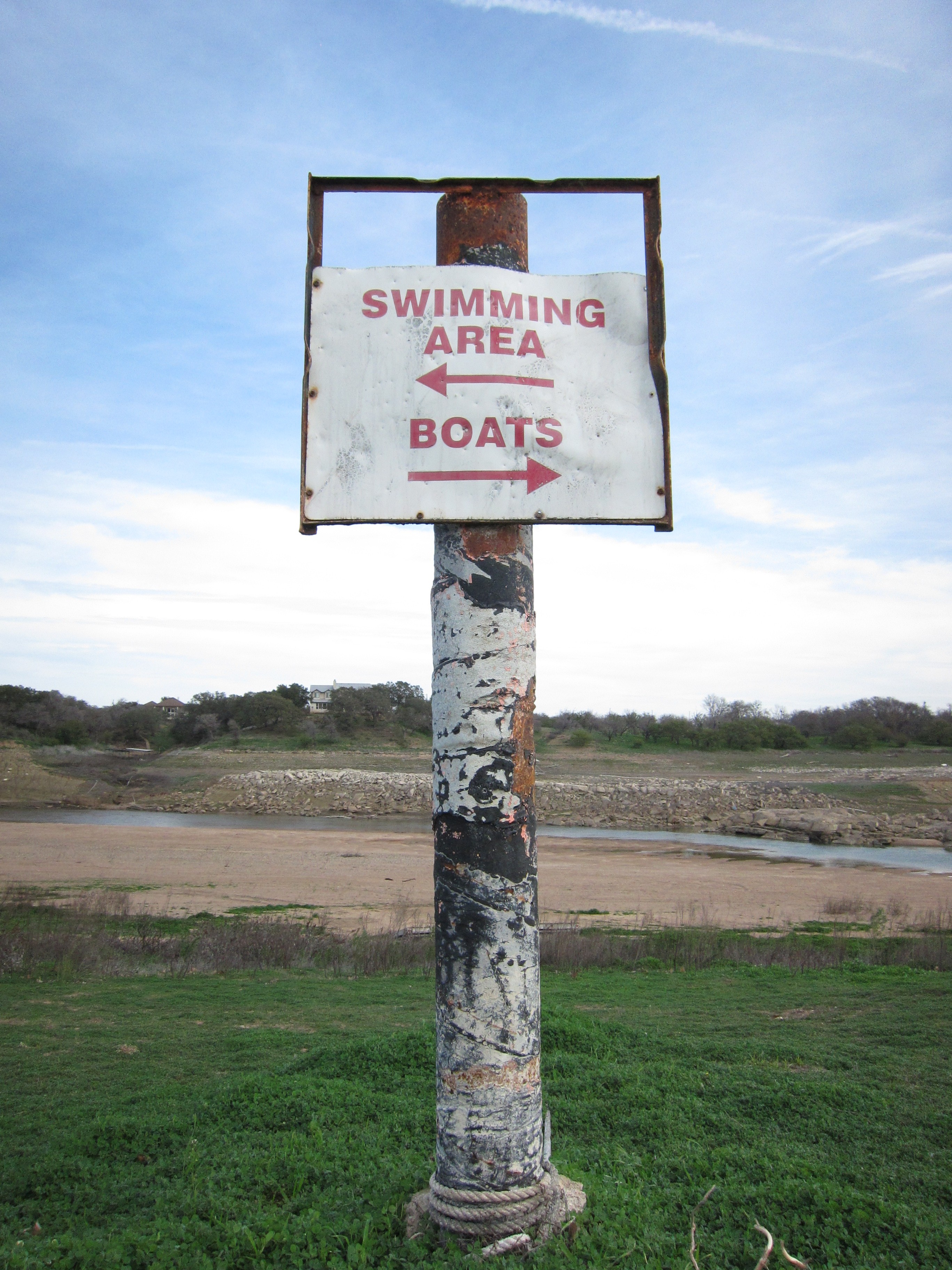
Once you arrive, you’ll find a verdant golf course (as long as it’s rained recently). When things are right at the lake, you can stand on the green and look out to a vast expanse of water. But when things are dry, as they’ve been over the last year, it looks like a curtain’s been pulled back unexpectedly. Instead of a swimming area and marina, you find yourself standing at an awkward cliff. Below is a sandy bed and boulders not used to seeing sunlight. To the south, stairs that used to lead to the lake now dangle in the air.
Since Spicewood Beach’s wells began to fail nearly a month ago, the Lower Colorado River Authority (LCRA), which owns and operates the water system, has been trucking water in to keep the taps running.
“So far, so good,” says Cathy Mull, who’s lived here about ten years, of the water hauling. “We’ve always had water since they started it.”
But just as they were getting used to the three or four truckloads a day, residents were warned things may soon have to change.
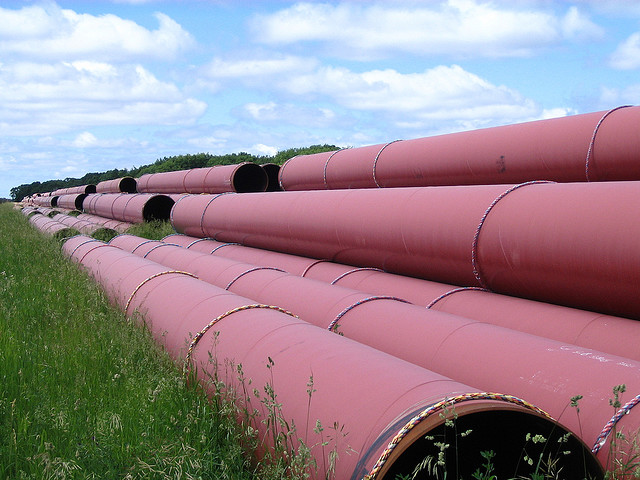
The Keystone XL pipeline would take oil from sand pits in Canada to refineries in Texas.
It’s round two in the ongoing battle between a northeast Texas farmer and the company behind the Keystone XL pipeline.
Today a district court judge dissolved a restraining order filed by farmer Julia Trigg Crawford against the TransCanada corporation, which wants to build the Keystone XL pipeline across her property. After Crawford declined to sign an agreement with the company, they used eminent domain to gain access to her land. She responded by filing a temporary restraining order, which up until today had kept the company from going onto her land. But the two will meet again at a trial over the eminent domain claim in the same court in April.
“It’s obviously a disappointment,” Crawford said in a statement, “but the bigger question is whether they took my land and land from other Texans legally. I don’t think they did and I think they’ll get a rude awakening when we show up in court in April.”
“We are gratified with Judge Harris’s ruling to dissolve the temporary restraining order,” TransCanada said in a statement. “We believed from the outset — and apparently Judge Harris agreed — that the temporary restraining order was without merit and improperly granted.” Continue Reading →
We do a lot of reporting on the ongoing (but hopefully abating) Texas drought around here, with a weekly update on drought conditions in the state.
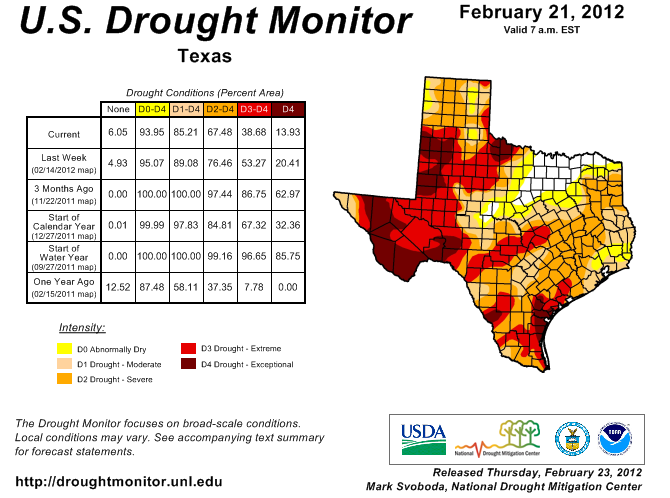
Yesterday’s update showed that drought conditions continue to improve in Texas, with Dallas/Fort-Worth drought-free, and parts of Houston are now out of drought as well. Austin is in the lightest stage of drought, as are El Paso and San Antonio. But the one region that hasn’t seen much relief is West Texas. Many parts of the state there are in “extreme” or “exceptional” drought:
Map and graph by National Drought Monitor
The latest drought monitor shows continued improvement for much of the state
The drought information comes from the U.S. Drought Monitor at the National Drought Mitigation Center at the University of Nebraska-Lincoln. It’s a joint project between the center and several federal partners like the departments of Agriculture, Commerce, and National Atmospheric and Oceanic Administration.
But what’s the difference between “extreme” and “exceptional” drought? Here’s a handy explainer of what those different drought levels mean: Continue Reading →
The President outlined his campaign platform on energy today at a speech at the University of Miami
In the face of rising gas prices and outspoken criticism from the oil and gas industry, President Obama outlined major campaign proposals for energy and drilling today at a speech at the University of Miami.
“It is great to be back in sunny Florida,” the President said. “I still don’t know how you all make it to class every day down here.”
He then went on to expand on some policies he initially introduced during his State of the Union speech in January.
First on his list? Eliminating tax breaks for oil and gas companies. “Right now, four billion of your tax dollars subsidize the oil industry every year,” Obama said. Continue Reading →
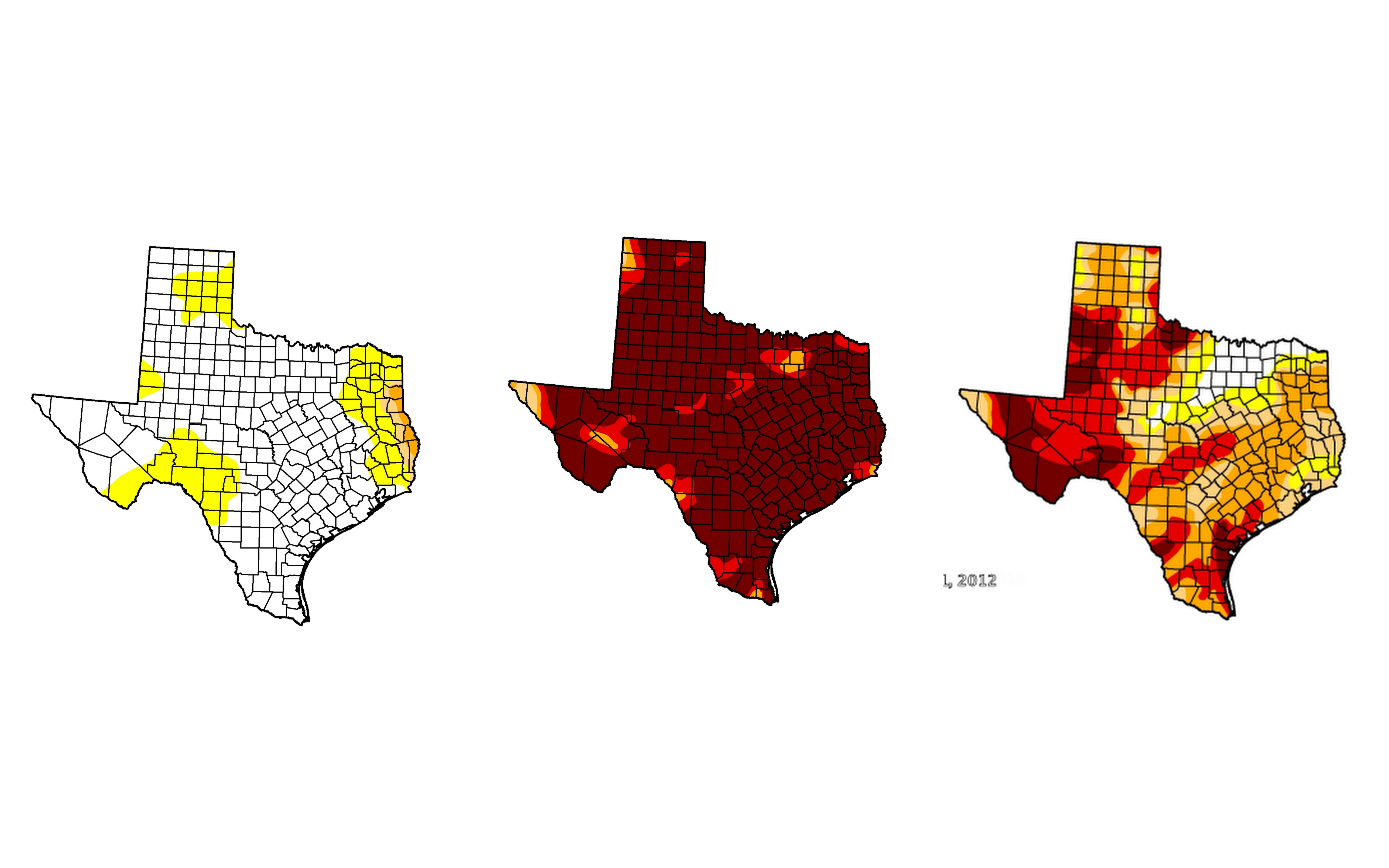
The progress of the drought: Beginning, Peak and Today
We’re far from the finish line, but after another week with rains in parts of Texas, the record single-year drought shows continued signs of abating. While 85 percent of Texas is still in “moderate” drought, only 14 percent of the state is in the highest level of drought, “exceptional.” That’s down from 20 percent last week and 86 percent at the peak of the drought in early October 2011.
Dallas/Fort-Worth is still drought-free, and you can now add parts of Houston to that list as well. (They’re still in the “abnormally dry” category or higher, however.) Austin is now in the lightest stage of drought, as are El Paso and San Antonio.
The one region that hasn’t seen much relief is West Texas. Many parts of the state there are in “extreme” or “exceptional” drought.
But the progress is unmistakable, as you can see from the three maps above that show the progression of the drought, from its beginning in October 2010 to its peak in October 2011 to today.
Stay tuned for more updates on the drought today (and forecasts for this summer).
In what they’re calling the “most decisive issue” they’ve ever come across, the Lower Colorado River Authority voted today in favor of a new water plan that will change how much water goes from the Highland Lakes to customers downstream.
The water plan was created over the last 18 months by a group with representatives from lakeside businesses, rice farmers, the City of Austin and environmental groups. The plan will likely result in less water for rice farmers downstream, and more water in the Highland Lakes. “We have been through the most intense drought in our history,” TImothy Timmerman, chair of the LCRA board, said. “We’ve had the least amount of rainfall and lowest inflows into our lakes in history. We’ve never seen a drought quite this intense. One only needs to look to Lakes Buchanan and Travis to see something needs to change with our water plan.”
The vote was ten in favor and five against, with all of the against votes coming from LCRA board members that represent counties downstream of Austin and the Highland Lakes.
Before the vote, the board heard more public comment from many residents and business owners of the Highland Lakes and rice farmers as well. At times the testimony grew intense and emotional. Buster Cole owns a company that builds trams for people to access the lake. He says his business will likely lose close to a million dollars this year. “We are a lake based business; due to water level, no one is coming,” he told the board. “Our property value has lost 40 percent of its value because of the drop in lake levels. Devastation in the Highland Lakes is here now.” Cole said he’s had to lay off 29 employees.
The rice farmers mostly sat on the other side of the room. Their reaction to the vote was reserved. Continue Reading →
About StateImpact
StateImpact seeks to inform and engage local communities with broadcast and online news focused on how state government decisions affect your lives. Learn More »