Terrence Henry reports on energy and the environment for StateImpact Texas. His radio, print and television work has appeared in the New York Times, The Washington Post, The Atlantic, NPR, The Texas Tribune, The History Channel and other outlets.
He has previously worked at The Washington Post and The Atlantic. He earned a Bachelor’s Degree in International Relations from Brigham Young University.
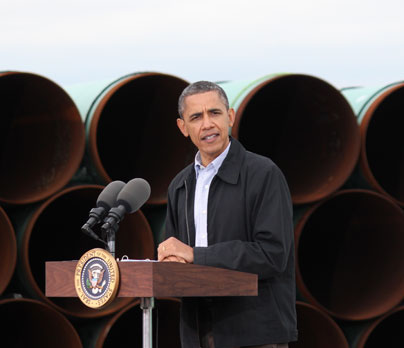
President Barack Obama visited an Oklahoma pipe yard in March and pledged his support for the Cushing-to-Texas Keystone Gulf pipeline.
All this week we’re running stories on the Keystone XL pipeline in collaboration with our neighbors to the north, StateImpact Oklahoma. We’re looking closely at the southern leg of the pipeline which would run from Cushing, Oklahoma to refineries on the Gulf Coast of Texas.
While the original Keystone XL pipeline was denied a permit by the President in January, Obama said the company was welcome to reapply if they found a new route through environmentally-sensitive regions of Nebraska (which they’re currently working on). And after the company also announced it intended to go ahead and begin construction on the southern leg, that got the endorsement of the president.
How do you feel about the pipeline? Share your thoughts and opinions in the comments below. And you can learn more on our topic page, What is the Keystone XL Pipeline?
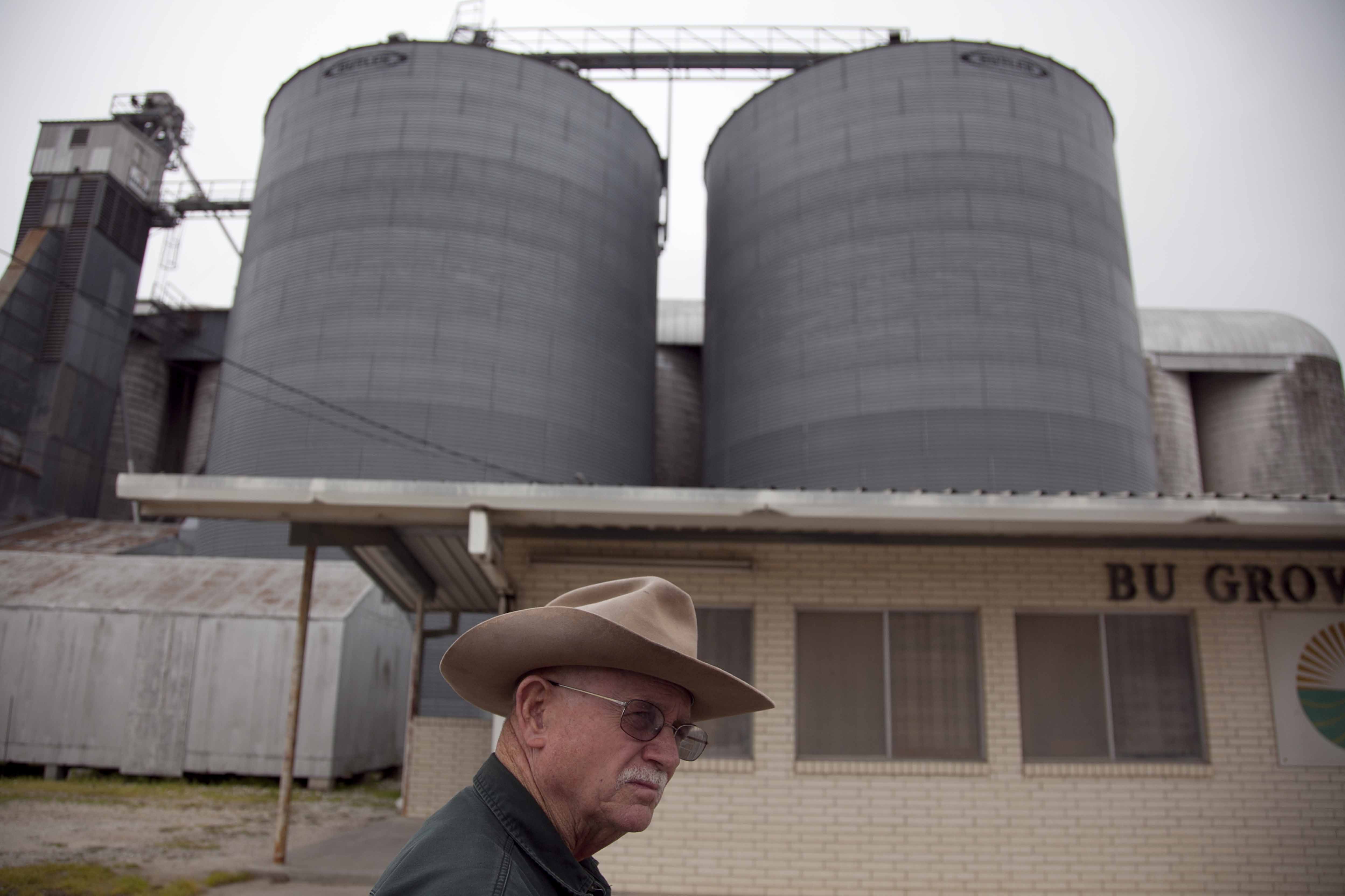
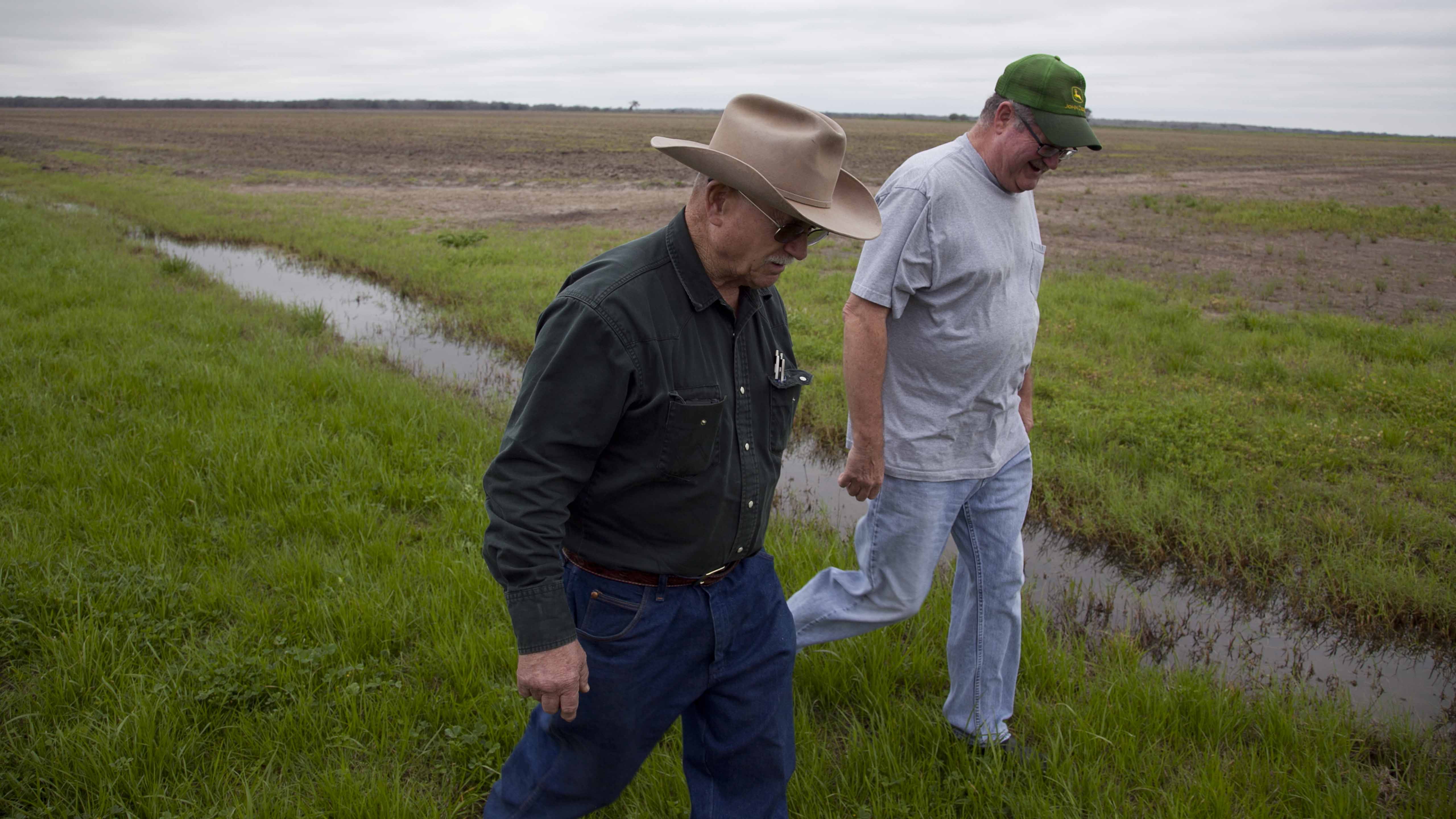
Rice farmer Billy Mann says that in the future, they'll have to grow more rice with less water.
New numbers put into perspective just how much water rice farmers in southeast Texas used out of the Highland Lakes for their water-intensive crop compared with city-dwellers in Austin last year. The Highland Lakes consist of two large reservoirs, Lakes Buchanan and Travis, and several pass-through lakes. Buchanan and Travis are still only half-full, despite a wetter-than-average winter.
A new report from the Lower Colorado River Authority (LCRA), which manages water in the Highland Lakes for the city of Austin and farmers downstream, shows that rice farmers used 367,985 acre-feet of water from the lakes in 2011. (An acre-foot is a measurement of water, i.e., how much water it would take to cover one acre with one foot of water, which is roughly equivalent to 325,800 gallons.) Another 65,266 acre-feet of water was released from the lakes downstream but not used, due to evaporation, seepage, or “conditions changed that eliminated the need for the water,” according to the LCRA, bringing their total to 433,251 acre-feet used from the Highland Lakes.
The city of Austin, on the other hand, used 106,622 acre-feet of water from the Highland Lakes, less than a third of the amount used by rice farmers. And the same pretty much holds true for previous years. (Another 192,404 acre-feet of water straight up evaporated from the lakes last year.)
Judge John Dietz has made a ruling that could cost the state billions in tax revenues.
A new ruling this week from Travis County District Judge John Dietz this week could cost the state of Texas billions in tax revenue. Ruling in favor of the drilling company Southwest Royalties, the court found that oil and gas equipment used for exploring and completing wells should not be subject to sales tax because it qualifies for an manufacturing exemption.
Frequent lawn watering may soon become a thing of the past in the Dallas-Fort Worth area.
While the Dallas-Fort Worth Metroplex was the first major population center in Texas to become drought-free this winter, it looks like they’re preparing for more droughts like the one that has baked the state over the last year and half. This week a coalition of four mayors in the region (representing Arlington, Dallas, Fort Worth and Irving) announced their intention to enact permanent water restrictions in their cities by this summer. This would mean residents could only water their lawns twice a week.
“For us to grow in our future, we’ve got to have that water,” Dallas Mayor Mike Rawlings said at an announcement Wednesday, according to local news reports. “We don’t have enough water for those people. In less than 20 years, you talk about a deficit in Washington. We have a deficit right here in North Texas and it’s water,” he said.
Ken Kramer, Director of the Sierra Club in Texas, applauded the move in a statement Thursday. “Although this is only one measure in a series of potential water conservation practices that might be pursued, it is significant,” he said. “It demonstrates that the North Central Texas area – which has often been criticized for its heavy water use – is making progress in embracing a water conservation ethic.”
Dallas, Fort Worth and Irving are some of the top users of water per capita in the state, making them prime subjects for conservation. But each city’s council still has to approve the permanent restrictions before they go into effect.
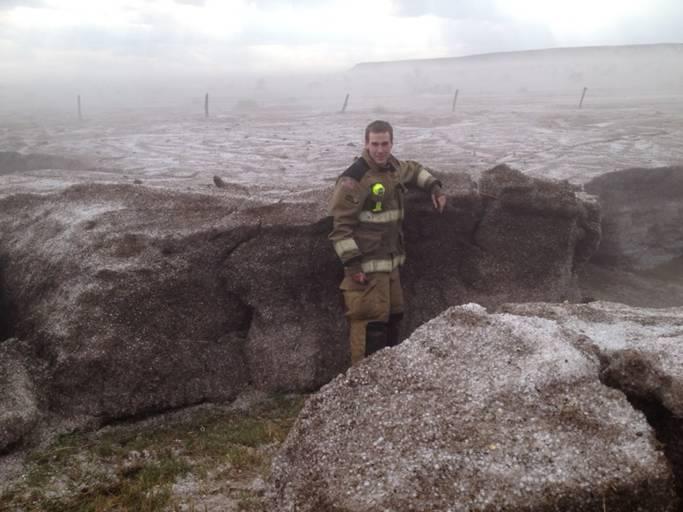
A firefighter poses in front of a wall of hail in Amarillo, Texas Wednesday.
At first people didn’t believe it, but it really is true. A photo from the National Weather Service’s Amarillo office (NWS) posted on Facebook Wednesday night shows a local firefighter standing next to a wall of hail some four feet high.
In an interview with MSNBC, Krissy Scotten, a spokeswoman for the National Weather Service in Amarillo, denied that the photo just showed ice on top of rocks, as some skeptics asserted after seeing it. “I can assure you we do not have big rocks like that in West Texas,” she told MSNBC. She said the four feet of ice was caused by a lot of rain and water. “Anytime you have hail accumulate 2 to 4 feet high and get over three inches of rain, no matter how it occurs, it’s pretty incredible,” she told the news site. And because of excessive drought in the region, there was a lot of dust, which gave the ice that rock like color.
Garcia takes the seat of Elizabeth Ames Jones, who resigned from the commission in February to run for the Texas Senate. Jones had come under fire for moving to San Antonio to run for the senate, as rules require Railroad commissioners to live in the state capital.
(The Railroad Commission of Texas is something of a misnomer as it no longer has anything to do with railroads. You can read some background here.)
In a press release from the governor’s office, Garcia is noted as being “a member of the Texas Coastal Land Advisory Board and Gulf of Mexico Alliance, an ex-officio member of the Texas Water Foundation, and co-chair of the America’s Wetland Foundation Blue Ribbon Resilient Communities Effort.” And also for being a Little League coach.
UPDATE: Garcia released a statement early Friday morning through the TCEQ on his new appointment: Continue Reading →
A new map from the Texas Tribune shows water levels in lakes and reservoirs across the state.
A new interactive map from our friends at the Texas Tribune allows you to see up-to-date levels for major lakes and reservoirs in the state. The map was created by the Tribune’s environmental reporter Kate Galbraith and data reporter Ryan Murphy.
Although overall drought conditions have improved in much of the state, our water storage hasn’t fully recovered. As you can see from the Tribune’s map, many lakes and reservoirs in the western parts of the state are still no more than a quarter full. On the eastern half of Texas, however, nearly all of the lakes and reservoirs are between 75 and 100 percent full. You can see the map in full at the Texas Tribune.
In the latest drought monitor released today, over 17 percent of the state is completely drought-free. But much of the western part of the state is still in the worst stages of drought, as is clear in the map to the right. These new maps put in stark relief the difference between the two halves of the state in their recovery from the drought.
Just how much damage has the drought done to Texas? For the first time, you can see an interactive map and several visualizations that show just how severe the drought has been our new interactive web app, ‘Dried Out: Confronting the Texas Drought.’
In a January announcement, the LCRA said that they wanted to add 100,000 acre-feet of water. (An acre-foot is the amount of water it takes to cover an acre of land with water a foot deep, about 326,000 gallons of water.) One of the ideas to accomplish that goal was to build “off-channel” reservoirs downstream of the Highland Lakes, essentially side buckets that capture extra water downstream and store it for agricultural use.
This week the LCRA announced a pilot project to see how viable the bucket idea is. Continue Reading →
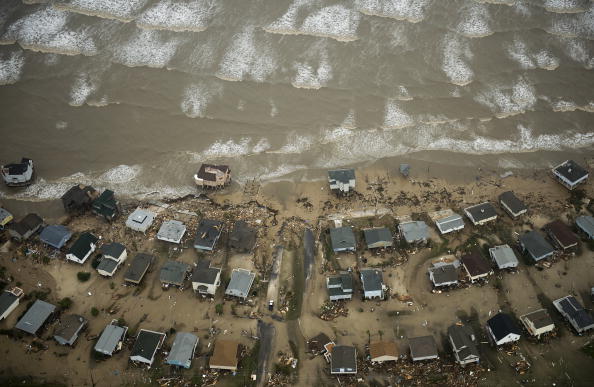
Damaged beach front homes are seen on Galveston Island after the passing of Hurricane Ike September 13, 2008 in Galveston, Texas.
A recent ruling by the Texas Supreme Court wasn’t very well-received by the General Land Office (GLO). In a 5–3 opinion, the Court ruled that the GLO couldn’t force a beachfront homeowner, Carol Severance, to move her house after a Hurricane eroded the public beach in front of it. After the hurricane, that beach was gone, and was now essentially under her house.
“It seems that the Open Beaches Act — at least for Galveston’s West End — is dead, thanks to the Supreme Court,” Texas Land Commissioner Jerry Patterson said after the ruling was announced. “This is truly a sad day.”
But a new response from the legal team behind the landowner begs to differ. The lead attorney for the defendant, David Breemer, said in a recent statement that “the decision does not ‘kill’ the Open Beaches Act; it enforces it. What it kills is a rolling easement theory that cannot be found anywhere in that law, a theory made up by state officials to avoid complying with provisions of the Act that say easements go to the vegetation line only when proven to exist by public use.”
Our new interactive webpage on the drought has resulted in quite a few comments from readers with their own stories and thoughts about the Texas drought. Here’s a roundup of some of those responses:
What’s Being Done to Plan for a Drier Future?
Many readers were concerned about planning for future droughts like the one that began in 2010.
Commenter Theodore Roberts says what planning is being done doesn’t factor in a changing climate:
“Interesting that the 5 solutions listed ignore entirely the root cause of this crisis. Where is the plan to reduce carbon emissions, consume less petroleum and electricity, and the face the simple reality that temperatures are going rise and rise over the coming decades? Global warming is a reality and no amount of wishful thinking or anti-science hysteria will make a difference.”
StateImpact seeks to inform and engage local communities with broadcast and online news focused on how state government decisions affect your lives. Learn More »