Mose Buchele is the Austin-based broadcast reporter for StateImpact. He has been on staff at KUT 90.5 in Austin since 2009, covering local and state issues. Mose has also worked as a blogger on politics and an education reporter at his hometown paper in Western Massachusetts. He holds masters degrees in Latin American Studies and Journalism from UT Austin.
TransCanada wants to seize land to construct part of a pipeline over Julia Trigg Crawford's farm in Lamar County, Texas.
Texas politicians love giving lip service to the sanctity of private property. They also talk a lot about the benefits of the state’s robust oil and gas industry. But what happens when those two things come into conflict?
Some run for the hills, some pick sides, and sometimes laws are changed. Continue Reading →
Courtesy of KQED Radio via Flickr Creative Commons
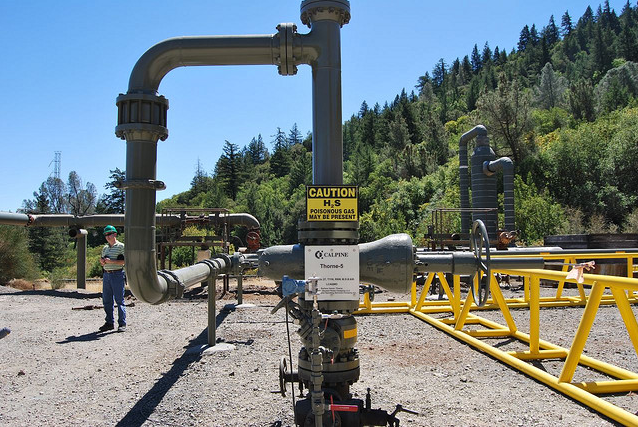
An injection well in Northern California, one of the most seismologically active regions in the country.
At a meeting of the Seismological Society of America today, scientists for the U.S. Geological Survey presented their much-anticipated findings linking the oil and gas industry with an increase in earthquakes in parts of the United States. (You can find NPR’s report on the findings here.)
The abstract released this week, which is still the only publicly available part of the study, says that “the acceleration in activity that began in 2009 appears to involve a combination of source regions of oil and gas production… to deep waste water injection wells.”
The report indicates that disposal wells, where liquid by-products from oil and gas excavation are stored, are linked to an uptick in earthquakes in states like Arkansas and Oklahoma. But what about here in Texas?Continue Reading →
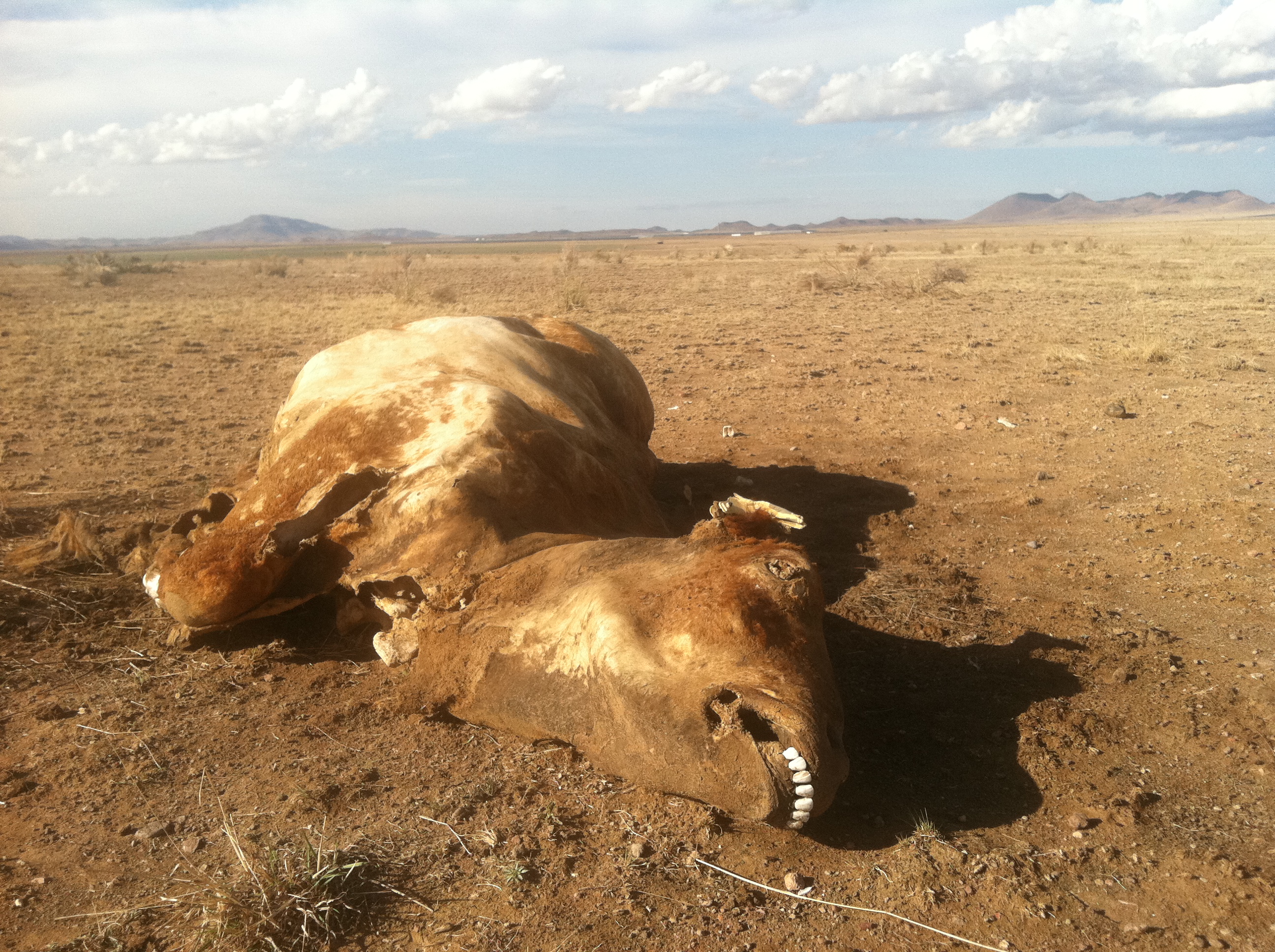
A cow that perished on a ranch outside of Marfa was dried "like jerky" by the drought.
Driving a pickup through a ranch outside of Marfa, Texas last week, grad students Justin Hoffman and John Edwards came across a sight sadly common for their region in far West Texas. A cow that had perished in the field.
What was strange about the grisly discovery was the condition of the body. After months in the elements, the animal still looked very nearly intact. The arid weather had dried its skin and organs “like jerky,” says Edwards. He gave its side a knock with his fist, the hollow drum-like thud illustrating his point.
For many Texans who came close to forgetting what rain looked like, this past winter was a welcome surprise. Unusually-wet weather helped Central and East Texas crawl their way out of last years historic drought. But the same can’t be said for the Trans-Pecos region, the far western point of the state, where the drought persists unabated. Continue Reading →
Anybody who lived in Texas last summer will tell you it was hot. Really, really hot.
It was the hottest summer on record statewide. Numerous cities, including Austin, Houston, and Dallas saw their heat records shattered by the high temperatures. Austin, for example, experienced 90 days of heat 100 degrees or over, including 27 days straight of triple digits heat from mid July to August.
It was hot.
So it might come as a relief to Texans that this summer will very likely not be as hot as last. In fact, John Nielson-Gammon, the State Climatologist, says it’s basically a sure thing.
“The rain we’ve had is a good start,” Nielson-Gammon, told StateImpact Texas this week. “It means it won’t be as hot this summer no matter what else happens.”
A man herds cattle at the West Auction in the winter of 2012.
What happens in a country that runs out of farmers? The question may not be as crazy as it sounds.
During the last agricultural census the number of farmers aged 65 or over grew by 22 percent. It’s the fastest growing group of farm operators in the country. Continue Reading →
Photo Courtesy of the U.S. Fish and Wildlife Service.
Advocates say Endangered species classification is the last hope for the Dunes Sagebrush Lizard.
Today Texas Senator John Cornyn filed an amendment to the Energy Tax Credits Modification bill on the Senate Floor that would block the listing of the Dunes Sage Brush Lizard as an endangered species. The U.S. Fish and Wildlife Service is due to make an announcement in June on whether the creature will be added to the list.
In a conference call with reporters today Cornyn said he wanted the lizard blocked from the list because classifying it as an endangered species could harm the Texas Oil industry.
“In this instance it would threaten about 27,000 jobs in the Permian basin at a time when it has regained its status as one of the premiere oil and gas producing regions of the country,” Cornyn said in response to a question from reporter Ben Philpott from KUT News. Continue Reading →
Texas political leadership was in a celebratory mood today, after news spread that the state had won a battle in its ongoing legal disputes with the Environmental Protection Agency in federal court earlier in the week.
The decision Monday from the 5th US Court of Appeals effectively ordered the Agency to take a second look at TCEQ pollution control procedures. The EPA had initially said those procedures failed to meet the standards of the Clean Air Act. But the court found the Agency’s reasons were insufficient to prove that case and that it’s rejection of the Texas rules came long past the deadline when such rules can be nullified.The opinion read in part: Continue Reading →
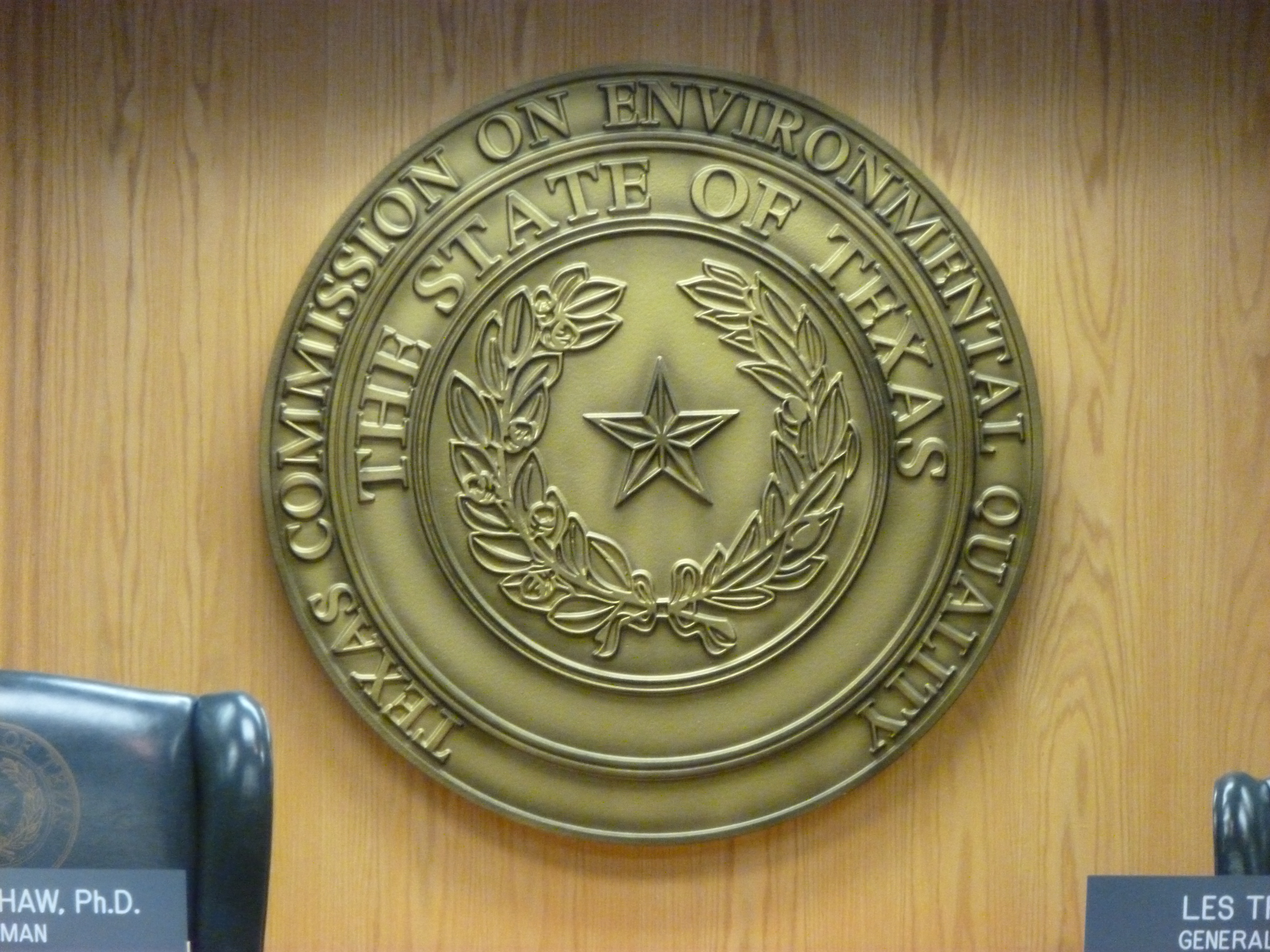
Governor Rick Perry announced Friday that he has chosen Toby Baker to serve on the Texas Commission on Environmental Quality. Baker will replace Commissioner Buddy Garcia on April 16th. Garcia’s term expired in August, according to Perry spokesperson Catherine Frazier.
A press release from the Governor’s Office outlines Baker’s work history:
Baker was most recently a policy and budget advisor on energy, natural resources and agriculture issues for the Governor’s Office, where he was also the liaison between the office and members of the Legislature, constituents, the Railroad Commission of Texas, TCEQ, Texas Parks and Wildlife Department, Texas Department of Agriculture, and the Texas Animal Health Commission. He is a past natural resource policy advisor to Sen. Craig Estes, former director and clerk of the Texas Senate Subcommittee on Agriculture, Rural Affairs and Coastal Resources.
Just a day after 130 people were arrested protesting the Yankee nuclear power plant in Vermont, a commission of Texas and Vermont officials voted on new rules to allow low level nuclear waste from around the country to be brought to Texas for storage.
The vote from the Texas Low Level Radioactive Waste Disposal Compact Commission put the final touches on a process approved by the State Legislature last year. Under the new rules, radioactive waste from other states can be transported to Texas for storage along the Texas/New Mexico border.
The storage facility is owned by Harold Simmons, a Dallas billionaire and major financial backer of Governor Rick Perry and other Texas politicians. It is “the only facility in the United States licensed in the last 30 years to dispose of Class A, B and C low-level radioactive waste,” according to it’s website.
Some opponents worry about radioactive spills on the highway and possible water contamination at the site. They say they’ll closely watch each application to transport waste as it goes before the commission for approval. Continue Reading →
The research team may have found a way to mitigate the effects of oil drilling and shipping noise on sea life.
One of the insidious things about noise pollution is that it is invisible. While the long plume that rose after the Deepwater Horizon explosion is a discernible reminder of how oil can harm the ocean, the sound that explosion made is less tangible.
But recent research shows that the noise caused by human activity, like noise from oil shipping and drilling, is having a negative impact on the marine ecosystem. That’s lead to new research and the possibility of new regulation, all aimed at keeping human activity quieter. Continue Reading →
About StateImpact
StateImpact seeks to inform and engage local communities with broadcast and online news focused on how state government decisions affect your lives. Learn More »