Dave Fehling is the Houston-based broadcast reporter for StateImpact. Before joining StateImpact Texas, Dave reported and anchored at KHOU-TV in Houston. He also worked as a staff correspondent for CBS News from 1994-1998. He now lectures on journalism at the University of Houston.
Along the Texas Gulf coast in cities where the skylines are formed by the stacks of refineries, they’re talking about a perfect storm headed their way. But this storm has nothing to do with the tropics and everything to do with natural gas.
“It’s almost a perfect storm of low energy costs, low financing costs, low construction costs,” said Bob Lieper, the city manager of Baytown.
There’s fear in Austin over what could happen if the state runs short of electricity and has to use rolling blackouts to keep the statewide electrical grid from collapsing.
The fear is for the state’s image.
At a meeting of the Texas Public Utility Commission (PUC) June 13th, Chairman Donna Nelson expressed concern that pleas to the public to conserve electricity during the late afternoon when demand is greatest might also send a message that Texas was running out of power and therefore was no place you’d want to do business. Continue Reading →
So far, so good as 100+ degree temperatures blanket much of Texas, stressing the ability of power plants to keep millions of air conditioners running.The manager of the statewide grid, the Electric Reliability Council of Texas (ERCOT), said while the system was stressed with the second day of triple digit temperatures and there was concern there would be problems, none occurred. And some relief may be on the way.
“Tomorrow (Wednesday), the weather forecasts have the temperatures moderating a few degrees and right now were forecasting (peak demand) something between 64,000 and 65,000 (megawatts),” said Kent Saathoff, ERCOT’s vice president for grid operations.
That demand would be below Tuesday’s which Saathoff said they expected to break 66,000 megawatts which would be a new record for June. The old record was set yesterday with 65,047 megawatts. Continue Reading →
2007 implosion of power plant to clear site for new homes
For developers of housing or commercial projects in Texas, bringing what had been contaminated, blighted lots back to life can be full of challenges, both legal and economic. But sometimes it works.
“Once you own the site, you have repercussions to that and potential liabilities,” says John Slavich, a Dallas lawyer.
TCEQ Easier, EPA Harder
Slavich has shepherded hundreds of Texas brownfield projects through an often daunting legal and regulatory maze. Most sites he worked on were ones overseen by the Texas Commission on Environmental Quality (TCEQ). He says he tries to avoid other, sometimes more toxic sites under control of the US Environmental Protection Agency (EPA).
Texas has a Revolving Door law but critics say it's ineffective
There’s a flow of talent leaving Texas environmental regulation agencies, often for better-paying jobs in the private sector. In some cases, the former state employees are hired by the very companies they used to regulate.
The revolving door is obvious by looking at resumes posted on job-hunting websites by people whose experience includes stints at the Texas Railroad Commission (RRC) or at the Texas Commission on Environmental Quality (TCEQ), the big state agencies that regulate refineries, oil and gas drilling, pipelines and power plants.
Located in Galveston County, it was disposal site for millions of gallons of petrochemical waste
It’s the summer vacation season and on the way to Galveston, thousands of beach-goers drive right past it. It’s a 12 acre field that lies along the east side of I-45 right before you head over the causeway to Galveston Island. It’s doubtful many of the vacationers stop to look, but if they did, they might see a stone marker. It’s an historical marker, of sorts. In big letters it proclaims what is just the other side of a barbed wire-topped chain-link fence: the MOTCO FEDERAL SUPERFUND SITE.
It’s one of over 150 polluted Superfund sites in Texas. Some are under control of the Texas Commission on Environmental Quality. Many of the worst are managed by the U.S. Environmental Protection Agency. Continue Reading →
There is disagreement over whether higher wholesale prices could raises costs for residential customers
With warnings piling up that Texas could face power blackouts this summer, a consulting group gave its support to the Texas Public Utility Commission’s (PUC) proposal to dramatically increase the cap on the wholesale price of electricity during critical, high demand times. The idea is to make Texas a more profitable electricity market so investors will be willing to fund construction of new power plants.
The Brattle Group report to the Electric Reliability Council of Texas (ERCOT) recommends tripling the maximum wholesale price “from the current $3,000 to $9000…but impose this price cap only in extreme scarcity events,” said the report.
Those figures are in keeping with what the PUC has proposed and which the commission’s chairman wants to start phasing in this summer.
It says while most of the nation has adequate reserves of electric power to make it through the summer, Texas may not.
“Given the expected reserve margin in the ERCOT Region for the 2012 summer season (below the minimum Reference Margin Level), unavailability of one or more large thermal generators due to the compliance requirements of the CSAPR or, in fact, for any reason (such as an extended maintenance outage), would increase the risk of emergency conditions during 2012 summer peak load hours, and could necessitate rotating outages in the event of extreme heat or significant other generation unit outages.”
A Red-cockaded woodpecker, an endangered species, in a forest at the Cook’s Branch Conservancy.
‘It’s a false sense of security if people think it doesn’t matter that one species is disappearing. To me, that tells me the whole system is in trouble” – Sarah Scott Mitchell, granddaughter of George Mitchell
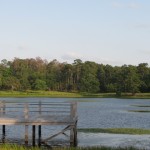
The Cook’s Branch Conservancy is located on 5,600 acres in Montgomery County. The land was purchased by Texas oil & gas billionaire George Mitchell in 1964.
“We’re now getting close to the condition the settlers found it in. We’re restoring grasses and doing controlled burns.” -Sheridan Mitchell Lorenz, daughter of George Mitchell
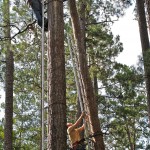
Naturalists improve breeding of the woodpecker by climbing old pines to build nests and remove predators like squirrels
Watching woodpecker return to feed hatchlings
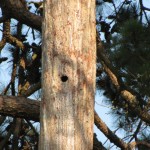
Woodpecker nest in old-growth pine
Woodpecker hatchling
“I can hear the difference. You can hear so many more song birds that I didn’t hear before. We’ve actually doubled our population of (woodpeckers) in 10 years” -Kathy Hutson (center), Conservancy Manager
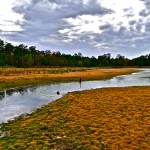
Wildflowers in a restored meadow
Flock of Eastern Wild Turkeys on the conservancy, one of many species that benefited from the restoration.
Keeping the lights on at home in Houston as state regulators debate letting power companies make bigger profits
The three members of the Texas Public Utility Commission (PUC) seem in agreement that the cap on the peak price for wholesale power should be raised. They’ll likely finalize a massive increase this summer.
Then, the big question: will it encourage power generating companies to build more plants in Texas as intended? Or will it only encourage profit-taking and possibly even market manipulation?
At a meeting of the PUC April 12, there was disagreement over how to implement a higher cap on the price allowed on the spot market, typically a factor in extreme weather when power use surges. The current cap has been tripled in recent years and is now the highest in the nation at $3,000 per megawatt/hour (during normal times, the price per megawatt/hour can be $50 or less). The commissioners are considering raising the cap to $4,500 this summer and to $9,000 by 2015. Continue Reading →
About StateImpact
StateImpact seeks to inform and engage local communities with broadcast and online news focused on how state government decisions affect your lives. Learn More »