Along the Texas Gulf Coast, billions is being spent to build or expand petrochemical plants.
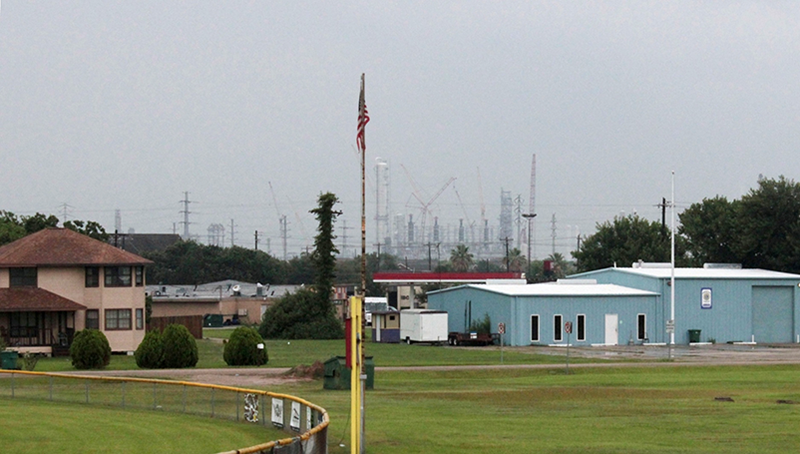
A big, new expansion of a petrochemical plant is under construction in Clear Lake. It’ll make methanol, a key ingredient for producing other chemicals. But will it also make pollution that will add to global warming?
The expansion of an existing complex owned by Celanese is part of trend along the Texas Gulf Coast as low prices for natural gas have made making chemicals cheaper.
“There’ve been several methanol and ammonia plants proposed for the area. And those are very natural gas intensive,” said Katie Teller, an analyst with the Federal Department of Energy.
A map of projects to increase transmission capacity in the Rio Grande Valley.
It had been about three years since Texas experienced major rolling blackouts, but they happened this week in the Rio Grande Valley. The Electric Reliability Council of Texas (ERCOT), the group that manages nearly all of the Texas grid, says the blackouts are related to longstanding problems with the transmission system in the region.
Trouble started on Wednesday afternoon when two power plants suffered breakdowns. Fearing that high demand and low supply of electricity could damage the regional grid and cause an uncontrolled blackout, ERCOT called for “rotating outages” (industry speak for rolling blackouts) to keep some power on the lines.
Grid managers have known for some time the valley runs a higher risk of rolling blackouts. The reason is that the transmission system in the Valley is more isolated than other parts of Texas. It cannot easily bring in electricity from the rest of the ERCOT grid when needed. That can cause blackouts in the Valley even when the rest of the grid is stable, according to ERCOT.
“The valley area has some significant limitations as far as how much power it can import into that region,” says Robbie Searcy, an ERCOT spokesperson. “Right now when there is a hot early fall afternoon and we have these sort of generation outages there is a risk to the transmission system in that area.”
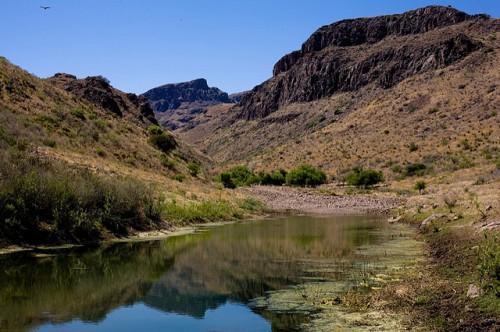
The Chinati Mountains State Natural Area in south Presidio County finally has public access, according to Corky Kulhmann, senior project manager for land conservation for Texas Parks and Wildlife. This is news given exclusively to KRTS.
For eight years, Kulhmann and his team have been working to gain public access to 39,000 acres donated to create a new state park.
“But that’s been blocked by either no funds or landowners changing their minds or just other priorities with state parks, as far as money could go when we had money,” Kulhmann explains. “It turned out a lot of the lands here are just a bowl of spaghetti.”
The four tracts of land needed to open a public road to the park were not straight-forward deals. There was the family that wouldn’t sell to the state and instead sold to a developer, who then sold back to the state; a landowner that had to be tracked down in Florida through Facebook; and a deal negotiated with Presidio County after a default on taxes gave them the land, says Kulhmann.
The last piece of the puzzle has Kulhmann’s surveyors working with the state of Texas General Land Office to purchase land from them.
Ernest Moniz was the keynote speaker of this year's SXSW Eco conference in Austin.
It’s not every day that you get to talk to the US Secretary of Energy about how the oil and gas boom affected your hometown. So, when Alyssa Wolverton saw her chance, she took it.
After delivering the keynote speech at this year’s SXSW Eco conference, Department of Energy Secretary Ernest Moniz took some questions from the audience. That’s when Wolverton, a student at the University of North Texas in Denton, asked him about a proposal to ban hydraulic fracturing (or “fracking”) within city limits. The town will be voting on the ban this November.
“I was curious to know if you think that your really good idea of diversifying our energy (…) can mesh up with the integrity of our cities that don’t want more advances,” asked Wolverton, who supports the proposed ban.
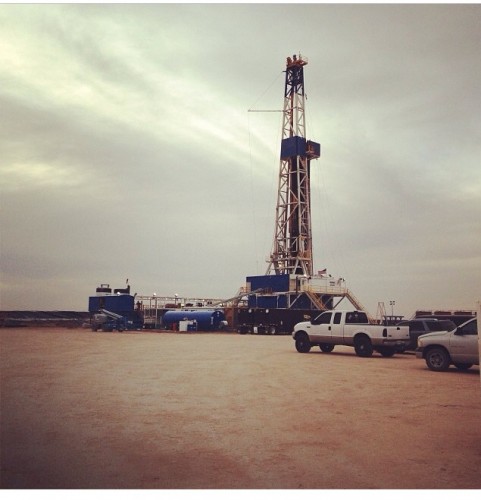
An oil rig south of Pyote, Texas, December 11, 2013.
Crude oil is now trading at roughly $13 a barrel less than it did a year ago. That’s in spite of the seizure of Iraqi and Syrian oil facilities by ISIS and a U.S.-led bombing campaign against those facilities.
“The beginning of the bombing campaign in Syria and Iraq recently was met with a big yawn by the energy markets and really had no upward effect at all on crude oil prices,” says economist Karr Ingham, creator of the Texas Petro Index on behalf of the Texas Alliance of Energy Producers.
According to the latest index, the state’s crude oil production approached 96 million barrels in August, up more than 23 percent from August of last year. Ingham suspects the rise in U.S. production is helping to hold down prices and stabilize energy markets. “Don’t you wonder if we are not seeing the benefits of expanded crude oil production in North America playing out before our very eyes?” he says. “I wonder if that’s not exactly what we’re seeing. I certainly hope that’s the case. This may in part be what energy independence looks like.”
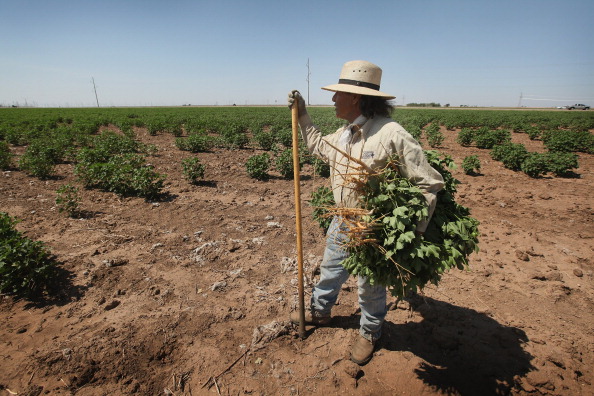
Juan Rico culls cotton plants growing between rows in an irrigated cotton field July 27, 2011 near Hermleigh, Texas.
Talk of Texas often conjures images of wide open ranch land and farmers at work their fields. But that iconic territory is being lost, according to a new analysis.
The conference, called “No Land No Water,” focused on what Lopez believes are inefficient and unsustainable landowning trends in Texas’ flourishing economy.
“In the past 15 years, we’ve seen a little over a million acres of working lands converted to other uses,” he says.
Land conversion can mean more than a loss of grazing space and pretty views. Lopez worries it will further impede water recharge by replacing soft, absorptive ground cover with impenetrable material, like road cement.
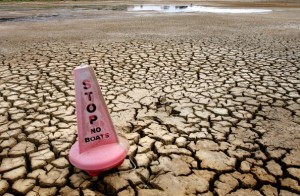
This photo taken 16 November, 2006 shows a warning sign for boats sitting on the bottom of the empty Green Hill Lake outside the small rural town of Ararat, some 170 kms west of Melbourne.
Nowadays, when there’s a killer heat wave or serious drought somewhere, people wonder: Is this climate change at work? It’s a question scientists have struggled with for years. And now there’s a new field of research that’s providing some answers. It’s called “attribution science” — a set of principles that allow scientists to determine when it’s a change in climate that’s altering weather events … and when it isn’t.
The principles start with the premise that, as almost all climate scientists expect, there will be more “extreme” weather events if the planet warms up much more: heat waves, droughts, huge storms.
But then, there have always been periodic bouts of extreme weather on Earth, long before climate change. How do you tell the difference between normal variation in weather — including these rare extremes — and what climate change is doing?
That sort of discernment is difficult, so scientists have had a rule, a kind of mantra: You can’t attribute any single weather event to climate change. It could just be weird weather.
Then they took a close at last year’s heat wave in Australia. Continue Reading →
About StateImpact
StateImpact seeks to inform and engage local communities with broadcast and online news focused on how state government decisions affect your lives. Learn More »