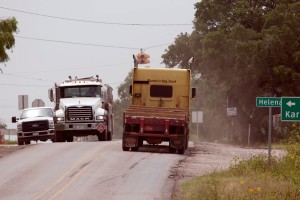
Photo courtesy Texas Department of Transportation.
Truck traffic on FM 81 in the Eagle Ford Shale formation area.
The Texas Department of Transportation gave an update Wednesday on their current measures to repair damaged rural roads in the Eagle Ford Shale.
During a Texas Senate Transportation Committee on Transportation hearing, TxDOT highlighted a $500-million solution enacted by the state to rehabilitate damaged roads linked to heavy oil and gas related traffic in the natural gas hot spot.
John Barton, deputy executive director of TxDOT, broke down exactly how the funds are being used. “We took $225 million and directed it to projects based on the criteria that was established in that bill [HB1025] that asks us to look at the safety in the [road] network.”
TxDOT inspected roadway conditions such as width and truck traffic volume. Continue Reading →
A car tire lays exposed in the dried lake bottom at Lake Abillene near Abilene, Texas.
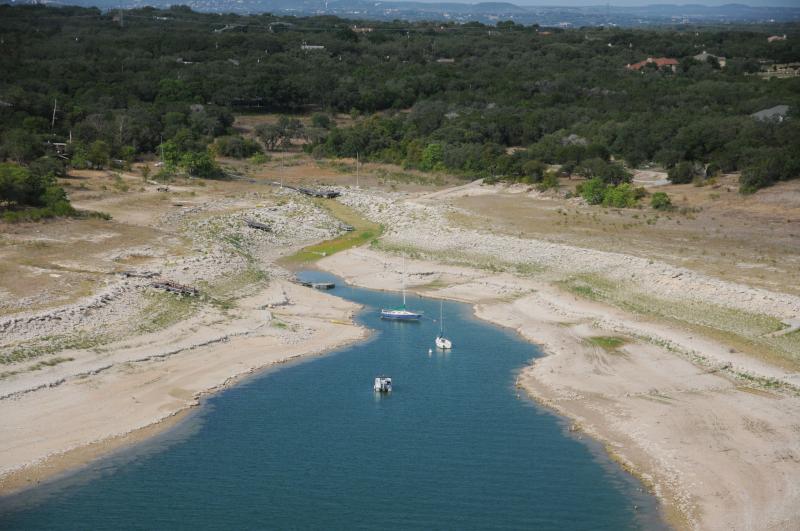
Summer brought no relief from drought in many parts of Northwest Texas. But storms related to Hurricane Odile could bring some much needed rain. The region, like much of Texas, has been struggling with drought for years. Now some communities there are now faced with a difficult task: find new water, or go dry.
Take the small Texas town of Gordon. Kenneth Epperson works for the Water Department there. By the end of August, the town had about four months of water left for close to 800 users. So he’s looking at his options, one of which is possibly getting water from a local rancher who has a lake on his land and bring it to the town treatment plant via pipeline.
Gordon is just one of many towns facing the prospect of running dry, and because the crisis is regional, stretching across city and county lines, officials are needing to get creative when considering new supplies. “You know, all over, this northwest Texas is kind of in a bind,” Epperson says.
Austin Energy earns 40 percent of its revenue in the summer months
Aside from the month of August, this summer has been relatively cool as far as Texas summers go. That’s a welcome change of pace for those who live here, but it’s brought an unanticipated gap in revenue for some electricity providers.
Take Austin Energy. At the start of the year, the city-owned utility was expecting to bring in around $654 million in base revenue from energy used by customers. Since then, it has reduced that estimate by about $16.5 million.
“That’s the impact the cooler weather has had. It’s to the tune of 16 and a half million,” says Carlos Cordova, a spokesperson for Austin Energy.
The utility makes 40 percent of its annual revenue in the four hottest months of the year that’s June, July August and September. This year all those months, except August, have seen lower than average AC use and peak electric demand.
The Three Rivers ISD school bus was totaled in this accident in January 2014, after a fracking crew driver fell asleep and hit the bus. Three workers in a commercial van were killed; but the children were safe.
State Highway 72 cuts through the heart of the Eagle Ford Shale in South Texas. The two-lane artery links oil boomtowns like Kenedy and Tilden to the Three Rivers Valero refinery. Local residents call the highway “Death Row.”
“Every week someone dies, just about,” says Steve Alaniz, a construction manager based in Three Rivers. “There’s so many guys that work nights, and there’s so many people getting up early. Everybody’s in a hurry. The roads aren’t big enough for this kind of traffic.”
Early on the morning of January 30, a Three Rivers school bus was pulling into an RV park off Highway 72, when a van filled with oilfield workers employed by Compass Well Services plowed into the bus’s rear end. Alaniz was one of the first on the scene. He found the students safe at the front of the bus, thanks to school district policy in response to the heavy traffic. Continue Reading →
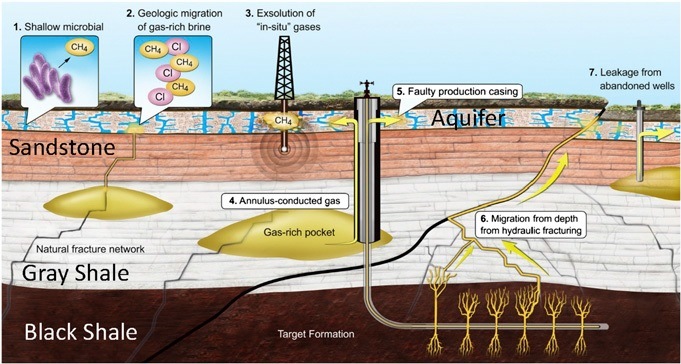
The study explored different scenarios that may have accounted for elevated methane in the groundwater.
For years, some residents of Parker County in North Texas have believed that nearby gas drilling was responsible for high levels of methane in neighborhood water wells. Research published today in the Proceedings of the National Academy of Sciences appears to back that up.
The study looked at water contamination in Texas and Pennsylvania. It suggests that faulty cement jobs on drilling wells could be at fault in North Texas. Cement is poured between the rock wall and the steel tubing of oil and gas wells to block contaminants.
“We think either there isn’t enough cement in this location or more likely there are cracks or imperfections in that cement. That’s what allowed the strong gas to move up through the well and then out into peoples drinking water,” says Robert Jackson, a professor of environmental sciences at Stanford, who co-authored of the study.
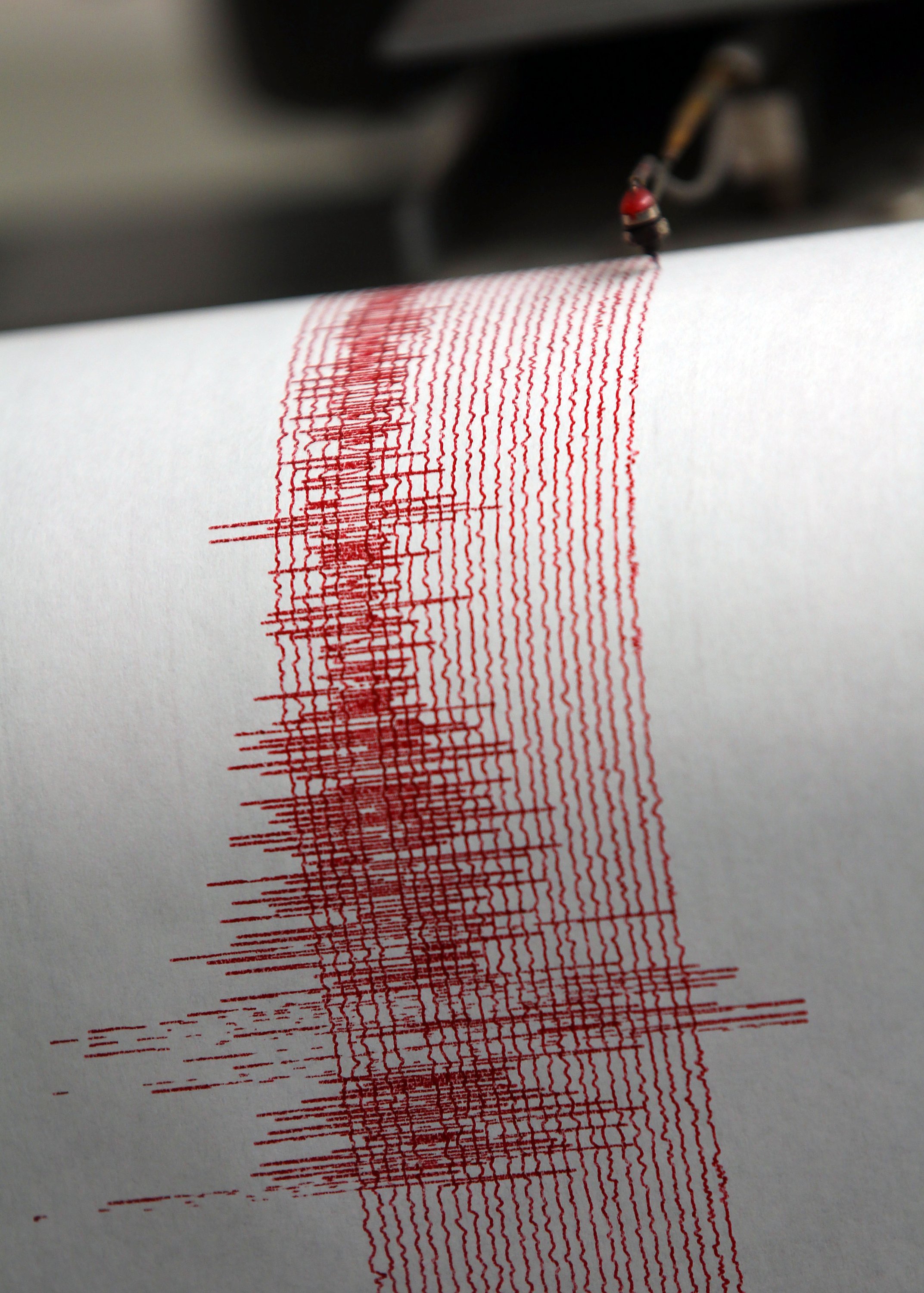
Regulators are trying to craft rules to respond to the dramatic uptick in quakes.
It was a shaky week in Texas last week with three small earthquakes rattling the Dallas-Fort Worth area and a slightly more powerful quake detected in South Texas.
The first quake measuring magnitude 2.4 struck near Arlington. It prompted some residents to call 9-11 after feeling their houses shake and hearing “explosions,” according to the the Forth Worth Star Telegram.
Earthquakes are often accompanied by loud “booms,” something that has become a source of anxiety in newly quake-prone parts of the state.
The quake coincided with a water main break that morning that left about a dozen homes without water. The City of Arlington tells StateImpact Texas that the water main break was not caused by the earthquake.
The South Texas quake was the strongest of the three. It measured 3.2 and was centered about two miles southeast of Charlotte. It struck on Wednesday, but was not reported by the USGS until Thursday.
A fourth quake again rattled Arlington on Friday evening, it measured 2.5.
All of the quakes happened in parts of the state with extensive oil and gas drilling activity.
For El Nino to fully appear, the ocean temperature must enter a feedback loop with the atmosphere.
Earlier this year Lower Colorado River Authority meteorologist Bob Rose, liked what he was seeing in the forecast.
“I’m optimistic that we will get into a pattern of above normal rainfall this fall continuing into next winter and possibly into next spring as well,” he said in April.
But since then things changed.
After much ado, the El Niño predicted by many meteorologists hasn’t quite showed itself in the form rainfall yet. While there’s still a chance it could strengthen before the summer’s end, it’s not likely it will meet its initial forecasted fury.
“El Niño, while it looked like it was really starting to ramp up, and would really start to develop in September. It actually took a pause in July,” he says.
The endangered golden-cheeked warbler could be at even greater risk, depending on what climate change does to its habitat.
Over three hundred species of birds are at risk from climate change in North America, according to a report from the National Audubon Society. Many of them can be found in Texas.
Brian Trusty, Executive Director of Audubon Texas, says the study has identified over one hundred Texas species that run the risk of losing significant habitat due to climate change (see below for details on this list).
These are birds species that “will see a significant change and or reduction of the climate suitable habitat over the next 10, 40 or 60 years,” Trusty tells StateImpact Texas.
The report used projected migration paths to determine the fate of bird species. It also pulled from bird “census” data, like the Christmas Bird Count, to determine traditional nesting ranges, and preferred weather conditions of bird species.
“We were utilizing over a hundred years collected from data to pinpoint the suitable climate areas of the home ranges of those species,” says Trusty.
Climatologists could one day predict the viability of soil by measuring and forecasting moisture levels.
A couple years ago UT Professor Zong-Liang Yang was at a conference on extreme weather in the Netherlands. It was 2012, just one year after the worst single-year drought in Texas history.
When it came to discussing extreme weather, Texas seemed like a good place to be. He suggested to colleagues that their next conference should take place in the Lone Star State.
Two years later, he and dozens of some of the world’s leading climate experts from 10 different countries have descended upon UT-Austin to talk about improving our ability to forecast and prepare for extreme weather. They seem confident that they’re making progress.
That might come as a surprise considering how often meteorologists appear to get it wrong, but Yang points out that forecasting is a science that’s made massive leaps in the past fifty years.
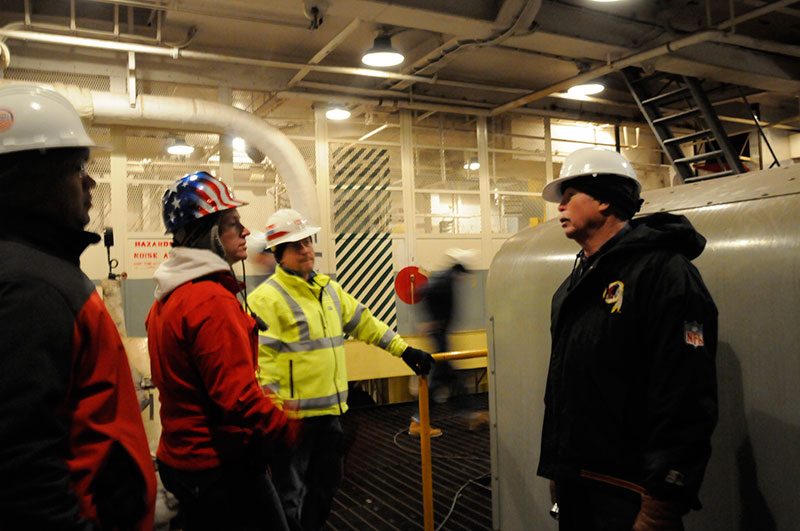
Aboard the Sturgis: US Army Corp of Engineers project managers Brenda Barber (flag safety hat) and Hans Honerlah (yellow jacket)
Sometime this winter, an historic sea vessel will float into Galveston. But you won’t be able to take a tour of it. In fact, you probably won’t be allowed to get close to it. Because the big barge is radioactive.
A half century ago, the U.S. Army came up with what sounded like a great idea: put a small, nuclear power plant on board an old military cargo ship. The Army called it the Sturgis after a three-star general.
“The Sturgis was fairly highly classified,” said Will Davis who used to operate nuclear reactors in the Navy and now has a blog on atomic power. He said the Sturgis had one mission: it was sent to the Panama Canal to generate electricity to operate the locks. But after about 7 years, it was no longer needed and was mothballed.
“Sturgis has been de-fueled since 1977. The nuclear fuel was taken out,” said Davis.
StateImpact seeks to inform and engage local communities with broadcast and online news focused on how state government decisions affect your lives. Learn More »