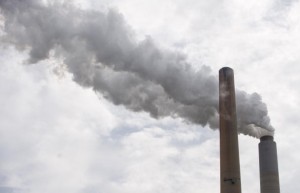
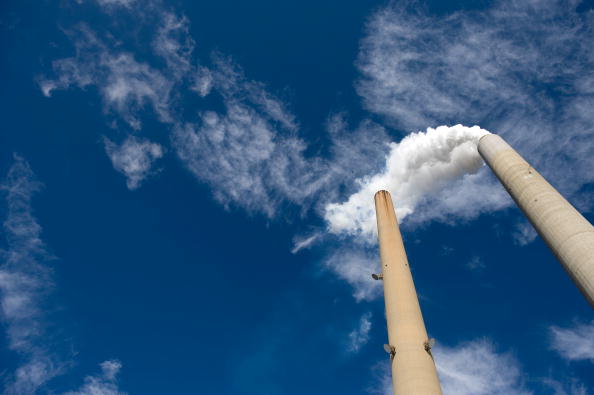
New rules proposed by the Obama administration seek to reduce greenhouse gas emissions from power plants
As greenhouse gases reach their highest concentrations in human history, the Obama administration has pledged to take action on climate change, unveiling a Clean Power Plan this summer to go after a prime target of those emissions: coal power plants. And true to form, that plan is running into opposition from lawmakers and regulators in Texas.
At a hearing of the Texas House Committee on Environmental Regulation Monday, both regulators and lawmakers expressed concern in the feasibility of complying with energy regulations proposed in EPA’s plan.
“One of our main concerns is that they don’t reflect the reality of electric markets, which operate at the literal speed of light” said Brian Lloyd, Executive Director of the Public Utility Commission of Texas. “[The plan] requires very long-life, hugely expensive capital expenses.”
Lloyd said the Public Utility Commission would need to collect an additional billion dollars from ratepayers in order to achieve energy efficiency standards proposed by the EPA. Energy efficiency is one of several initiatives, including renewable energy generation and switching from coal to natural gas power generation shifting, that the agency calls for in its plan.
A recent drop in carbon emissions in the U.S. could only be temporary, a new report warns.
Texas will need to make big cuts in carbon emissions over the next 15 years under a mandate from the Environmental Protection Agency. You can expect to hear complaints about the EPA rule at a two-day meeting of the House Environmental Regulations Committee starting Monday.
The federal agency and state leaders have been at odds for years and many conservatives worry that limiting carbon emission to fight climate change will hurt the economy.
But there are some in Texas who see an upside. Click the player to learn more.
The oil and gas rich Eagle Ford Shale formation straddles both sides of the Texas Mexico border.
Today, members of the state House Energy Resources Committee met in the Rio Grande Valley town of Edinburg to discuss how a partial privatization of Mexico’s oil and gas sector could impact the Texas economy.
Until this year, drilling in Mexico was run by Pemex, a state-owned company. A change in Mexican law has now partially opened the county to foreign business. That could be a big opportunity for Texas companies familiar with the oil and gas rich Eagle Ford shale that straddles the border. Some estimates have already said a shale boom in Mexico could grow the Texas economy by tens of billions of dollars. Others say it’s too early to tell.
“I have seen some of those estimates, and at this point all they are are numbers on a spreadsheet,” say Tom Tunstall, director of the Center for Community and Business Research at UT San Antonio.
He says infrastructure and border security concerns could complicate investment. Then there’s uncertainty around the continued roll of Pemex.
Texas Governor Rick Perry waiting to be introduced at Energy & Climate Policy Summit in Houston
Governor Rick Perry says the United States can keep Russia in check by increasing the production of oil and gas here at home.Perry spoke last night in Houston at a conference on energy and climate policy, sponsored by the conservative think tank the Texas Public Policy Foundation.
“The reliance on oil has made us more dependent than we should have been on sources that are hostile to this country, ” Perry said.
But now, oil and gas production here has surged with the boom in the drilling technique called fracking. Perry said domestic production could be expanded even more, which he said, would give the U.S. added leverage in dealing with Russia. Russia has its own vast supplies of natural gas it sells to Europe.
“Energy is a weapon in the hands of aggressors. So I say if energy is going to be used as a weapon, America should have the largest arsenal,” said Perry. Continue Reading →
Hurricane Sandy, pictured, churns off the east coast on October 28, 2012 in the Atlantic Ocean.
There’s a good chance of an El Niño weather pattern forming by the end of the year. That could be good for easing or even ending the Texas drought. But it’s not a sure thing.
For meteorologists to know El Niño has definitely arrived, warmer surface water in the Pacific needs to engage with the atmosphere. So far, that hasn’t happened.
Forecasters, however, are already seeing another sign of El Niño: fewer hurricanes than average in the Atlantic.
“I think we’ve only had five named storms so far [in the Atlantic], about 50 percent of normal,” says Victor Murphy, a meteorologist with the National Weather Service. “Whereas the Eastern Pacific Basin, I think they’re on the “P” storm Polo. I think they’re at about 150 percent of activity in the Pacific.”
The “O” storm, “Odile,” from the Pacific, dropped a sizable amount of rain on parts of Texas just last week.
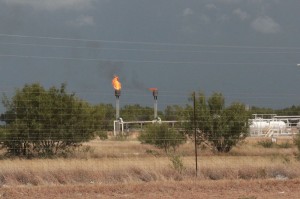
Oil & gas facilites in LaSalle County, part of the Eagle Ford Shale.
Economists made a surprising discovery when they measured the economic impact of oil & gas drilling in Texas. For the past four years, Thomsas Tunstall and a team of economists at University of Texas-San Antonio have been measuring the economic impact of surging oil & gas drilling in the rock formation called the Eagle Ford in South Texas.
“Clearly the formation production has legs,” Tunstall told News 88.7.
And those legs are running faster than expected. Way faster.
The economists had predicted just last year that they expected the total economic impact to South Texas to be $89 billion in 2022. Instead, they now estimate that the impact has already reached almost that amount: $87 billion.
Divestment has become a popular topic on college campuses and some boardrooms.But it will likely have trouble taking hold in oil rich parts of the state.
“I think it is worth asking ourselves as a society how much longer we think we need to have an oil economy.” — Michael Webber, UT Energy Institute
This week in New York, the UN Climate Summit is underway, and the Rockefeller Foundation made news with the announcement that it will divest close to a billion dollars from fossil fuels. Here in Austin, University of Texas President Bill Powers gave his State of the University address. But in contrast to the news from New York, Powers thanked “heavens” for the oil wealth provided to UT by its land holdings, and celebrated the fracking revolution as “good news” for the University.
The disconnect between the two messages leads one to wonder about the role of the divestment campaign in oil-rich parts of the country. Could divestment in other parts of the country grow to the point where it disrupts Texas’ fossil fuel economy? By contrast, could divestment ever catch on here?
We called Michael Webber, Deputy Director of UT’s Energy Institute, to talk about all that and more.
It should be noted that the Institute receives funding from industry and from UT, which, as President Powers noted, is no stranger to the oil business. (StateImpact Texas has also been sponsored by the Energy Institute on special projects. These disclosures seem all the more important in a blog post about how deeply intertwined the fossil fuel industry is with many aspects of the life in the state.)
StateImpact Texas: Could divestment shake up the Texas economy?
Joel Rodriguez is the County Commissioners Court Judge in LaSalle County
The Railroad Commission of Texas will meet Monday morning to consider an issue of huge importance to landowners across Texas. It has to do with how the state oversees energy companies that need access to private land. At issue at the hearing will be pipelines for oil & gas.
But there are other land use issues emerging in the hot plays including the Eagle Ford shale of South Texas. One local dispute involves one particular county road, Hindes Road. It’s in LaSalle County, which lies halfway between San Antonio and the Mexican border.
“When it rains, it has standing water and mud holes where you need four-wheel-drive,” said Steven Mafrige, who lives on a nearby ranch.
Ranchers have always shared the land with energy companies: They make money together. But this oil & gas boom is like nothing ever seen here before. And maybe that’s why this little road has become a source of conflict. Continue Reading →
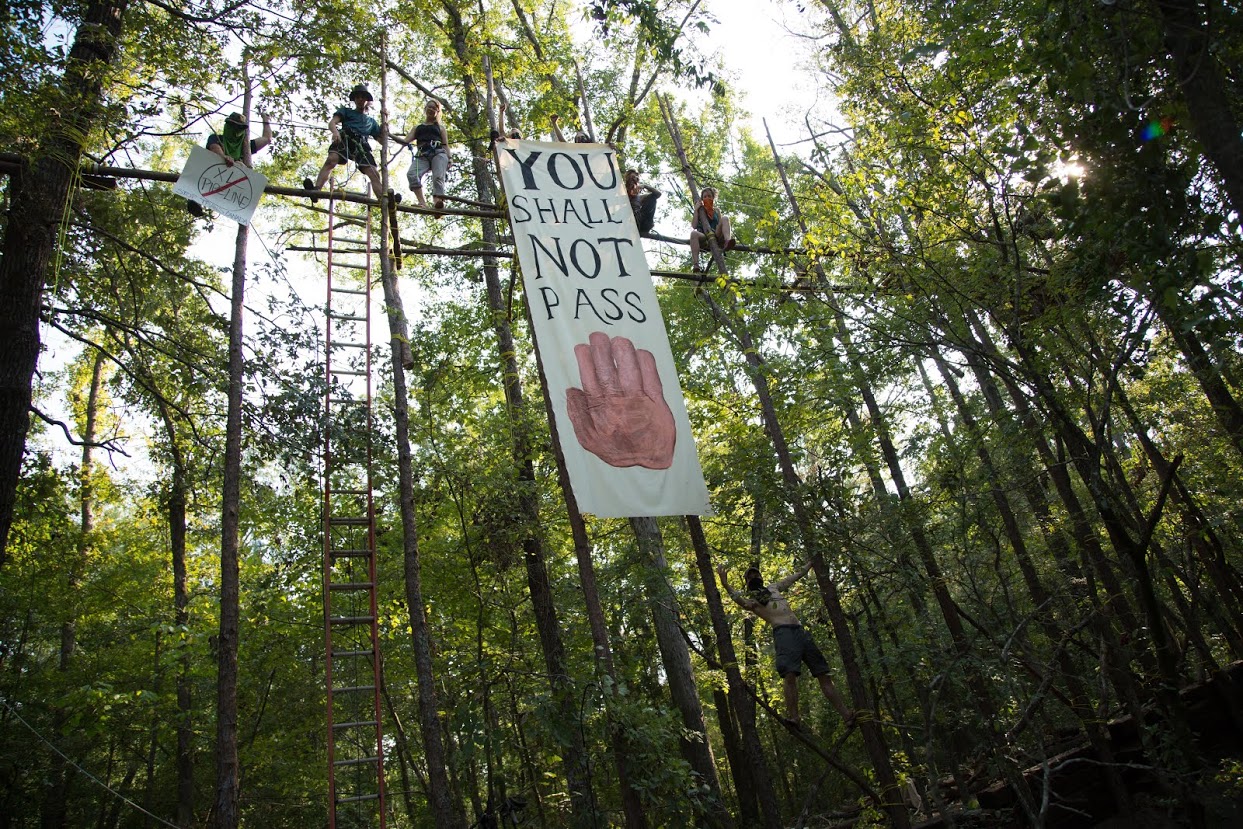
Activists took to the trees to try to stop the Keystone XL Pipeline in East Texas.
Last year at a farm in outside of Beaumont, Dick O’Keefe sat at the kitchen table and talked about how a pipeline had come to his land. The company had claimed eminent domain powers. O’Keefe was not convinced.
“The pipeline companies should have to demonstrate that they have the right of eminent domain before they ever start beating the streets and handing out contracts,” O’Keefe said. “The threshold for them is extremely low.”
The Texas Supreme Court agrees with that assessment. In a 2011 decision, the court called the process giving eminent domain powers to pipeline companies nothing more than a “registration.” In the ruling the court said “No notice is given to affected parties. No hearing is held, no evidence is presented, no investigation is conducted.”
The conclusion: “Our Constitution demands far more.”
Today, the state’s oil and gas regulators are meeting to consider changing those rules. But getting there has been a long and windy road, as KUT’s Mose Buchele reports for State Impact Texas.
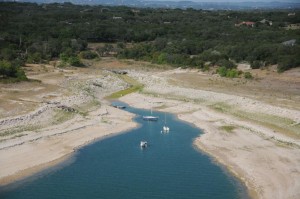
Lake Travis is heading towards its lowest levels in history if we have a dry fall.
Central Texas is having a pretty decent year, rain-wise. We’re sitting just below normal. And it’s been a good week, too: early Thursday, one part of Austin got over seven inches of rain.
So much rain fell over downtown Austin that the statue of Stevie Ray Vaughan along Lady Bird Lake looked like he was walking on water. It brought back memories of the Halloween floods last fall — back then Stevie was standing in water waist-deep. But these big rain events all have something in common: They really haven’t fallen where we need them most.
“The watershed that helps our water supplies isn’t here in Austin; it’s way up into the counties to the north of us. It’s the drainage that goes into Lakes Buchanan and Travis,” says John Hofmann, Executive Vice President of Water for the Lower Colorado River Authority (LCRA).
Hofmann says while the areas around the lakes got some decent rain earlier this summer, other than that it’s been pretty dry up there. So while Lake Austin is getting doused, the creekbeds that go into the Highland Lakes can stay relatively dry. Lake Travis has risen over a foot this week, and could go up another foot today. But it’s still nearly 40 feet below where it should be, and lower than it was a month ago.
And it’s not just where the water is falling that’s preventing the lakes from recovering. It’s the condition of the ground that it’s falling on.
StateImpact seeks to inform and engage local communities with broadcast and online news focused on how state government decisions affect your lives. Learn More »