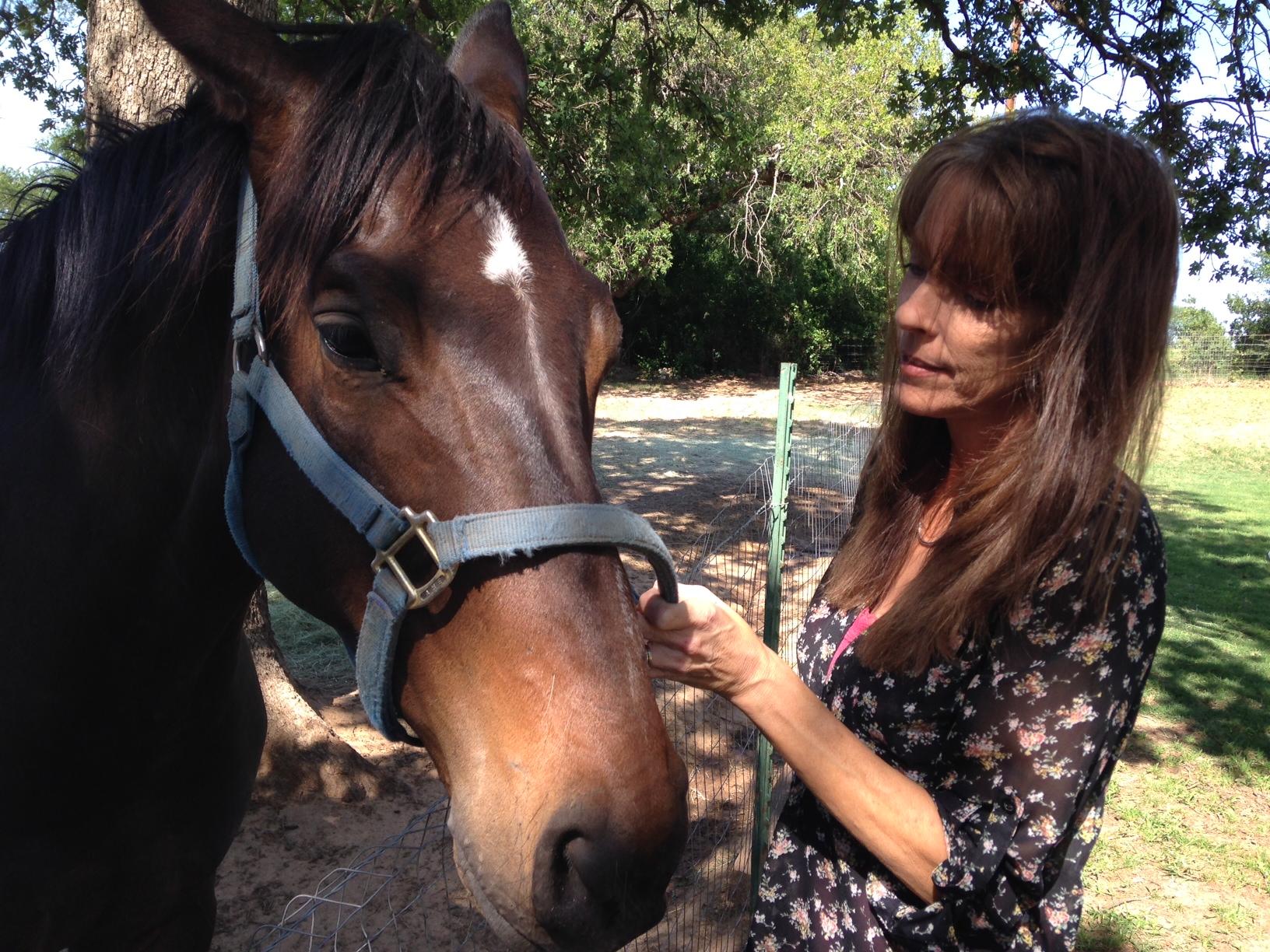
Barbara Brown says her horse runs into his pen when an earthquake strikes in Reno, Texas.
Barbara Brown is known to some of her neighbors as “The Digger.” She earned that nickname after collecting thousands of documents about oil and gas drilling, shortly after she says a swarm of minor earthquakes damaged her dream home, and those of her neighbors in Reno and Azle.
Brown is an Army wife in her 40s, with blue eyes, long brown hair, and a petite frame.
“Pretty much everyone around here knows: If they have a question, just call me,” Brown says.
She lives in a small town, less than 20 miles northwest of Fort Worth, called Reno, where dozens of minor quakes were centered back in November and December.
“First you’re thinking, ‘There’s no way that’s an earthquake,'” Brown says. “And then, you’re realizing, ‘No, that’s definitely an earthquake, those are earthquakes.’ And then you’re looking on the USGS [United States Geological Survey] website, and you get validation that is an earthquake. Okay, there’s something wrong.” Continue Reading →
Big freighters and small barges in the Houston Ship Channel near the site of the collision
U. S. Coast guard investigators are reviewing testimony they heard during a four-day hearing held last week in Galveston. They’re trying to learn what might have prevented the collision of a freighter with a barge carrying fuel oil in March. Some of what they heard points a finger right back at the Coast Guard.
Along Galveston Bay, the big collision is still fresh in the minds of people who have a front row seat to the very busy Houston Ship Channel. John McMichael is a retired Navy submarine officer who manages Seawolf park on Pelican Island.
“They knew they were there. They were on the radar. It’s hard to fathom that it would have happened in today’s world,” McMichael told StateImpact Texas.
The beef checkoff vote is about more than just a one dollar tax.
Forget the governor’s race. All across Texas people are voting over beef.
Friday is the final day for ranchers and others who deal in cattle to vote on implementing a Texas beef checkoff, a tax charged each time a cow is sold. There’s already a national beef checkoff that levies a one dollar assessment on the seller per cow.
The vote today is on a proposal to create a Texas checkoff, also for a dollar. If the proposal passes, most ranchers in the state will pay a two-dollar tax for each head of cattle they sell.
The government doesn’t collect this tax. The money goes to the Cattlemen’s Beef Board which then gives some of it to the National Cattlemen’s Beef Association. That industry group uses it to fund beef-related research and to promote beef. The same group also lobbies Washington on behalf of the beef industry. Supporters of the checkoff argue that the tax has raised the price of beef over the years by creating demand.
“Every time the price of beef goes up, it helps me,” says Texas Rancher Curtis Younts Jr., who supports the checkoff.
But the Texas vote has become about more than a one-dollar tax. Many are viewing it as a referendum on the way beef is taxed and promoted in Texas and the US.
In Texas, the Keystone XL pipeline is a forgone conclusion. Every day, up to 700,000 barrels of oil (both domestic crude and heavy oil commonly known as “tar sands,” extracted from Canada) make their way from Cushing, Oklahoma through the Gulf Coast segment of the Keystone XL pipeline to refineries in Texas. This section of the controversial project went ahead while the northern leg awaits presidential approval. Despite objections by some landowners and environmental groups, the southern leg began commercial operations earlier this year.
But one man just wants to know where the pipeline will actually run. And he’s been stymied again and again in his efforts to get that information. Thomas Bachand, a San Francisco photographer, finally got an answer this week from the U.S. Department of State on why they won’t release the info to him: Because the company behind the project, TransCanada, doesn’t want to. Continue Reading →
A "very early version" Google's prototype vehicle. The self-driving car doesn't include a steering wheel.
Google is taking the wheel – taking it literally out of the car.
The company is set to launch a test fleet of driverless cars in the near future. It’s completely re-imagining the automobile, removing fundamental features like the gas pedal and the steering wheel. The work raises a fundamental question: is there a market for such automated vehicles?
The Texas Standard’s David Brown spoke with University of Texas engineering professor Kara Kockelman, who has analyzed how driverless cars may impact our society. “We’re all incredibly busy, we’d love to have that time to be getting things done … legally … in our vehicle,” she says.
Although the technology is rapidly progressing, it isn’t without its share of drawbacks. Continue Reading →
Oil field workers wear these safety alert devices that detect hydrogen sulfide gas
Hydrogen sulfide — a gas that smells like rotten eggs — can be insidious in its lethality. Its odor will be unmistakeable to its victim. But the gas can quickly numb the sense of smell, leading to the belief that the threat has passed. Unconsciousness and death can follow.
“Unfortunately, if you come in contact with hydrogen sulfide there are not a lot of second chances,” said Sheldon McKee, director of business development at AMGAS, a Canadian company that makes equipment to remove hydrogen sulfide in the oilfields, where it can be a deadly risk for workers.
AMGAS opened an office last year in San Antonio to serve what the company sees as a growing need. Drilling for oil has surged just south of San Antonio in a swath of rural counties that comprise the Eagle Ford Shale. It’s an area known for what’s called “sour gas:” natural gas and crude oil with high amounts of hydrogen sulfide. Sour gas can also be found in parts of West Texas and in East Texas.
The new line was marketed as a BRT system, but the MetroRapid buses still need tinkering to meet those requirements.
Standing on Guadalupe Street in Austin facing the tower at the University of Texas, 26-year-old Emily Mandell waits at the bus stop with a scowl on her face. She’s not looking forward to this ride.
“It’s the same as sitting in traffic, but now you’re sitting in traffic stopping at a lot of places with a lot of other people,” Mandell says.
Along Guadalupe and Lavaca, two major north-south arteries through downtown Austin, long, bendy buses labeled “MetroRapid” have recently joined the chaos that is Austin traffic. The city of Austin’s transportation agency, Capital Metro, rolled out this new line in January* in an effort to get more people out of cars and using public transportation. But the rollout hasn’t gone as expected, calling into question how the agency will handle expanding transportation to meet the fast-growing city’s needs.
Now several months into the project, the line has made hardly a dent in Austin’s traffic problem. Board the fancy new buses at any given time of the day, and rows and rows of sparsely populated seats will likely wait for you. Continue Reading →
Big changes could be coming for Texas power plants. The Obama administration is announcing new rules today aimed at cutting carbon dioxide emissions from power plants – the chief culprit behind global warming.
The Environmental Protection Agency (EPA) wants to reduce carbon dioxide emissions from fossil fuel power plants in the U.S. by 30 percent (from their 2005 levels) by 2030. That “is equal to the emissions from powering more than half the homes in the United States for one year,” according to the EPA. In Texas, that drop will need to be even higher: the state’s carbon emissions from the power sector will need to fall 39 percent by 2030 under the proposal.
The U.S. is already moving towards that goal, thanks in large part to the boom in shale gas drilling that has brought more natural gas into the energy mix. That has contributed to a 12 percent decline in energy-related carbon emissions between 2005 and 2012, according to federal statistics. The economic downturn and warmer winter weather may have also played a role in that decline.
In Texas, the leading carbon emitter in the country, the new rules could have a big impact, but the devil’s in the details.
StateImpact seeks to inform and engage local communities with broadcast and online news focused on how state government decisions affect your lives. Learn More »