As the final week of the 83rd Legislative Session kicks into gear we can expect a flurry of activity at the Capitol. Lawmakers will be trying to pass a slew of bills that could affect Texas' water, energy and environment.
With precious little time left in Texas’ 83rd Legislative session, lawmakers will be working this week to vote still-living bills out of the House and Senate.
StateImpact Texas has compiled a short list of some bills related to water, energy and the environment that have made it through or may still have a shot. (This list is not meant to be comprehensive.)
Water Bills
SJR 1, by Rep. Jim Pitts, R-Waxahachie and Rep. Allan Ritter, R-Nederland would create a State Water Implementation Fund through a constitutional amendment. The fund would assist in financing water projects outlined in the State Water Plan. Another bill designed to finance water infrastructure, HB 11, died in the House in late April. SJR 1 failed to be brought to the floor on Monday. Tuesday is the last day for it to be voted on in Second reading in the House.
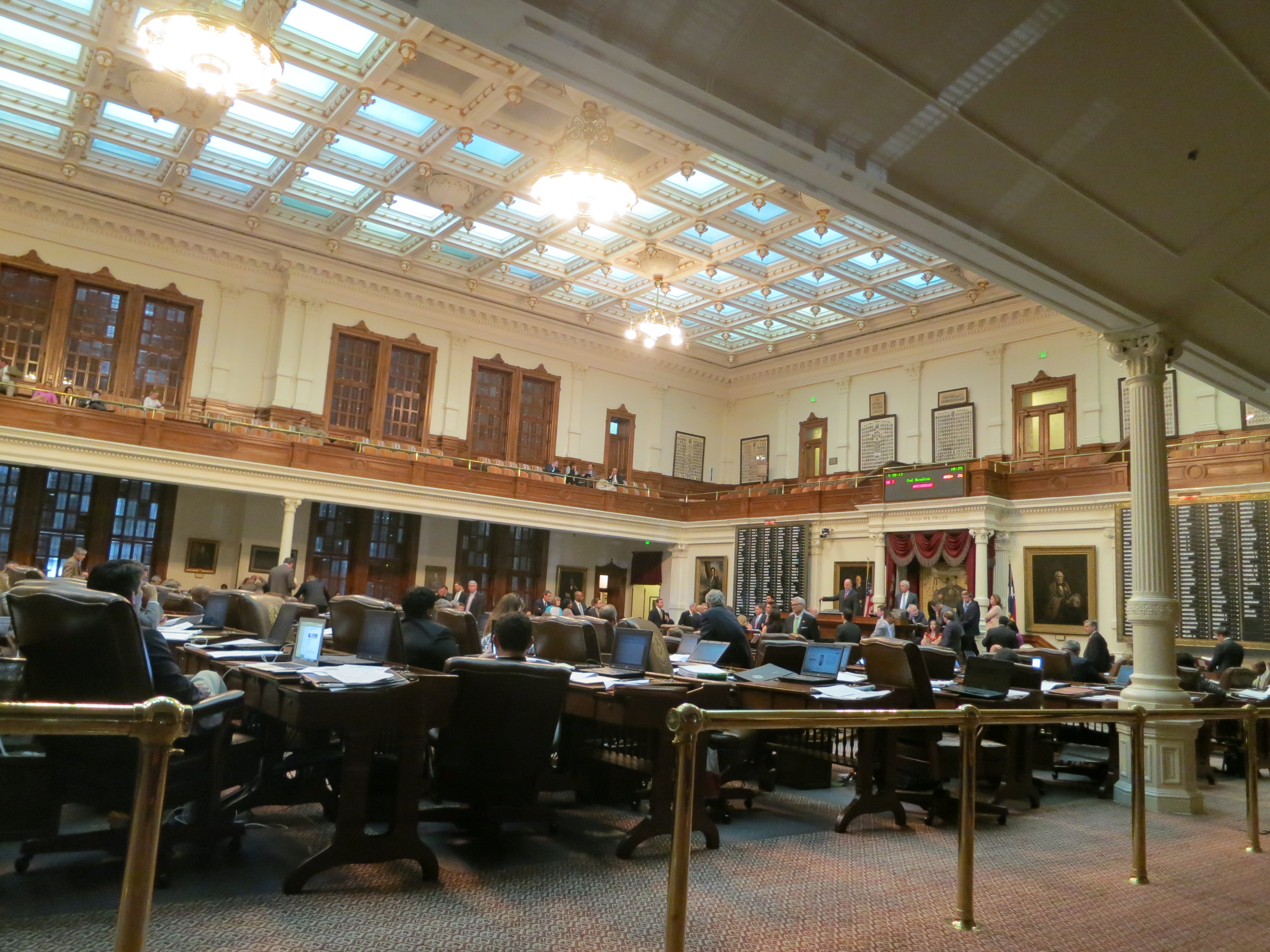
The Texas House tackled many Senate measures Monday night, SJR1 was not among them.
Twice the arrival of SJR1 was announced before the House Monday night, and twice it disappeared like a stock pond in a Texas drought.
Senate Joint Resolution 1 would amend the state constitution to create two accounts to fund water infrastructure projects. That would require voter approval in November. Lawmakers in the House had been talking about this approach to water funding for over a week, but needed to negotiate amendments to the Senate version of the measure and bring it through committee before it could come to the floor.
Last Friday many thought a deal had been struck to bring the measure to a vote on Monday.
The first time the bill was announced Monday, a lawmaker rose to speak but began addressing an amendment for a different, previously postponed, bill. Confusion briefly took hold as some Representatives were unsure what bill had been brought to the floor.
The second time the bill was called it was quickly postponed till 9:00 PM and then not spoken of again on the floor of the House.
While it's called the Railroad Commission of Texas, it actually deals with regulating oil and gas in the state. And a name change isn't likely to happen this session.
As Americans watch the U.S. Bureau of Land Management develop rules to manage fracking on federal land, the Texans among them would be forgiven for wondering “what does have to do with us?” After all, due to the state’s unique history, there are virtually no federal lands in Texas.
Well, the rules may have more to do with Texas than you may think. Particularly in their reliance on the online database FracFocus.org to disclose what chemicals drillers are pumping into the ground.
As we reported last month, FracFocus was criticized in a report from Harvard Law School’s Environmental Law Program. It found that the database doesn’t do a good job of disclosing information and can make it more difficult for companies to comply with state regulations. Twelve states, including Texas, require drillers to use FracFocus to disclose their drilling chemical mixes.
The Harvard report, which was quickly dismissed by many state regulators including the Railroad Commission of Texas, also echoed previous findings that FracFocus allows too many companies to hide their chemical ingredients under the guise of trade secrets. This is especially a concern for people worried about the potential for groundwater pollution associated with fracking.
Part of the aim of the Harvard report was to encourage the Bureau of Land Management to seek out a more comprehensive and user-friendly system for companies to disclose what chemicals they use.
Matt Stamey Staff photographer, Gainesville Sun /Landov
Only a small fraction of bills filed at the state legislature are ever passed into law.
For the past six months, StateImpact Texas covered dozens of bills as they moved through the Texas legislature. In that time, we’ve seen a lot of measures fall by the wayside. Remember reading up on a bill here, and wondering where it ended up? Well, we’ve compiled a list of the so-called “dead bills” covered in the past by StateImpact Texas.
Energy
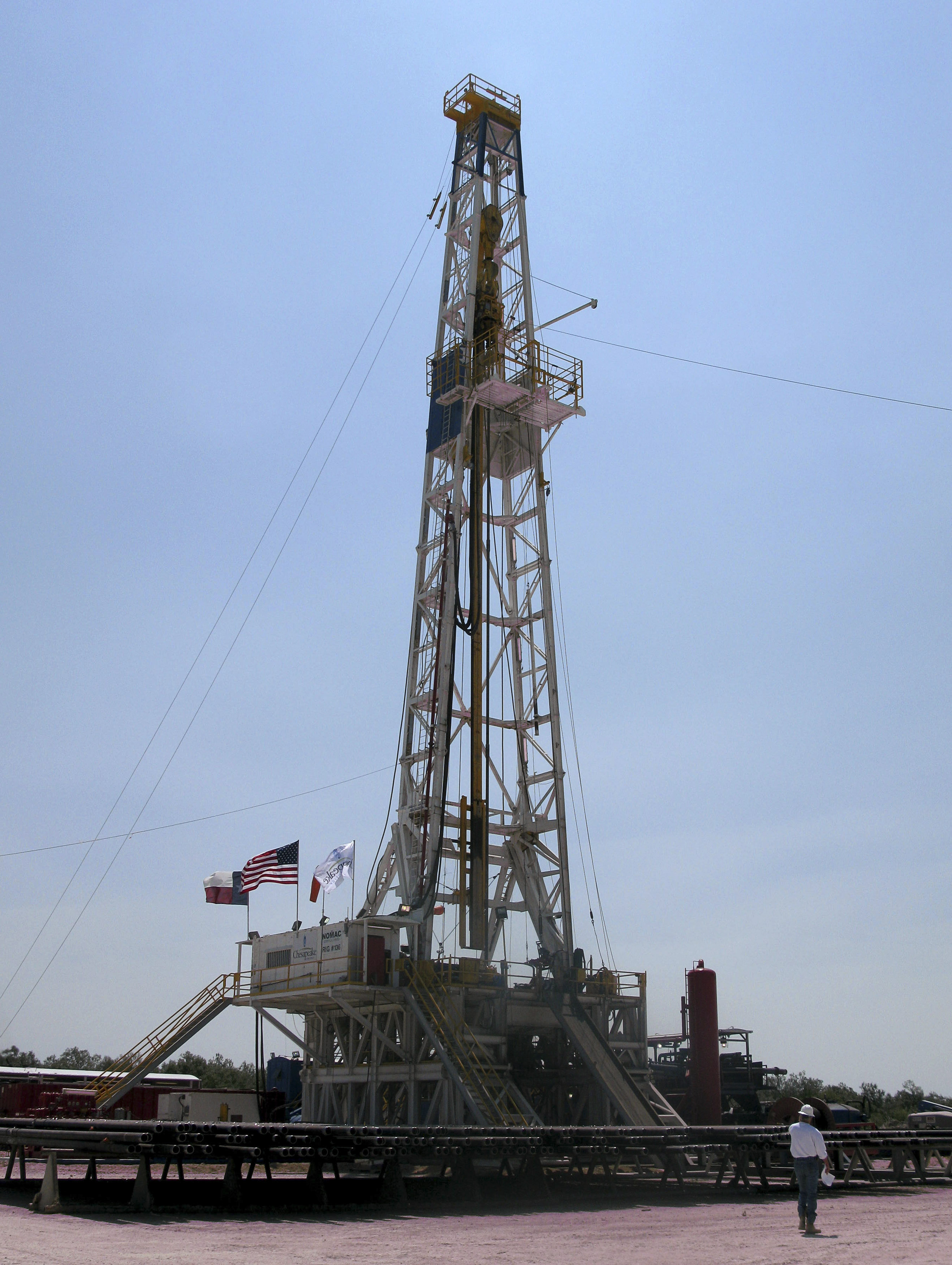
HB 55, by Rep. Lon Burnam, D-Fort Worth, would have ended tax exemptions to natural gas drillers in the state. Burnam filed a similar bill last legislative session that fared the same fate as this one.
Rep. Van Taylor, R-Plano, filed HB 100, which he said would reduce Co2 emissions by making carbon gasses more valuable to drillers looking to extract more oil and gas from unitized fields. It, along with HB 1496, which Taylor said would change the state’s eminent domain rules, was left pending in committee in March.
Only a very small percentage of bills filed in each Legislative session are adopted into law.
KUT’s Veronica Zaragovia co-reported this article.
A revised version of a plan to pay for Texas water projects is heading for the House floor today.
Senate Joint Resolution 1 would amend the state constitution to create two accounts to fund water infrastructure projects. That would require voter approval in November. Lawmakers in the House had been talking about this approach to water funding for the last week, but needed to negotiate amendments to the Senate version of the measure and bring it through committee before it could come to the floor.
Friday, the House Appropriations Committee stripped the original SJR of language it contained about billions of dollars of funding from the Rainy Day fund that would go into the accounts. It also removed language about funding for transportation.
The House plans to vote on the funding issue separately as part of the appropriations process.
Lavaca Bay in Calhoun County is one proposed site for an LNG Terminal.
As a drilling boom continues in Texas and other states, the U.S. finds itself with so much natural gas that some companies now want to export domestic fuels abroad.
Today, the federal Department of Energy (DOE) announced approval of a second facility, the Freeport LNG Terminal on Quintana Island, to export natural gas in liquid form to countries not party to free trade agreements with the U.S. That would mean that gas-hungry markets like Japan could start buying natural gas from Texas ports at much higher rates than domestic consumers.
In an interesting twist, many of these facilities for exporting natural gas already exist: they were built in recent years to import natural gas from other countries, before a fracking boom unlocked domestic supplies. The Freeport terminal only started construction in 2005. By the time it was up and running in 2008 to import natural gas, the fossil fuel balance in the U.S. had started to turn upside down. Now there’s a rush to undergo an expensive (roughly $5 billion per plant) conversion at these plants to send gas out instead of bring it in. Continue Reading →
Levels on some of the state's reservoirs have reached record lows for this time of year. In general, reservoir levels are lowest in November and December.
Statewide reservoir levels are at their lowest point ever for this time of year, according to National Weather Service Southern Region climate program manager Victor Murphy. Murphy says many reservoir levels have not changed much since November, which is when reservoirs are typically at their lowest.
“Quite honestly we should be higher,” Murphy says. “We should have been seeing improvements and we’ve been flat-lined since about mid January. Absent of any unforeseen major rain events, when summer starts rolling around, we should start to see some drop off in these values.”
In East Texas, reservoir levels have remained steady. Recent rains have also pulled some of the coastal areas completely out of the drought. But much of the rest of the state may not feel relief any time soon. Continue Reading →
Growing up on Long Island in New York, Diana Davids Hinton never thought much about oil drilling. “The closest we got to oil and gas was the local Exxon station,” she says.
But upon moving to the Midland-Odessa area in 1973, “I learned it sure wasn’t easy to do 19th-century British history in the middle of Texas,” said Hinton, whowrote her dissertation on the seventh Earl of Carlisle, a 19th-century Briton. So she made the natural move to study oil, and she found herself in the midst of one of the great boom-and-bust cycles of all time.
As a history professor at the University of Texas of the Permian Basin, she has co-written two books on the colorful history of Texas oil. Another one on the Barnett Shale is under contract with TCU Press and, she hopes, will be out on the shelves in two years. Yet another project on Texas’ post-World War IIpetroleum historyis also in the works.
She spoke with the Tribune about how the current boom compares to the past and how the Railroad Commission of Texas — whose name lawmakers failed to change this session — came to regulate oil in the first place.
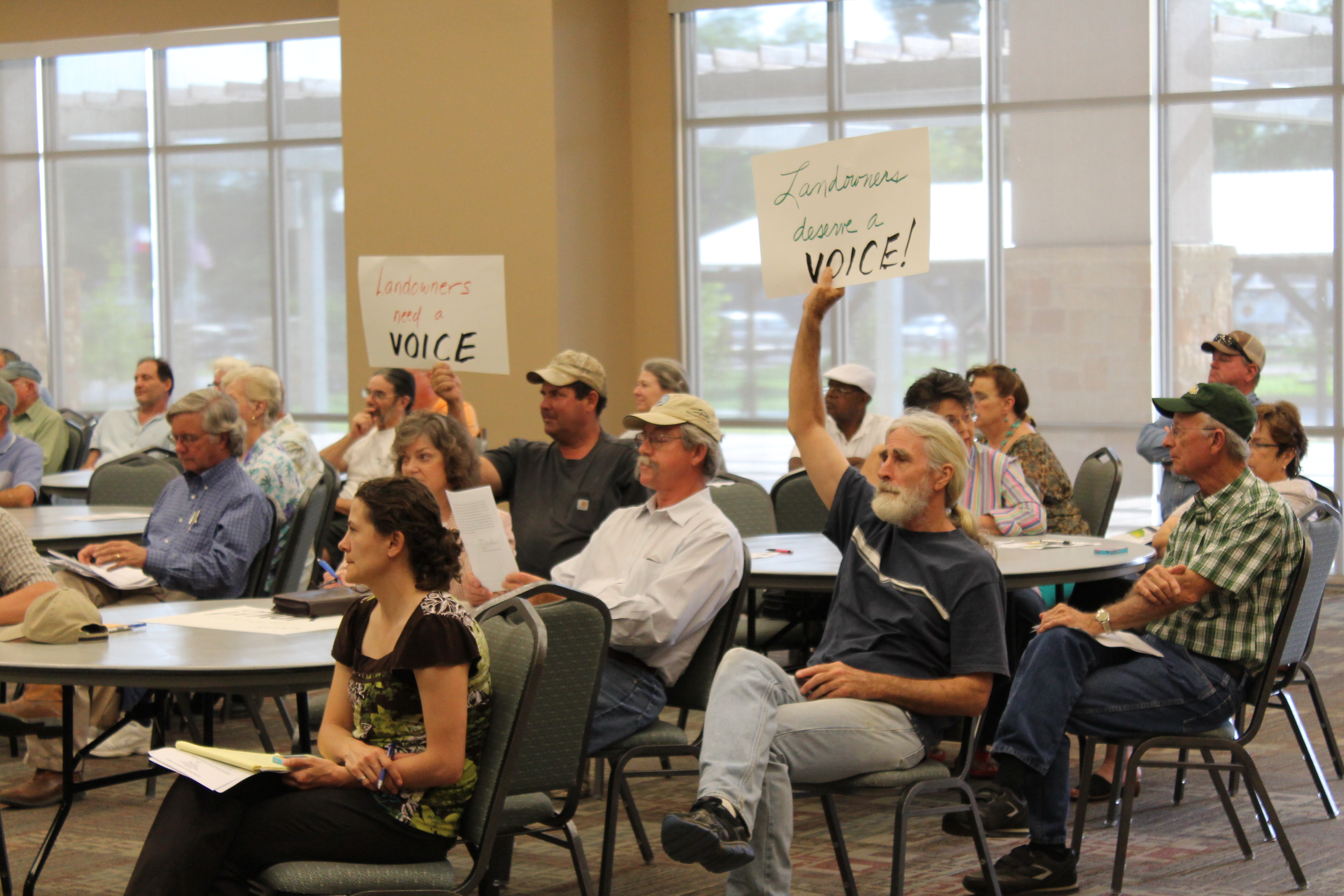
Bastrop area landowners attended a meeting of the local groundwater conservation district on Wednesday
This story was co-reported by Andrew Weber for KUT News.
It’s easy to understand why Rick Knall would be nervous with outside businesses taking water from his neck of the woods. Knall is a property owner in Bastrop County who relies on his well.
“Our well has been a godsend it has been pumping strong good clean fresh water for a number of years,” he said at a hearing of the Lost Pines Groundwater Conservation District last night.
Like many others at the hearing, he worried that that steady supply could dry up with more straws in the ground. But the question of whether the Lost Pines Groundwater Conservation District would move ahead granting new permits had resonance beyond this Central Texas community.
“I think the whole state will be watching this,” Steve Box, with Environmental Stewardship, told StateImpact Texas ahead of the hearing.
His group opposes the permits. He and others saw the hearing as a sort of test case for the role of local groundwater districts.
At the Texas legislature, some things don’t stay dead for long. As time runs out for lawmakers to move dollars towards funding water, roads and education, it appears that for water, at least, an agreement may be in the works. Continue Reading →
About StateImpact
StateImpact seeks to inform and engage local communities with broadcast and online news focused on how state government decisions affect your lives. Learn More »