If lawmakers do not act soon, the agency that regulates oil and gas in Texas could disappear.
A legislative review of that agency, the Texas Railroad Commission, failed this session, and a measure that would keep the agency alive until 2015 or later doesn’t include any reference to the agency.
“It means the Railroad Commission will go away,” said state Rep. Dennis Bonnen, R-Angleton.
Bonnen chairs the Sunset Advisory Commission, which is charged with periodically assessing and renewing the charters of state agencies. The RRC’s “sunset” legislation failed in 2011, and lawmakers extended the life of the agency until this year. It didn’t work; the legislation that would have renewed the agency’s charter and made additional changes has already failed again.
What’s more, House Bill 1675, this year’s version of the “safety net” that rescued the RRC and other agencies last year, doesn’t include the Railroad Commission this time. Unless lawmakers add it in the final days of the session, the agency will go out of business. Continue Reading →
Lawmakers made good on a promise to fund the state's water plan, but a crucial part of that plan is subject to voter approval.
After days of negotiations, amendments and Star Wars references, the Texas legislature has finally put together a mechanism to start seriously funding water infrastructure and conservation in the state. But there’s a big “if” — voters still have to approve a crucial part of the plan this November. (For more on the details, read our earlier story on the plan.)
While many legislators and lobbying groups — from farmers to drillers to environmentalists — largely supported the plan to fund water projects, there was opposition from the Tea Party on infrastructure spending. Here’s some of the reactions to the water plan funding from groups for and against:
A new interactive infographic by The Texas Tribune allows users to track campaign contributions from some of the most powerful groups and names in the energy and environmental sectors.
The energy and environmental lobbying tracker shows the dollar amounts in contributions each elected official has received since January 2011. With a drop-down menu, contributions from individual organizations or donors can be viewed as well. Continue Reading →
Photo courtesy of Photomonkey via Flickr's creative commons http://bit.ly/10MHsQP
The House and Senate both advanced measures to fund the State Water Plan, but many hurdles remain.
After days of postponement, arm twisting and behind the scenes negotiation, measures to advance funding for Texas’ State Water Plan were approved in the State Legislature Wednesday.
Lawmakers have been talking about taking money from state’s rainy day fund to improve water infrastructure since at least 2011, when a historic drought gripped the state. Today, members of the House and Senate found the votes to keep that plan alive.
The House voted 130-16 to call for a constitutional amendment to create two accounts from which to loan money for water projects. The Senate passed a supplementary budget bill that would put around $2 billion dollars in that water bank from the state’s rainy day fund with a vote of 29-3.
Because of complicated deal making between the State House and Senate and between Democrats and Republicans, the vote on the constitutional amendment was postponed past a House deadline yesterday while lawmakers waited to make sure the supplementary budget in the Senate contained what they wanted.
Neither chamber would jump first. Wednesday, they held hands and jumped together.
The Ogallala Aquifer suffered its second-worst drop since at least 2000 in a large swath of the Texas Panhandle, new measurements show.
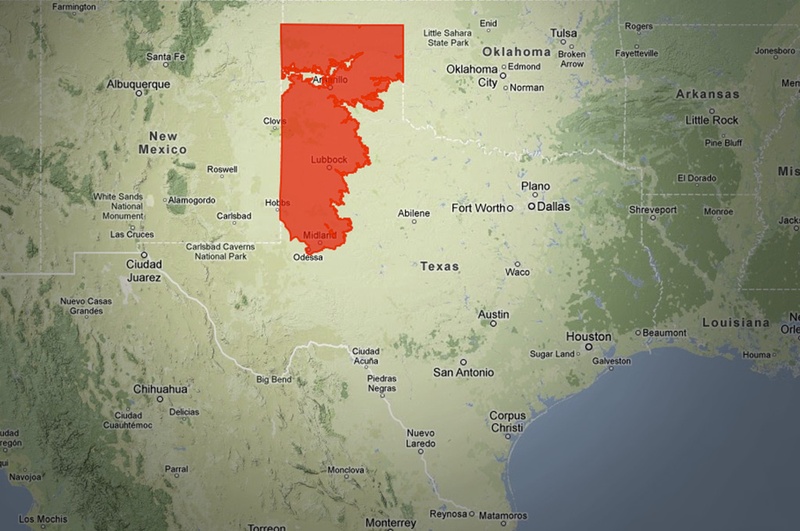
The closely watched figures, published this week by the High Plains Underground Water Conservation District, cover a 16-county area stretching from south of Lubbock to Amarillo. The Ogallala wells measured by the district experienced an average drop of 1.87 feet from 2012 to 2013. That makes it one of the five or 10 worst drops in the district’s more than 60-year history, said Bill Mullican, a hydrogeologist with the district.
“There are some pretty remarkable declines,” Mullican said. One well in the western part of the water district, he said, dropped 19 feet over the year.
The vast majority of Texas is enduring a drought, but the Panhandle has been especially hard hit, causing farmers to pump more water to make up for the lack of rain. That depletes the amount of water stored in the aquifer over the long term, which means future generations will find less water to pump to grow crops.
Recently larval Mexican fruit flies were spotted in Texas.
Don’t let its size fool you, the Mexican Fruit Fly is a serious threat to Texas’ agriculture.
Authorities spotted larval Mexican Fruit Flies in South Texas and quarantined an 85 square mile area to contain the dangerous pest and its insidious larvae, according to the Texas Register.
The quarantine is one of many used over the years as part of a strategy to stave off an infestation of the fly, a pest with the potential to devastate an integral part of the South Texas economy. But while Texas and federal agencies use a variety of methods to keep the little bug at bay, some measures can adversely affect farmers.
“In terms of what the quarantine means, first of all, it’s the extra cost,” says Ray Prewett, President of Texas Citrus Mutual.
A fruit quarantine isn’t like a human quarantine for a disease, Prewett told StateImpact Texas, it’s not as if nothing can leave the quarantine zone. The fruit can leave, but it has to be fumigated or sprayed. That costs money. Also, fumigating the fruit early in the season can cause cosmetic damage to the peel. Fortunately, this year’s quarantine was instituted late in the season so not much fruit will be affected.
As an FBI agent then as an assistant federal prosecutor, Malcolm Bales has investigated crooked judges in Chicago and drug dealers in Texas. Now, as the U.S. Attorney in Beaumont, he’s working amid one of the nation’s biggest petrochemical complexes.
Courtesy U.S. Department of Justice
Malcolm Bales is the U.S. Attorney in Beaumont
Bales says he’s finding there are plenty of criminal pollution cases. But not the agents to pursue them.
“We lack the appropriate number of investigators. EPA (the federal environmental regulator) is struggling to meet the caseload. There are not enough agents,” Bales told StateImpact.
“In fact, when we have cases worked over here in the Beaumont area — where we believe there is a significant number of unaddressed environmental violations — those agents have to come from Houston in every instance.”
Bales said the FBI used to work environmental cases but with changing priorities in the post-9/11 world, he says pollution cases are now way down the list. FBI Houston Division spokesperson Shauna Dunlap agreed, saying agents usually get involved only in big pollution cases like the Deepwater Horizon spill.
One recent case showed how his staff had to tackle a crime that was a bit out of their comfort zone. Continue Reading →
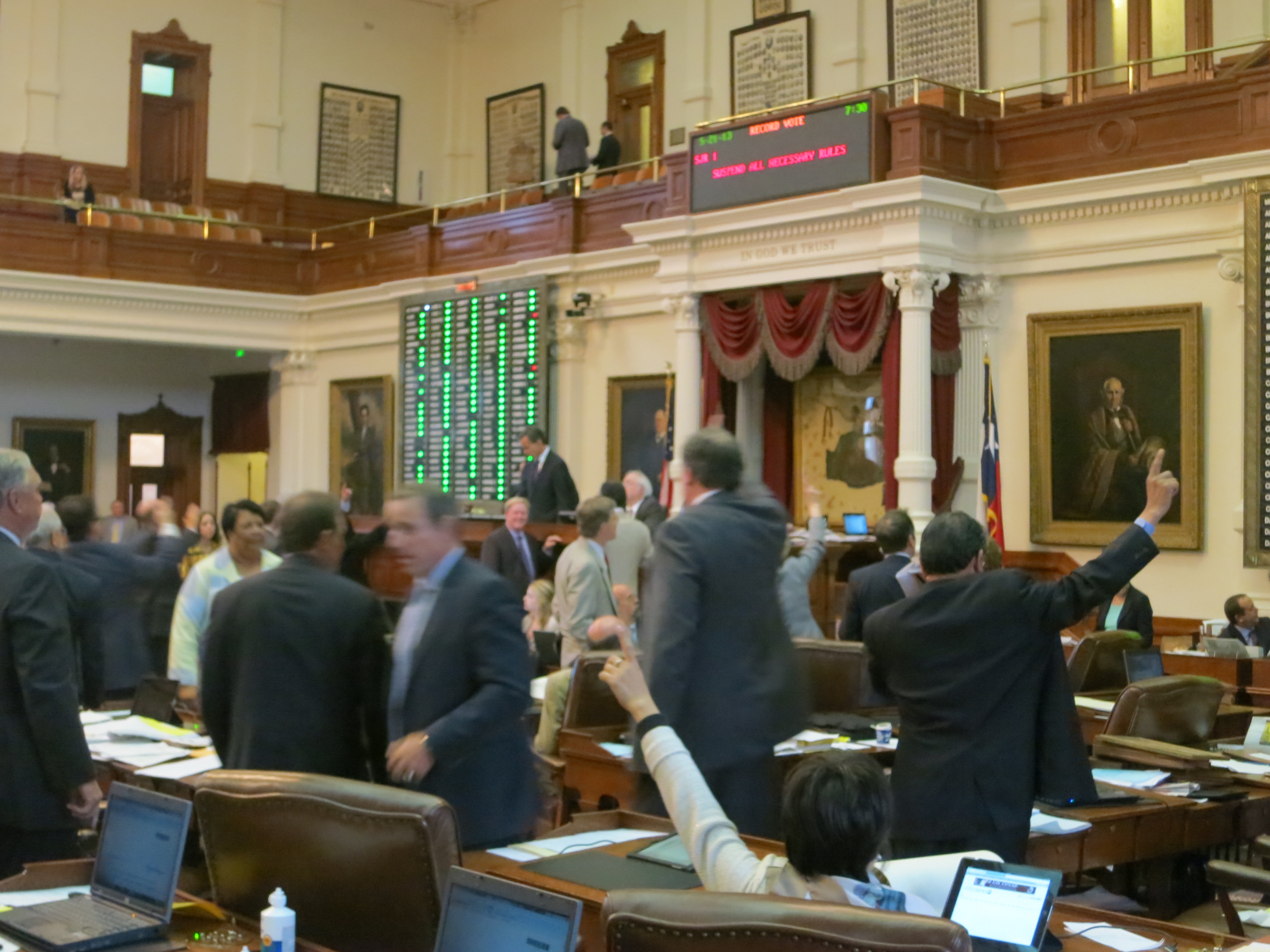
Lawmakers in the House voting for a rule suspension to postpone a vote on SJR1 until Wednesday.
Update: SJR1 was finally approved in the Texas House on Wednesday night. Read more here.
Right now Texas does not have the capacity to supply water to everyone who wants it in times of drought. Lawmakers have talked about taking money from Texas’ rainy day fund to fix that problem for years. On Monday, a vote was scheduled in the State House to help make the plan a reality. It would call for a constitutional amendment to set up two bank accounts to loan out money for water projects. Now, it’s Wednesday and the vote still has not come.
The measure, called Senate Joint Resolution One, is about water. But the intrigue surrounding it is about money. A vote on the resolution was postponed Monday, then again on Tuesday afternoon. There is a Texas House rule saying it had to be voted on by midnight last night, so that seemed like a sure thing. Except lawmakers suspended that rule later in the evening.
A massive tornado tore through Moore, Oklahoma Monday. Weather forecasters anticipate more severe weather will hit Central Texas on Tuesday afternoon and evening.
A day after a massive tornado ripped through Central Oklahoma, the National Weather Service predicts severe storms will move across a swath of Central and North Texas Tuesday afternoon and evening.
There is potential for tornadoes in the Dallas-Fort Worth area. The Weather Service’s Fort Worth office recorded 55 mph winds early Tuesday afternoon, according to the Service’s Twitter account.
In Central Texas there could be isolated chances of tornadoes, said Mark Lenz, a forecaster with the National Weather Service.
“The main threat is large hail, golf-ball size or larger,” Lenz told StateImpact Texas.
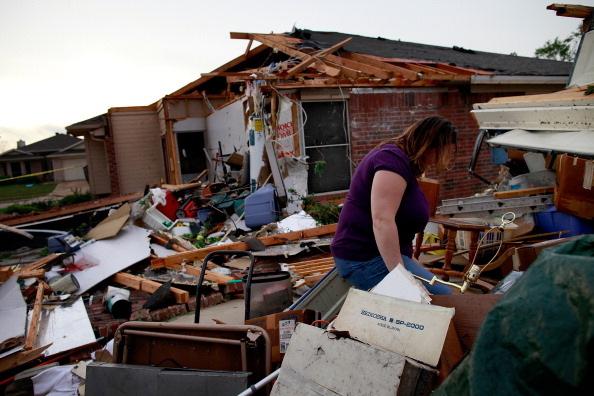
April Bridges searches through the remains of a house she at when it was destroyed by a tornado on April 3, 2012 in Arlington, Texas
Note: The tornado Monday in Moore, Oklahoma has been upgraded to an “EF5” on the Enhanced Fujita Scale from an “EF4.”
Monday’s devastating tornado in Moore, Oklahoma, and another fatal and destructive storm in Granbury, Texas the week before have called attention to the system of tornado measurement called the “Enhanced Fujita Scale.” The Tornado in Texas measured an EF4 on the scale, the one to strike Moore is now ranked an “EF5.” But just what does that mean?
The Enhanced Fujita scale is the most recent incarnation of a system of tornado measurement invented by Dr. T. Theodore Fujita in 1971. According to NOAA the original scale was designed to 1) categorize each tornado by its intensity and its area and 2) estimate a wind speed associated with the damage caused by the tornado. It became the standard by which tornadoes were measured in the U.S.
The scale ranks storms from level F0 (gale) to level F5 (incredible). But, as you can see, it has a weakness. Namely, it is subjective as a system of measurement and “based solely on the damage caused by a tornado. If the same tornado that hit Granbury, last week had touched down in an unpopulated stretch of the plains with no people and no structures, its rank on the scale would have been significantly lower. Continue Reading →
About StateImpact
StateImpact seeks to inform and engage local communities with broadcast and online news focused on how state government decisions affect your lives. Learn More »