Tesla want's to sell it's electric vehicles in Texas directly to consumers, but will the legislature oblige?
There are lots of retail businesses that have come to Texas recently: Trader Joe’s, H&M, even In-N-Out Burger, a move so bittersweet it brought one Dallasite to tears.
But for one gleaming, seductive product with an almost astronomical price tag, you’ll have to look elsewhere — the Tesla electric car.
Because of state law (which is similar to those in many other states), manufacturers of cars can’t directly sell new cars to customers in Texas. Enter Tesla, who wants to do just that, and is now engaged in a full-press charm offensive to get the Texas legislature to amend the law. Tesla maintains that their only chance of survival is to own their own dealerships, and under current law they can’t market and sell their electric cars fairly and profitably.
To give you an idea of what it’s like trying to buy a Tesla in Texas, I went to the company’s showroom at the Domain in Austin. There, a shiny black Tesla S sits in the center of a long, narrow showroom, with bright lighting, clean lines, and no clutter, much like an Apple store. There are T-shirts, swag, some seats and large posters extolling the car’s virtues. But the star of the room is the car.
You just can’t drive it, or even find out from Tesla staff how much it costs.
While it's called the Railroad Commission of Texas, it actually deals with regulating oil and gas in the state. A name change could be in the works this legislative session.
Update, May 2, 2013: The Senate Bill passed on the Senate floor today, and now heads to the House.
Original story, April 24, 2013:
SB 212, which would change the name of the Railroad Commission of Texas to the Texas Energy Resources Commission passed out committee today. The bill would also restrict campaign contributions for Commissioners, their ability to run for a different office while overseeing the Commission and institute a pipeline permit fee. There were no amendments. The bill now heads to the Senate floor.
The Railroad Commission wields a big stick in Texas. It regulates the state’s most profitable industry, oil and gas, and all Texans elect its three commissioners. One thing the Railroad Commission doesn’t control, however, is railroads.
Few oppose a more apt title for the agency, but wrapped up in the legislation are also rules restricting campaign contributions for commissioners and their ability to run for a different office while overseeing the commission.
What “we’d like to see changed in the bill are the resign-to-run [provision] and the two ethics financial issues,” relative newcomer Commissioner Christi Craddick said during testimony. “But otherwise I’d like to see this bill move.” Continue Reading →
Four months after a fire shut it down, a nuclear reactor at the South Texas Project in Bay City is being restarted. That is the second prolonged shutdown at the plant in two years, prompting critics to demand closer scrutiny of the operation.
Four months after a fire in January, one of Texas’ four nuclear reactor units is being restarted, bringing to an end the unit’s second prolonged shutdown in two years.
“We’re bringing the unit back up,” said Buddy Eller, a spokesman for the South Texas Project, the enormous Bay City nuclear plant where the problems have occurred. The 1,350-megawatt reactor unit, known as STP Unit 2, should be producing 100 percent power by sometime Tuesday, according to Eller, who spoke with the Tribune on Monday afternoon.
The fire in January occurred at a transformer in the electrical switchyard outside the reactor. The fire was fueled by oil, lasted about 10 minutes and was immediately put out by the plant’s fire brigade, Eller said. Continue Reading →
A water fight between Texas and Oklahoma heads to the Supreme Court today.
The highest court in the land will hear about Texas’ water woes today. It will be the culmination of several years of litigation over Oklahoma water that Texas wants.
“There’s often been tension between Texas and Oklahoma. A dispute over the state boundary line dates back nearly 200 years. And for more than a century Texas and OU football teams have clashed in the Red River Rivalry. Tuesday, the latest skirmish goes before the U.S. Supreme Court when the State of Oklahoma and the Tarrant Regional Water District in Fort Worth argue over water rights.”
While the case attends to Texas and Oklahoma’s water war, the decision rendered could affect interstate water disputes beyond Texas and Oklahoma. Continue Reading →
State lawmakers will discuss whether to recognize the City of Garland at the cowboy hat capital of Texas this week.
Time is winding down at the State Legislature, but the pace is picking up.
We’ve put together a list of some important bills on energy and the environment up for discussion this week. They tackle the Railroad Commission, fracking, drought and more. But they aren’t all serious, a House committee will discuss a slew of honorifics as well.
(The bills are not listed in any particular order, and the list isn’t meant to be comprehensive.)
Railroad Commission Name Change and More
The Texas Railroad Commission’s misguiding name could change to the Texas Energy Resources Commission, if a bill, SB 212 by Sen. Robert Nichols, R-Jacksonville, passes the legislature. The bill would also implement changes to the agency outlined in a 2011 Sunset review that didn’t pass last session, such as authorizing the commission to impose a fee for permitting pipelines to help pay for safety programs. The Senate Natural Resources Committee will discuss the bill Tuesday morning.
A flag is flown at half staff in West, Texas, near the scene of the fertilizer plant that exploded Wednesday night in in the town of 2,8000 on Thursday, April 18, 2013.
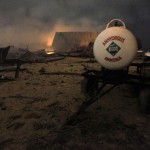
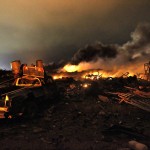
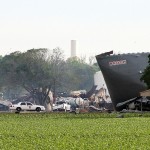
It will take time to determine the exact cause of the fire and explosion at the fertilizer plant in West, Texas. The disaster has cost at least 14 lives, caused 200 injuries and has destroyed at least 50 homes. The blast was so strong that it blew out windows for miles, and even registered as an earthquake. First responders said the aftermath looked like “a war zone.”
Yet even at this early stage of the investigation, there are signs that not all was right with the plant, like the fact that it had as much as 270 tons of ammonium nitrate (which can be explosive) at the site, but no sprinklers or fire barriers. It’s also brought up questions about regulation in Texas, and whether homes and schools should be so close to industry. (State fire officials have said that there are no signs of criminal activity so far in the West explosion.)
“Everybody plays over there,” resident Deborah Waters tells StateImpact Texas. “That track that is right beside the intermediate school, normally at that time of day, there are 20 to 30 people walking the track.” Continue Reading →
As the drilling boom grows in parts of Texas, so has the demand for power, leading to an energy crunch. In this photo, Michael Stephens repairs a power line in South Memphis.
Texas is often called the energy capital of America, so it might come as a surprise that the oil and gas boom has substantially driven electric prices up in some parts of the state. And in those same areas, prices are expected to spike again this summer.
To understand why, it’s best to start with the small city of Seymour, which is somewhere between Wichita Falls and Abilene. Fewer than 3,000 people call it home.
“We are a small West Texas Community that, like all West Texas communities, is struggling with every cent is important to us,” says John Studer, Seymour’s city manager.
The town of Seymour runs its own electric utility. It buys on the wholesale market and sells power to its citizens. Voters have control of their utility, and profits go to the city. Studer says it’s worked pretty well. Until last year when the electric bills started going up.
“Every one that came in, it just kept progressively getting higher and then when you get one up for ten percent of your bill for congestion charges,” Studer explains. “It kind of takes your breath away.” Continue Reading →
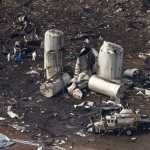
A damaged vehicle is seen after an explosion at the fertilizer plant.
The deadly explosion ripped through the fertilizer plant late on April 13, injuring more than 200 people, destroying 50 homes and damaging other buildings.
A chemical trailer sits among the remains of the burning fertilizer plant in April 2013.
A vehicle is seen near the remains of a fertilizer plant burning after the explosion.
Maria Galvin cleans up broken glass in the front of her business.
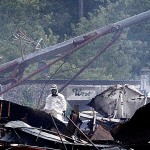
Searchers in protective suits walk through the blast zone of the fertilizer plant that exploded.
Meghan Clontz of Oklahoma City travelled to the town of West to be with family members after the massive explosion in the town
A tattered flag on the rainy morning of Thursday, April 18, in West, Texas.
Police and rescue workers stand near a building which was left destroyed.
An aerial view shows investigators walking through the aftermath of a massive explosion at a fertilizer plant in the town of West, near Waco, Texas April 18, 2013.
The apartment building where Darryl Garricks’ grandchildren were when the blast hit. The children are OK.
Residents of West gather for a candlelight vigil on Thursday, April 19.
A flag is flown at half staff in West, Texas, near the scene of the fertilizer plant that exploded Wednesday night in in the town of 2,8000 on Thursday, April 18, 2013.
KUT photographers Filipa Rodrigues and Jorge Sanhueza-Lyon traveled to the town of West with StateImpact Texas to document the story. You can see their images, along with photos from wire services and state officials, in the gallery above.
Residents of the town of West, Texas, hold a candlelight vigil Thursday evening for those killed and injured in an explosion and fire at a fertilizer plant in the town.
Update: As of 3 pm Saturday, some residents of West, the site of a major explosion at a fertilizer plant Wednesday, will be allowed back into their homes in part of the severely damaged neighborhood in the North section of town. Residents 18 and over living in the area from Walnut street southward will be allowed to enter until 7 pm. From 7 pm to 7 am, the city will have a curfew, and residents will need to either stay in their homes or leave the neighborhood. North of that area, Mayor Pro Tem Steve Vanek said at a press conference this afternoon, the city will work “as quickly as possible”to allow people back to their homes. More information for residents is available at the City of West’s website.
Some press reports earlier today said that there were still small fires at the site of the fertilizer plant. Vanek said that “Everything is safe. It’s good. We’re trying to get our people back in.”
“Safe, safe, safe,” Vanek repeated.
The number of fatalities remains 14, according to the Department of Public Safety.
StateImpact seeks to inform and engage local communities with broadcast and online news focused on how state government decisions affect your lives. Learn More »